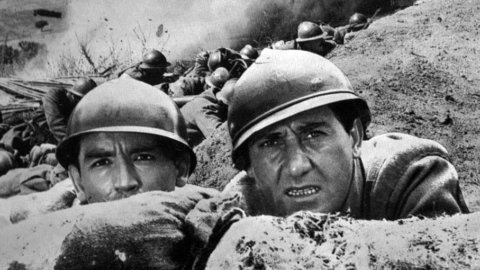
On the centenary of the epochal conflict that changed the history of the XNUMXth century, the House of Cinema e the La Sapienza University of Rome present Italy says "Farewell to arms": was it really a great war or just a great war? a journey through cinema and the five continents that were involved in the First World War. 25 from October to December 2 2015 scheduled 38 films (the most extensive review dedicated to the theme this year) to illustrate personal stories, strategies and plots, heroes and traitors, culture and anti-culture starting from the formidable evocative capacity of the big screen. Indeed, precisely in those years, cinema became the protagonist as a recorder of reality and amplifier of ideas, propaganda and imagination.
The cinematic itinerary will be accompanied by 11 public conversations with directors, writers, historians, analysts and critics, each time highlighting unusual aspects and themes, capable of making a page of history contemporary and alive.
The choice of the first weekend in the program is emblematic: Saturday October 24 the complete version of the formidable saga created by Fritz Lang will be screened with “Dr. Mabuse", who in 1922 recounted the consequences of the conflict against the backdrop of a total upheaval of society, anticipating the consequences that would soon overwhelm Germany.
Sunday 25 at 11 it shows up instead "WIN" by Marco Bellocchio in the presence of the director. Bellocchio will dialogue with the art historian Claudia Cieri Via and with the director of the House, Giorgio Gosetti, on the image and the art that changed the perception of reality and the life of European society at the beginning of the century, just as they were preparing the great dictatorships born from the head of Medusa (free admission subject to availability of seats).
Among the rarest films Japanese program Duel of eagles by Kengo Furusawa The mounted army by Miclos Jancso, Fraulein Doctor of Alberto Lattuada, And Johnny took the shotgun by Dalton Trumbo, Humanity by Elvira Giallanella, Westfront by Georg Wilhelm Pabst e Trench Pinocchios. The Wounded Body in the Great War, by Nene Grignaffini and Francesco Conversano.
Among the first protagonists of conversations many figures loved by cinephiles. In addition to Marco Bellocchio, for example Giorgio Pressburger and Steve Della Casa, but also many very high profile scholars such as Claudia Cieri Via, Giovanni Sabbatucci, Sergio Romano, Nadia Fusini, Giorgio Mariani, Piero Boitani, Giorgio Boatti, Giuseppe Di Giacomo, Beatrice Alfonzetti .
“FAREBY TO ARMS, a symbolic title, intended precisely to represent the anti-rhetorical spirit with which the project was conceived – says Giorgio Gosetti – also a fantastic journey through the suggestions and ideas that nourished the twentieth century. Together with Andrea Minuz we worked on the idea of intriguing and surprising especially a young audience, because the most vital lesson of history lies in its contemporaneity, so finding the paths that connect the past to the present means restoring memory and curiosity to a new generation which today finds little or nothing of that massacre, both global and distant, except in the pages of history books".