A share capital of just over 188 thousand euros; 2017 consolidated revenues close to 11 million; a capitalization of approximately 1,3 billion; a performance of +46,15% in the last month; +127,07% in the last six months; +248,25% in one year. And the percentages are down due to the prevailing sell-off in recent sessions: it is the Bio-on phenomenon on the Stock Exchange, after admission to Aim on 22 October 2014 at a placement price of 5 euro per share. The Bolognese company led by Marco Astorri and Guy Cicognani has recently reached over 71 euros per share and is currently worth around 64.
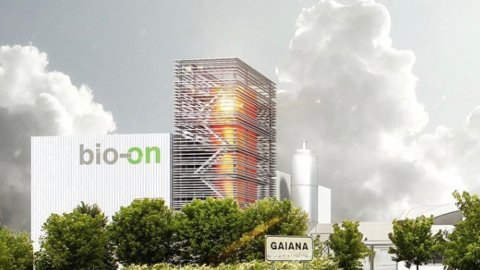
But who is Bio-on? His profile can be read on the Borsa Italiana website, which tells, among other things, that "Bio-on is an intellectual property company and supplies the technologies necessary to produce or use polyhydroxyalkanoates-PHA through licenses that limit the rights to a particular territory or a specific business area. Bio-on has designed and patented the world's first PHA plastic that is completely bio-based (certified in 2014 by the United States Department of Agriculture) and 100% naturally biodegradable in water and soil (certified in 2008 by Vincotte) without the 'use of chemical solvents'. In essence it is a forge of patents, for completely bio-based plastics. which opened its first production site a few weeks ago. A pole in the province of Bologna which is spread over an area of 30.000 m3.700, with 6.000 covered m1.000 and 2.000 mXNUMX for building and has a production capacity of approximately XNUMX tonnes per year which could rise to XNUMX tonnes per year.
E what makes a small business so attractive, that had a big acceleration in the last year? Definitely the partnerships with important and reliable players on the industrial scene: Kartell, Gima, Maire Tecnimont. And then, or rather, before that, the idea. Bio-on was founded in 2007 with the aim of finding an alternative to traditional plastic deriving from hydrocarbons and to this end it was awarded a series of patents around the world. In particular, it focuses on the use of agro-food processing residues such as molasses or sauces left over from the production of cane or beet sugar, potatoes, glycerol, fruit and vegetable waste extracts. Waste becomes a resource because it is used to feed colonies of bacteria defined as "good" which, growing in volume, produce PHAs within them. The bioplastic is born naturally during a fermentation process which takes place inside large tanks called fermented. Once the bacteria are "fattened" and have produced the bioplastic inside them, they move on to the extraction or recovery phase. Bio-on researchers have perfected a recovery system which allows them, they say, to be the only ones in the world not to use organic solvents or expensive and polluting chemical products, but only mechanical systems and steam. The whole process would therefore be sustainable and ecological.
The company works until 2016 only with a so-called IP Based business model, in essence, it markets the licenses to use its patent by supporting industries in various sectors in the development of processes for the production of its products, using the bio-polymer Minerv PHAs by Bio-on.
In fact, it is above all the "Minerv PHA" that reveals its development potential, as a platform product capable of operating in many applications for different sectors (from games to packaging to furnishings to cosmetics, bio medicine, organic electronics).
A further leap was made in November 2016 when Bio-on decided it was time to produce on its own. The aim is to replace the micro plastics (called microbeads) contained in cosmetics with a bio-degradable product. These are pollutants for the seas and are now banned in countries such as the United States, Canada and the UK. “A huge market – claims the company in a note – that Bio-on plans to cover through user licenses, but also with a factory to define a production standard to which all market operators (both big cosmetics or manufacturers of the "bases" of the cosmetics their suppliers) can make up for it. In this sort of prototype laboratory, products will also be made for the biomedical sector and for cleaning up the sea from hydrocarbon pollution. The start of these other productions is expected after 2020.
Waiting to know the 2018 trend, the 2017 numbers we are told that Bio On recorded consolidated revenues of 10,8 million euros, against 5 million in 2016; Ebitda 6,7 million against 0,8 million; Ebit 6,4 million, up from 0,4 million the year before; net profit of 5,2 million against 0,4 million as at 31/12/2016; Positive net financial position (liquid funds) equal to 24,2 million compared to 3,3 million in 2016 and shareholders' equity of 47,4 million compared to 14,4 million as at 31/12/2016.