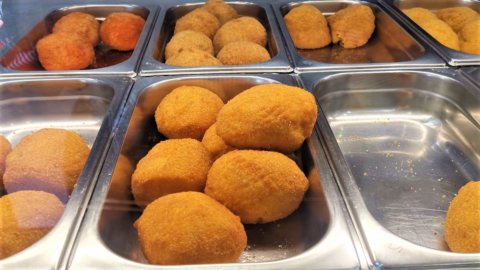
"Croquette "or "rice ball “? It is the eternal diatribe gastronomic Sicilian. There is no perfect fried without a “crunch” effect: one breading crispy and golden that frames a soft filling that melts in the mouth with every single bite. The Sicilian street food par excellence is based on rice and is declined in many versions from Dolce al salty to satisfy all palates. How was the arancino born? What is the correct name of this beloved street food: arancino or arancina? This is a dilemma that divides the Sicilian population into two factions. In Palermo, in fact, it is called "arancina" to recall the round shape of the orange, while in Catania "arancino" has a conical shape, therefore with a pointed end, to recall Etna. From here was born a real gastronomic diatribe of a Sicilian dish, the shape of which recalls the orange, the fruit of which the island is rich. Who can try to solve the literary enigma is the Accademia della Crusca. But let's first find out how theSicilian arancini.
The origins of the arancinu date back to the Arab domination
It seems that this street food has its origins in the times of Arab domination in Sicily which lasted from the 9th-11th century. The Arabs prepared a casket of round saffron rice with lamb meat inside. From here i Sicilians may have drawn inspiration to make theorange, which is enriched with rice filling and completed with a crunchy breading.
In Giambonino da Cremona's "Liber de ferculis" we read that all round-shaped meatballs in the Arab world took the name of the fruit from which they could most easily be compared in shape and size. In the case of the arancino it was orange, but there are other dishes that are compared for the same characteristics to dates or hazelnuts. However, when do the first recipes of theorange? In reality there are no texts that affirm with certainty the first recipe and it seems that in any case it was not realized before the second half of 1800.
In the Sicilian-Italian dictionary of Joseph Biundi from 1857 we find, for the first time, the definition of “arancinu”: “a sweet rice dish made in the shape of an aubergine”. Furthermore, the arancinu was originally only present in the sweet and not savory version, but the switch from sweet to savory was often made. In the following decade in Traina's Nuovo Vocabolario siciliano-italiano (1868) from the entry "arancinu" you are sent back to "crucchè “: “sort of meatballs gentiles made of rice or potatoes or something else.” In these first definitions found there are no hints, however, of the use of tomato and meat which, to date, are found in the original recipe. Furthermore, there is no certainty of when these two ingredients were included in the preparation. What is certain is that the tomato began to be grown in southern Italy at the beginning of the XNUMXth century. It emerges from this that perhaps the arancinu has not much to do with the Arab tradition. In fact, it seems more probable that this dish was born in the second half of the XNUMXth century as a sweet rice dish and subsequently found a savory connotation.
The breading, therefore, was added later and made it possible to transform this dish into an ante litteram street food for walking. It seems that this idea came to the Swabian sovereign Federico II, who was very fond of arancinu, who did not want to give it up even during his long hunting trips away from the castle. The breading made it possible to have no conservation problems in the following days.
Is the arancinu therefore male or female? An unresolved question from the Accademia della Crusca
To the gastronomic diatribe on the correct name of the arancinu that has been going on for centuries, he has tried to answer the Crusca Academy, highest linguistic institution in our peninsula. However, the gastronomic dispute over this name is not completely resolved due to the few and uncertain literary sources present. The Academy has decreed the correctness of both terms. "Arancino": taking into account that the first roots of the term are masculine, they date back to 1857 and are present for the first time in a Sicilian-Italian dictionary. At the same time also "arancina “is a correct term, because the timbale of rice brings to mind, due to its shape, the orange and therefore the female version of the term can also be considered correct. In short, the gastronomic dispute is still being studied and it is not known whether this ancient dilemma will ever be solved.
Infinite recipes: in addition to the classic white and meat sauce, there are also pistachio, chocolate and black cherry recipes
It doesn't matter that it is called "arancino "Or"arancina “, this dish doesn't need much introduction, because it is among the most famous street foods in Italy and, above all, in Sicily. These enormous "rice balls" are presented in a rounded or conical shape and with different types of fillings, from savory to sweet. They are made both red, tomato-based, and white. The simplest version is the white one with butter. Between versions more full-bodied are the ragù-based arancini with peas and carrots or ragù and mozzarella or béchamel and ham. There are more creative reinterpretations of this street food which include, in addition to the rice-based filling, the use of Sicilian pistachio, mushrooms, sausage, salmon, swordfish, seafood, pesto, cuttlefish ink and shrimp. Ample room therefore for creativity, also in the sweet version based on cocoa, gianduia cream (especially in Palermo), Sicilian chocolate and black cherry. To distinguish the various flavors, the shapes of the arancini can be varied.
In conclusion, we report below the recipe that Pellegrino Artusi writer, literary critic and gastronome included in his monumental book "Science in the kitchen and the art of eating well" published in 1891, the first text to tell the national cuisine by collecting the many local traditions published for over 100 years and translated into various languages. The forerunner recipe of arancini and arancine does not see them but appear as "rice croquettes".
The recipe for Pellegrino Artusi's "Simple rice croquettes".
Ingredients:
– milk, half a liter
– rice, 100 grams
– butter, 20 grams
– grated parmesan, 20 grams
– eggs, n.2
Procedure:
Cook the rice very hard in the milk, and halfway through cooking add the butter and salt it. Remove it from the heat, pour in the Parmesan cheese and, once it boils, poke an egg into it, stirring immediately to incorporate it.
When it is very cold, take it up by the spoonful and wrap it in the breadcrumbs, giving it a cylindrical shape; with this dose you will get twelve croquettes. Blend the remaining egg, throw in the croquettes one by one, roll them up again in the breadcrumbs and fry them.
They can be served alone, but better accompanied with other types of fried food.