
In recent days, during a conference at the Faculty of Economics of the Sapienza University of Rome, it was presented the book by Domenico Andracchio, Doctorate in Economic Law, “Evolutionary profiles of the anti-money laundering discipline”, published by Giuffré.
The volume, which is part of the series "Market law", directed by Domenico Siclari, Professor of Economic Law at that University, is notable both for the great relevance of the topic at a national level, as well as in that of the European Union, considering the recent launch of a regulatory package concisely labeled “AMLA – Anti Money Laundering Authority”; both for the systematic way of dealing with a continuously evolving and, particularly, complex subject.
The anti-money laundering system
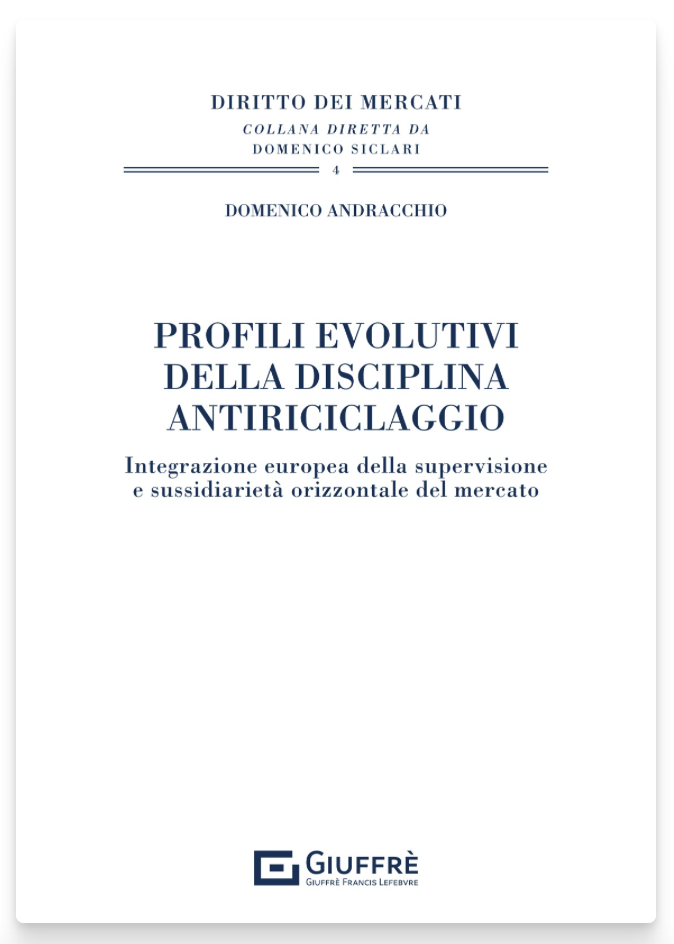
In this book, in fact, the reader will find pages dedicated toinstitutional aspect of the anti-money laundering system, with a careful historical reconstruction and an analysis of the regulations that have followed one another over time, as well as of the supranational, European and Italian institutions operating in this area. An articulated overall framework of reference, useful for addressing in the last two chapters of the book, first the theme of anti-money laundering governance system on a dual national and supranational level, with attention also paid to the role of private operators called upon to carry out significant functions of public interest; and, then, the adequacy assessment of the new European supervision paradigms of anti-money laundering.
According to the author, two main trends emerge from all these considerations: on the one hand, the substantial one invariance of the instruments prepared in order to prevent the entry of illicit proceeds into the legal economy; on the other, the variability of the institutional architecture responsible for preventing the laundering of illicit monetary flows, with a significant dynamism of change in the relevant European and national public structures.
This is a dichotomy, which will certainly be able to solicit stimuli for further in-depth study of the matter in the aspects investigated in the near future; to which must be added, inevitably, the problems created by the increasingly disruptive presence of the factor of technological innovation, which alone would require the opening of an autonomous side of investigation.
The rules approved by the EU Council
Beyond these potential future developments, of which the author himself is well aware, the book stands out for its scientific rigor and for the depth with which the different profiles are treated. Furthermore, the already mentioned aspect of the topicality of the topic of anti-money laundering and the importance of its pursued objectives plays in favor of a decidedly positive opinion. Appearance, as underlined during the presentation of the volume by Domenico Siclari, can be deduced from the standards approved by the Council of the European Union “to offer greater protection to EU citizens, the financial system and businesses from money laundering and terrorist financing”. Without forgetting that the harmonization of the rules provided for in the latest Regulation - continues Domenico Siclari "avoids regulatory arbitrage and extends the rules to new obliged subjects, such as the majority of those operating in the crypto-assets sector, the subjects who trade luxury goods and clubs and agents in the professional football sector".