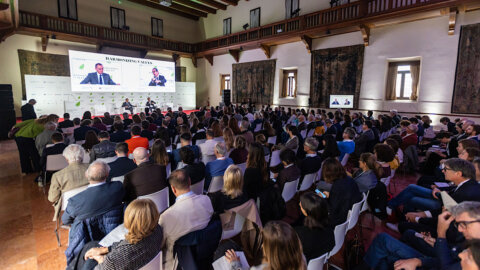
The event brought together institutions, brands, supply chain companies, and international stakeholders to discuss how to harmonize standards, values, and production processes, with the goal of building a more sustainable, transparent, and competitive sector. The forum once again confirmed Italy's role as a European hub for the sustainable evolution of fashion, highlighting the challenges posed by ultra-fast fashion models and unfair commercial practices, which compromise time, quality, and workers' rights throughout the supply chain. In this edition, sustainability is interpreted broadly, encompassing not only environmental protection but also collective responsibility, labor governance, and transparency in corporate management, engaging the entire fashion ecosystem, from major fashion houses to artisan workshops.
“Harmonizing Values”
Under this title the VSFF offered an opportunity for discussion between experts, companies and institutions to outline a new industrial model capable of combine sustainability, innovation and competitiveness. Among the central themes that emerged during the forum were the defense of the Made in Italy and Made in Europe, the need to ensure transparency and legality along the entire supply chain, and the transformation of sustainability into a real competitive edge.
The interventions
Among the main interventions, Luca Sburlati, President of Confindustria Moda, underlined the importance of legality, innovation and ethical coherence as new pillars of European competitiveness, while Flavio Sciucati, of The European House – Ambrosetti, highlighted the need for comprehensive representation of the entire fashion ecosystem to guide the sustainable transition. Paola Carron, of Confindustria Veneto Est, reiterated the urgency of harmonising rules and controls to protect the Italian supply chain from dumping of low-cost ultra-fast products, underlining how only careful and coordinated governance can guarantee quality, safety and sustainability.
“Just Fashion Transition 2025”
During the forum, a study was presented, which identified three key principles for sustainable transition: fair pragmatism, practical solutions e importance of narrativesThe study highlights how the European fashion sector faces complex challenges related to competitiveness, safety, protection of rights and environmental sustainability, leveraging innovation, sustainable finance, and clean technologies. In particular, the adoption of circular processes, the reduction of textile waste, and the use of innovative materials are key tools for building a more responsible and resilient fashion model.
The forum also highlighted how sustainability can become a true engine of innovation, capable of generating not only economic but also social and cultural value. From garment design to production, from distribution to final consumption, every stage of the supply chain requires consistency and transparency, in a context in which consumers are increasingly attentive to the environmental and social impact of the products they purchase. The start of this fourth edition of the VSFF has therefore reaffirmed the centrality of Italy in leading the transformation of fashion towards a more sustainable, ethical and competitive future, capable of enhancing artisan skills, promoting technological innovation and strengthening the reputation of Made in Italy throughout the world.