There are events that have profoundly marked the history of Italy, and one of these is undoubtedly the Ustica massacre and a plane crash, which occurred on 27 June 1980 at 20pm in the southern Tyrrhenian Sea between the islands of Ponza and Ustica, whose epilogue remains shrouded in mystery after 44 years. A mystery, or perhaps a hidden truth, which continues to elude us today. What is certain, however, is that the 81 victims and their families have been waiting too long a definitive truth.
Let's retrace this tragic Italian story which leaves open questions and suspicions of a possible concealment of the facts.
June 27, 1980: the last flight of the DC-9 Itavia
It all started on the evening of June 27, 1980, when the scheduled flight Itavia IH870, a McDonnell Douglas DC-9 of the airline Itavia, was supposed to depart from Bologna-Guglielmo Marconi airport with destination Palermo-Punta Raisi airport. Originally scheduled for 18pm, takeoff was delayed by almost two hours due to a storm over Bologna and the late arrival of the Douglas DC-9-15 aircraft with I-TIGI registrations.
At 20: 59, while flying over the southern Tyrrhenian Sea nearisland of Ustica, the plane suddenly lost the radio contact with the Rome area control center, responsible for air traffic in that sector. The plane it broke into at least two large parts and crashed into the sea, resulting in the deaths of all 77 passengers and 4 crew members on board.
Rescue operations began immediately, but it soon became clear that nThere was no chance of finding survivors. The recovery of the wreckage from the seabed and subsequent radar analyzes confirmed the tragic dynamics of the accident.
The Ustica massacre is the fourth Italian air disaster in terms of number of victims, after those of Alitalia flight 4128, Alitalia flight 112 and Linate.
The initial investigations were conducted by the ministerial commission chaired by the judge Prior Rosary. From the first moments, the causes of the accident were shrouded in mystery. Among the first hypotheses were the structural failure of the plane and thebomb explosion on board. However, both hypotheses were quickly challenged by new evidence and testimony.
The most popular hypothesis: a missile hit the DC-9
Over the years, several hypotheses have been put forward regarding the nature and causes of the Itavia DC-9 crash. However, the most accredited theory suggests that theplane was hit by a missile during a secret military operation. According to this reconstruction, the DC-9 may have been involved in a air conflict between NATO aircraft and Libyan forces. This hypothesis is supported by evidence such as radar patterns, testimonies from air traffic controllers and the presence of unidentified military aircraft in the area at the time of the accident.
In 1989, an expert opinion on the plane's fragments revealed traces of an external explosion, which further strengthened this theory.
Francis Cossiga, former President of the Republic and at the time Prime Minister, in February 2007 attributed the responsibility for the shooting down of the DC-9 to a French missile launched by an Aéronavale aircraft from the aircraft carrier Clemenceau (subsequently identified as Foch). Cossiga claimed that the missile, intended for a Libyan aircraft carrying Gaddafi, caused the accident “resonance and not impact".
Ustica massacre: other theories
Other hypotheses, considered less credible and revealed to be inconsistent, speak of a structural failure or of an terroristic attack with an explosive device hypothetically placed on board, in various positions, including in the aircraft toilet. This last hypothesis contrasts with the discovery of several intact parts of the fuselage, such as the trolley and luggage compartments, and even the toilet toilet seat, which was intact, suggesting the absence of an internal explosion. Furthermore, the confirmed presence of explosive substances such as T4 and TNT on some recovered scrap and furnishings indicates an explosive device of industrial and not artisanal manufacture, further complicating the validity of these theories.
In 1994, in the book "The Fifth Scenario" by Claudio Gatti, published by Rizzoli, the Israeli theory was put forward according to which the DC-9 would have been hit by a missile launched from a Israeli fighter. This hypothesis suggests that the attack was targeting the airliner, as it was thought that Gaddafi could have been on board with a load of plutonium destined for an alleged "Iraqi bomb".
Ustica massacre: the judicial line
The Ustica case led to numerous legal proceedings, many of which have dragged on for decades without reaching a definitive conclusion. In 1999, judge Rosario Priore concluded that the DC-9 was shot down by a missile, but was unable to identify those responsible. The families of the victims, however, continued to fight for truth and justice, achieving some legal victories. In 2013, the Court of Cassation has acknowledged that the plane was shot down during a war action and condemned the Italian State to compensate the families of the victims.
In 2018, the Court of Cassation ordered the Ministries of Infrastructure, Transport and Defense to compensate the heirs of the owner of the Itavia company (already in crisis before the accident and bankrupt six months later) for the serious financial damage immediately after the Ustica plane crash. The two Ministries were held responsible for not having carried out the necessary risk control in the Ustica air area, where unauthorized and unidentified military aircraft crossed the route of the Itavia flight.
Ustica massacre: Amato's words that reignited the race for the truth
Recently, Julian Amato gave an interview to La Repubblica, in which he provided his version of the tragedy of Ustica. Amato stated that the rresponsibility for the massacre is to be attributed toFrench Air Force, with the complicity of the United States, in an operation aimed at eliminating Gaddafi. According to Amato, the Libyan leader was warned of the danger by Bettino Craxi, thus managing to save himself. Amato, in the interview, then asked France and President Macron, who was unrelated to the matter, to to apologize for the tragic events in order to “remove the shame that weighs on France“. The Elysée has chosen not to comment on this request, while the families of the victims, represented by Daria Bonfietti, called for an end to the "tragic lie of the States".
Andrea Purgatori's battle: "We know everything about Ustica, but the truth has been denied for 40 years"
The Ustica massacre attracted aenormous media attention from the first days. Documentaries, films and journalistic investigations have tried to shed light on what happened, helping to maintain public interest and pressure on the authorities to clarify the circumstances of the tragedy. The film "The Rubber Wall” of 1991, directed by Marco Risi, had a significant impact on public opinion, denouncing the alleged silence and attempts at cover-up by the institutions. But, one above all, it has carried on a battle so that light could be shed on the truth: the journalist Andrea Purgatori, who unfortunately passed away last year.
From the first moments following the accident, Purgatori has dedicated his career to reveal the lies and omissions of those who wanted to hide the truth. Thanks to his efforts, many of the alternative theories and cover-up attempts have been debunked. Purgatori has continuously attracted the attention of public opinion and the authorities, keeping alive the search for truth and justice for the victims and their families.
Remembering the victims: the Museum of Bologna
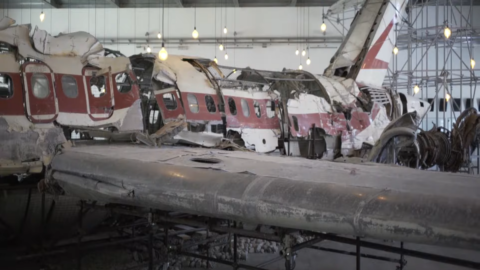
The Ustica massacre is not just a question of investigations and theories, but also a human drama which deeply affected the families of the victims. Every year, on June 27, commemorative ceremonies are organized to remember the people who lost their lives on that tragic night. In 2007 the Museum of the Memory of Ustica, a place dedicated to preserving the memory of the victims and raising public awareness about the search for the truth. It is in the museum the wreck was exposed of Itavia, which had previously been reassembled in a hangar at Pratica di Mare airport where it remained there until 2006 at the disposal of the judiciary for investigations.
44 years after the Ustica massacre, the truth about what happened that night of June 27, 1980 still remains shrouded in mystery. The investigations, testimonies and statements that have emerged over the years have shed light on some aspects of the tragedy, but many questions still remain unanswered. Only with full ascertainment of the facts will it finally be possible bring justice to the 81 lives lost and close one of the most painful chapters in Italian history.