La electricity demand in Italy continues to rise, supported by the recovery in industrial consumption and the high temperatures recorded in the final part of the month. In June, national requirement reached 28 TWh, an increase of 1,8% compared to the same period in 2025 and the highest monthly value in the last ten years.
According to the data released by Terna, the company that manages the national transmission network, this is the tenth consecutive monthly increaseAn even more significant result when compared to June 2025, when demand had already recorded particularly strong growth of 7,5%.
Temperatures and calendar drive demand
The June figure was influenced by both the calendar and the weather conditionsThe month had 21 working days, one more than June 2025, while temperatures, while lower than last year's exceptional levels, remained above the ten-year average.
Correcting the data for the effects of temperature and the different number of working days, theincreased salt requirement at 2,9%. Considering only the weather effect, growth would have been 3,5%. Seasonally and adjusted demand also increased by 1% compared to the previous month.the increase affected all areas of the countryIn the North, electricity demand rose by 1,6%, in Central Italy by 1,8%, while in the South and the Islands the increase reached 2,1%.
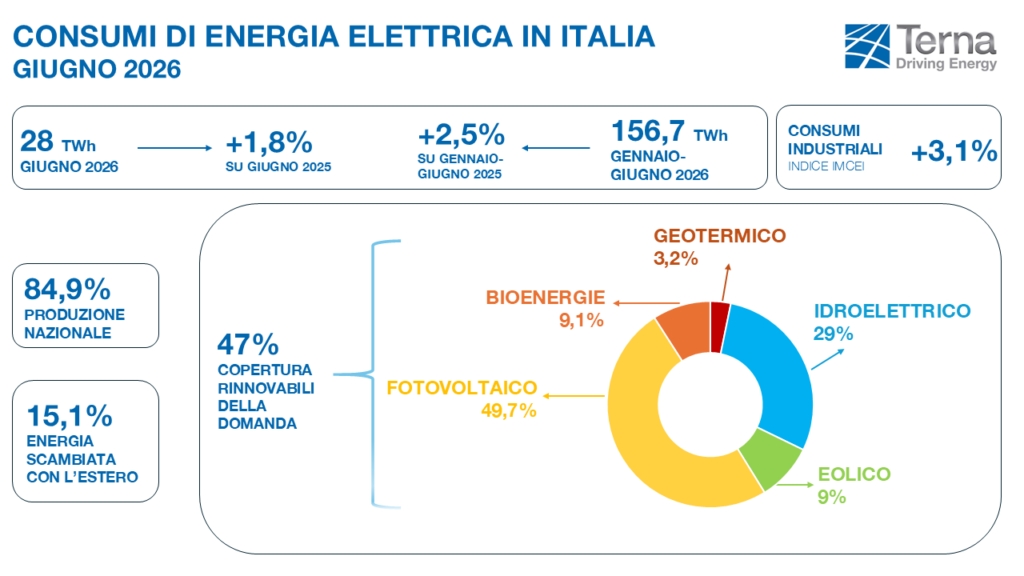
Le high temperatures The last decade's surges pushed the electricity system to a peak of 57,4 GW on June 29. This figure, 3,6% higher than the peak recorded in the same month in 2025, represents a new monthly record. Overall, in the first six months of the year, Italian electricity demand grew by 2,5%.
Photovoltaic is the first renewable energy source of the month
On the production front, the national plants covered 84,9% of demand, while the remaining 15,1% was met through foreign trade. Net domestic production reached 24,2 TWh, an increase of 2,6%. thermoelectric generation It grew by 8%, offsetting the reduced availability of some intermittent renewable sources and helping to cover peaks in demand. The foreign trade balance remained essentially stable, despite the reduction in both imports, down 2,9%, and exports, down 26,4%.
Overall, the renewables They met 47% of the national electricity demand, down from the 49,5% recorded in June last year. Hydroelectric production decreased by 23,7%, while bioenergy, wind, and geothermal energy also declined. Photovoltaics bucks the trend, which grew by 15,7% and exceeded 6,5 TWh, becoming the leading renewable source of the month. The 888 GWh increase was primarily driven by the expansion of installed capacity, which more than offset the lower production from solar radiation.
The June results come amid a six-month period characterized by 19,2% growth in photovoltaic production and 16,4% in wind power. Considering all technologies, renewable generation increased by 1,4% compared to the first six months of 2025.
New plants for 3,5 GW in the first half of the year
The transition of the electricity system also continues through the installation of new systemsIn the first six months of 2026, Italian renewable capacity increased by approximately 3,5 GW, of which 3,1 GW was attributable to photovoltaic.
In June alone, an additional 533 MW came online, including 171 MW of solar and wind plants directly connected to the high-voltage grid. As of June 30, total renewable capacity installed in Italy reached 86,95 GW.
Il PV represents the largest component with 46,61 GW, followed by wind power with 13,96 GW. The storage sector also continues to grow, with almost 944 plants, for a total capacity of 19,34 GWh and a nominal power of close to 8 GW.
Industry rises for the tenth consecutive month
The increase in demand was also contributed by the good performance of the industryThe IMCEI index compiled by Terna, based on the electricity consumption of approximately one thousand energy-intensive companies, grew by 3,1% year-on-year in June, confirming its positive trend for the tenth consecutive month.
The growth mainly concerned the iron metallurgy, the ceramics and glass sector, the paper industry, and the production of transportation equipment. Conversely, the chemical, mechanical, non-ferrous metals, food, and cement, lime, and plaster sectors recorded contraction. The overall picture remains positive even considering the entire first half of 2026. Between January and June, industrial electricity consumption increased by 4,3% compared to the same period last year, thanks in particular to the contribution of the steel and non-ferrous metals industries.
The dynamics of services are more contained.Index Enter, available two months behind other indicators, shows a 0,3% annual increase in April. In the first four months of 2026, overall growth was 1,1%, driven primarily by hotels, restaurants, and information and communications.
The detailed analysis of the provisional monthly electricity demand for 2025 and 2026 is available in the Monthly Report on the Electricity System, available in the “Electrical System”, “Dispatching” and “Operating Data” sections of the website Terna.
Real-time data on the operation of the national electricity system are also available on the Terna app for Android e iPhone and iPad.