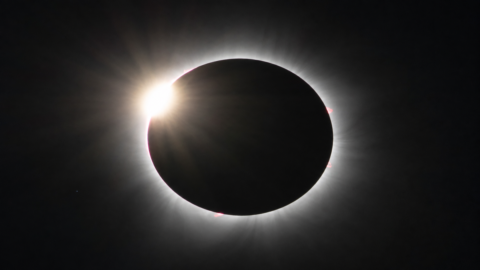
The wait is almost over. Today, Wednesday, August 12, 2026, the solar eclipse will cross part of Europe giving one of the most anticipated astronomical shows of recent years. In Italy we will not witness totality, but in several areas of the North and West it The Moon will cover over 90% of the solar disk.. The show will start at about 19:30, however, when the Sun will already be very low on the horizon, making the choice of observation point crucial.
The band of the totality will pass through Greenland, Iceland and a large part of Spain, where some of the best conditions for attending the event will be concentrated. For those who will remain in Italy, instead, it will be necessary to find a place with a completely clear view towards west and west-northwest And, above all, properly protect your eyes. Certified goggles have become difficult to find in recent hours, and relying on improvised solutions can be very dangerous.
Where to see the eclipse in Italy and why Spain will be the best place
In Italy the eclipse will be itinerary and will especially favor the northern and western regions. According to the maps developed by INAF, the National Institute for Astrophysics, using the INGV's TinItaly altimetric model, the coverage will progressively increase from south-east to north-west. The highest percentages are expected in Western Liguria and north-western Sardinia, where the solar disk may be obscured up to approximately 95 %Values above 90% are also expected in Piedmont, Liguria, Lombardy, Emilia-Romagna, and parts of Northern Italy. Moving toward Central and Southern Italy, coverage will progressively decrease, reaching values around 18% in Calabria.
But the percentage of blackout only tells part of the story.eclipse will begin around the 19:30 and will reach its most advanced stages when the Sun will be now close to sunsetPrecisely for this reason, a building, a hill, a mountain, or even a row of trees facing the wrong direction could be enough to completely hide the phenomenon. The INAF maps show that in central and southern Italy, the geometric maximum of the eclipse will often reach its maximum. when the sun has already setIn the Northwest, however, it will be possible to follow a much larger portion of the landscape. The advice is therefore to choose west-facing coasts, panoramic points, plains, or hills with a clear horizon, and to arrive there well in advance.
To witness the complete show, you will need to be along the totality band. Spain will be one of the best destinations in Europe, with a large area crossed by the Moon's shadow and totality expected to last about two minutes.
Weather forecast for August 12th, the real unknown is the clouds at sunset
Naturally, it will be up to the observer to decide how much of the eclipse will actually be visible. weatherThe available indications show a generally favorable picture, but for a phenomenon so low on the horizon, the situation will have to be evaluated practically until the last hours. The heat and clear weather do not automatically mean clear skies during the eclipse. For those who want to observe it, the most important thing will be the cloud cover between 19:30 PM and sunset, and in particular the presence of low clouds on the western horizon.
A single cloud cover in the wrong location could compromise observation even in generally good weather conditions. The most useful forecasts will therefore be those updated in the hours immediately preceding the event.
Live streaming of the eclipse, from INAF and ESA to NASA
Those who will not have a favorable view or would prefer to watch the all from Spain will be able to follow the eclipse through numerous direct streaming.
The Inaf will begin its broadcast at 19:30, together with the Italian Amateur Astronomers Union and the Italian Planetarium Association. The live broadcast will show images of the partial eclipse taken by the UAI sections of Cremona and La Spezia, alongside those of the entirety in Spain. It will be available on the EduInaf YouTube channel and on the Inaf and Uai Facebook channels. Also theEuropean space agency (the YouTube live stream is at the bottom) will follow the event from the Javalambre Astrophysical Observatory in Spain, with an informative broadcast and a second telescopic video stream without commentary via YouTube and ESA Web TV.
The coverage announced by the company is also extensive. NASA, with broadcasts on its own platforms and through services such as YouTube, X, Netflix and Amazon Prime. Virtual Telescope Project Astrophysicist Gianluca Masi will instead connect images of the partial phase observed from Manciano, in the province of Grosseto, with those of totality from Spain. The Greenwich Observatory will also broadcast the partial eclipse from London.
How to Watch the Eclipse Without Risking Eye Damage
The most important rule remains one: During a partial eclipse the Sun should never be looked at directly with the naked eyeIt's not enough that a large part of the disk is covered by the Moon, and even normal sunglasses aren't enough.
To directly observe the phenomenon, you need goggles or solar visors compliant with ISO 12312-2, intact and specifically designed for solar observation. Finding them has become increasingly difficult in recent hours. Many online deliveries are expected to arrive after August 12th, and stocks in physical stores are limited. Opticians, camera shops, and some pharmacies may still have them, but it's advisable to check first.
However, the lack of glasses should not push you towards do it yourself remediesSmoked glass, X-rays, CDs or DVDs, blackened pieces of plastic, ordinary sunglasses, and photographic filters not designed for solar observation do not provide adequate protection. Monica Varano, scientific director of the IRCCS Bietti, warns that "the only safe way to witness the eclipse is to use eclipse glasses certified according to the ISO 12312-2 standard". Looking directly at the Sun without adequate protection can cause retinal burns and solar retinopathy, with damage that can also be permanent and which does not necessarily cause immediate pain.
Even greater attention must be paid to binoculars, telescopes and telephoto lensesIt's not enough to simply put on eclipse glasses and look through an unprotected optical instrument: the concentrated light can cause very serious damage very quickly. Instruments must have special solar filters mounted in front of the optics.
Those who have not been able to obtain certified devices can forgo direct observation and use a system of projection, by passing light through a small hole in a piece of cardboard and projecting the image of the Sun onto a second surface. In this case, you must observe only the projection, without ever looking at the Sun through the hole.
Today's eclipse will therefore be spectacular but unusual for Italy. The sun will be low, time will be limited, and safety will have to come before the show.Where the horizon and the weather cooperate, shortly after 19:30 PM the Moon will slowly begin to "bite" the solar disk, leaving only a thin crescent above the horizon in the luckiest areas.