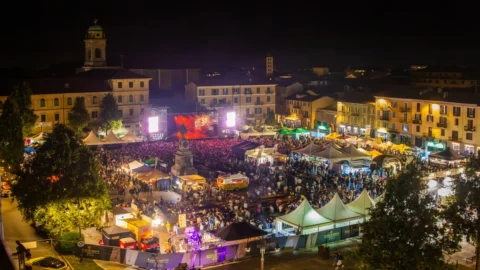
Gourmands in Italy can put a date on their calendar that will greatly stimulate their gastric juices: on 11 and 12 May in Piana degli Albanesi, in Piazza Vittorio Emanuele, one of the most popular gastronomic events comes back to life after 12 years of absence. sweets of Sicilian gastronomy, the cannoli festival. Piana degli Albanesi, in the province of Palermo, is traditionally and historically one of the iconic places for the production of cannoli in Sicily.
An ancient confectionery tradition rooted thanks to the influence of the Albanian community
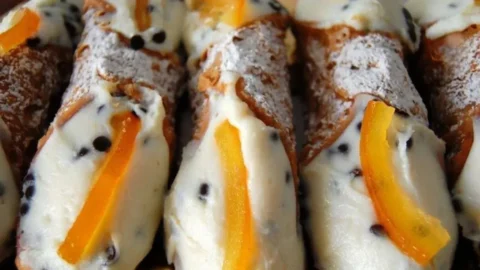
The cannoli tradition is particularly deep-rooted thanks to the influence of the Albanian community that lives there. The Cannolo di Piana degli Albanesi is mainly distinguished by the filling which, unlike the classic one based on ricotta, sugar and vanilla, here can contain additional ingredients such as chocolate chips. Obviously, as always happens with the gastronomic treasures of the area, every family, every pastry shop has its own "secret" recipe for the preparation of the "zest", i.e. the crunchy part that contains the delicious filling.
The Piana degli Albanesi Cannoli Festival on 11 and 12 May
According to a widespread tradition, it owes its name to a carnival joke which consisted of letting the ricotta cream come out of the cannoli instead of water. Cannoli is a dialect term that indicates a sort of tap.
The Sicilian Cannolo has very ancient origins: the name is linked to the river reeds on which the wafer was rolled in the 76th century during its preparation; according to one hypothesis, the dessert was invented in ancient times to celebrate carnival. According to others it even has Roman or Saracen origins. The first description dates back to Duke Alberto Denti of Pirajno who in his book Sicilians at the table wrote: “Tubus farinarius dulcissimo edulio ex lacte fartus”. According to Pirajno, the definition can be attributed to Cicero (chief of Lilybaeum, today's Marsala, between 75 and XNUMX BC).
The phallic homage of the women of the Harem to their men which then becomes a conventual dessert
Pino Correnti, in his Golden Book of Sicilian cuisine and wines, in turn provides another historical version of the exquisite Sicilian dessert: it would have been invented by the skilled hands of the cloistered nuns of a convent near Caltanissetta, starting from an ancient Roman recipe later developed by the Arabs. In addition to what Correnti claims, there is an ancient legend on the origin of cannoli which is worth mentioning: it says that the women of the harem of the Castle of the then Qalc'at al-Nissa (Caltanissetta) were the first to invent of the recipe. In this place, according to the tradition handed down to us, the Saracen emirs would have kept their harems and here the concubines would have created the cannoli, perhaps as a vaguely phallic homage to their men inspired by a dessert of Roman origin, made of ricotta, almonds and honey, which Cicero would have talked about. Subsequently, with the end of Arab rule in Sicily, the harems disappeared and it cannot be ruled out that some of the favourites, converted to the Christian faith, retired to monasteries, taking with them the recipes they had developed for the courts of the emirs. So according to tradition, Sicilian cannoli was one of the recipes handed down from Muslim women to their Christian sisters, who initially began producing it during the carnival period, and then became used and produced throughout the year.
Returning to the Cannolo Festival in Piana degli Albanesi, in addition to the Cannolo Expo where the pastry shops Bar Elena, Extra Bar, Antico Bar Sport in Piana degli Albanesi and Caffè del Corso dei Fratelli Biscari and Soul Caffè in Santa Cristina Gela will be present with their very famous cannoli, there will also be numerous stands offering both local and regional culinary excellence and craft exhibitors. For visitors to the festival, through the coupons that will be distributed at the various stations located along Piazza Vittorio Emanuele, there will be the possibility of purchasing five cannoli for the price of four. This year there will also be a station dedicated to cannoli and gluten free products with La mia Bakery in Cammarata.
The festival will also have a strong cultural connotation, in fact, during the two days it will be possible to visit many places of artistic and monumental interest in Piana degli Albanesi for free with the help of local guides who will explain its history. Among the attractions that can be visited are the Villa Comunale, the Cathedral, the Churches, the Borgo Sheshe (Open Air Museum) and the Museum of the Church of San Giorgio. Furthermore, for trekking lovers, an excursion to the Serre della Pizzuta organized by the Circolo Legambiente of Piana degli Albanesi is scheduled on Saturday 11 May at 9am.
There will be no shortage of cooking shows with the masters of Sicilian pastry making such as Giovanni Cappello of the very famous Pasticceria Cappello in Palermo included in the prestigious Guide to Pastry Chefs and Pastry Shops of Italy by Gambero Rosso, the art pastry chef Giovanni La Rosa who won with his chocolate sculptures prestigious international awards, the young and talented pastry chef Fabrizio Cannone and the chef Mario Ciulla of the Granofino restaurant in Agrigento who will propose a new vision of the cannoli. Among the in-depth events on Sunday there will be a conference entitled "The iconic Sicilian sweet Cannolo in the world" which will see the participation of journalists, writers and historians of Sicilian gastronomy.
For information you can call 0915649998 or write to the email address [email protected].
The classic Cannolo recipe and its variations
It consists of a fried dough peel (15 to 20 cm long with a diameter of 4–5 cm) and a filling made from sheep's ricotta. For the zest, small discs of dough made of soft wheat flour, Marsala, sugar and lard are formed which are rolled onto small metal tubes and then fried, traditionally in lard, today also in less expensive fats. According to researchers, the flour originally used was Mallorca soft wheat flour for cakes, widely spread in Sicily until the 1950s. Before modern hygiene laws, the dough was rolled onto small cylinders obtained by cutting out normal river reeds, which This is how they gave the dessert its name, but today they are made of steel. The traditional filling consists of sifted and sweetened sheep's ricotta. Candied fruit and chocolate chips are then added to the filling, and finally the cake is dusted with icing sugar.
In eastern Sicily and in particular in the Ragusa area, Iblean ricotta (vaccine, often from Modican cow) is traditionally used, with a more delicate flavor than the classic sheep's ricotta.
The cannoli, in any case, must be filled when eating them; this is because, as time passes, the humidity of the ricotta is absorbed by the wafer causing it to lose its crunchiness. To avoid this inconvenience, some pastry chefs coat the internal surface of the cannoli with melted chocolate: in this way, the casing does not get soaked and remains crunchy for longer.