Fasten your seatbelts
«Ladies and Gentlemen, the Commander informs that the landing maneuver has begun. Please fasten your seat belts..." L'plane of the world economy it is decreasing in altitude and losing speed, to arrive on the path of more sustainable growth, i.e. in line with potential and without inflation or deflation.
The markets are betting that the maneuver will be without accidents and that the tires will touch the ground softly. In fact, the probability of not being a fatal victim of a plane crash is almost four times less than that of being eaten by a shark (David Ropeik, Harvard University, 2006). It is known, however, that 70% of crash It happens precisely in this delicate phase of flight. However, it is an outdated statistic, because it refers to a time when many aircraft were not equipped with a ground proximity sensor.
The problem with economics is that this sensor cannot exist, simply because we don't even know what altitude the soil is at, i.e. the potential growth we must aim for. Or rather, the econometric estimates of this growth are certainly there and are made seriously, but they are valid for a medium-long period, while in the "here and now" this growth may have moved up or down depending on the historical, social context , technological, political and, we discovered in 2020, healthcare. Furthermore, there are so much turbulence, starting with the sadly warlike ones, where air gaps and jolts are guaranteed. We remain confident in the pilots' expertise, despite being forced by circumstances to navigate by sight. However, it is best to fasten your seat belts tightly.
In fact, the economic indicators world of orders and production they say the engines are dangerously stalled, even spinning backwards: the ordersin fact, globally they are contracting, especially those from abroad. What brings them down are manufacturing orders, which are more sensitive both to the "slimming" care of monetary policy (investment and durable consumer goods, above all) and to the geopolitical tensions that redraw the map of production locations and international trade. Orders in services, however, stagnate.
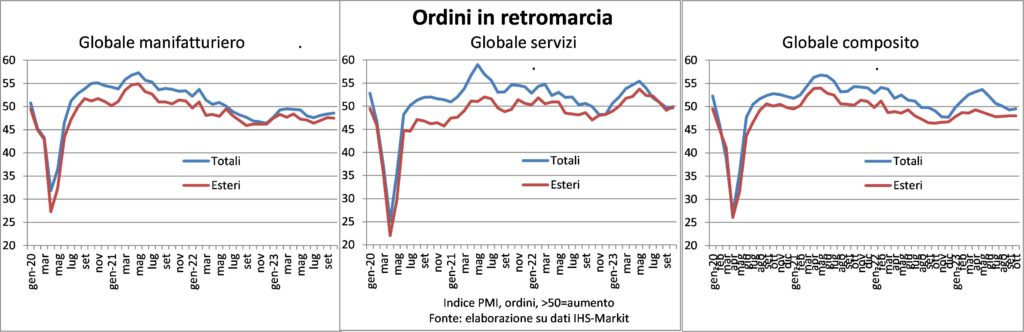
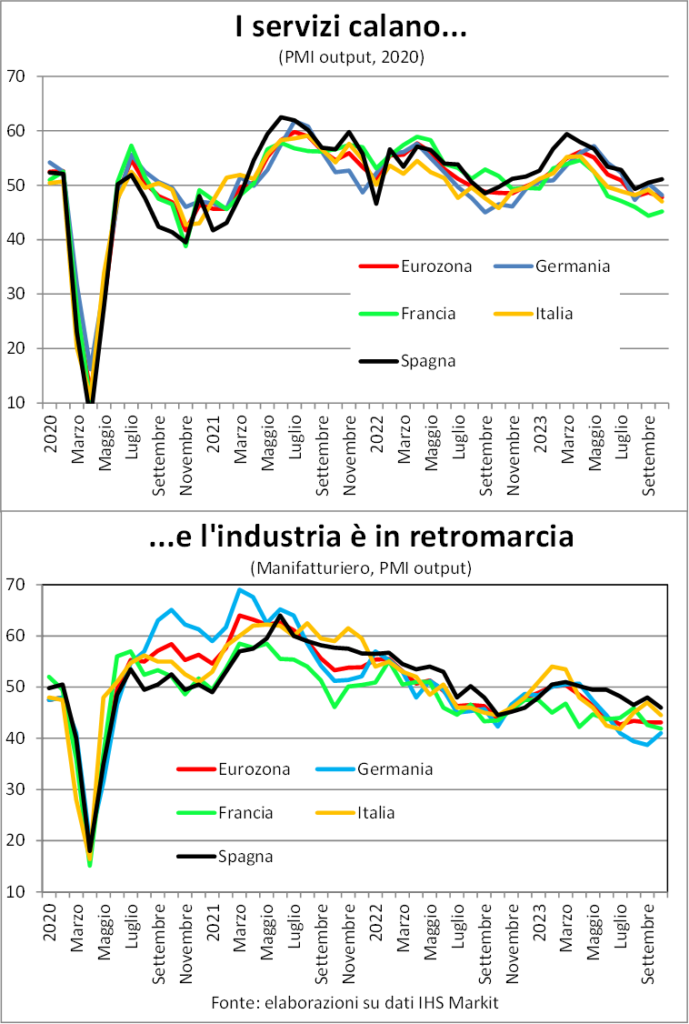
I manufacturing PMI data they allow us to look at the geographical composition of the picture, and the alarm signals increase in one direction and diminish in another. The mitigation derives from the observation that the output does not recede. It only stopped increasing, with the composite PMI index at 50, exactly poised between rise and fall. But the trend is downwards, as in an inexorable countdown: since 54,4 in May each month has contributed to taking away a piece of speed, and in November there could be the first contraction.
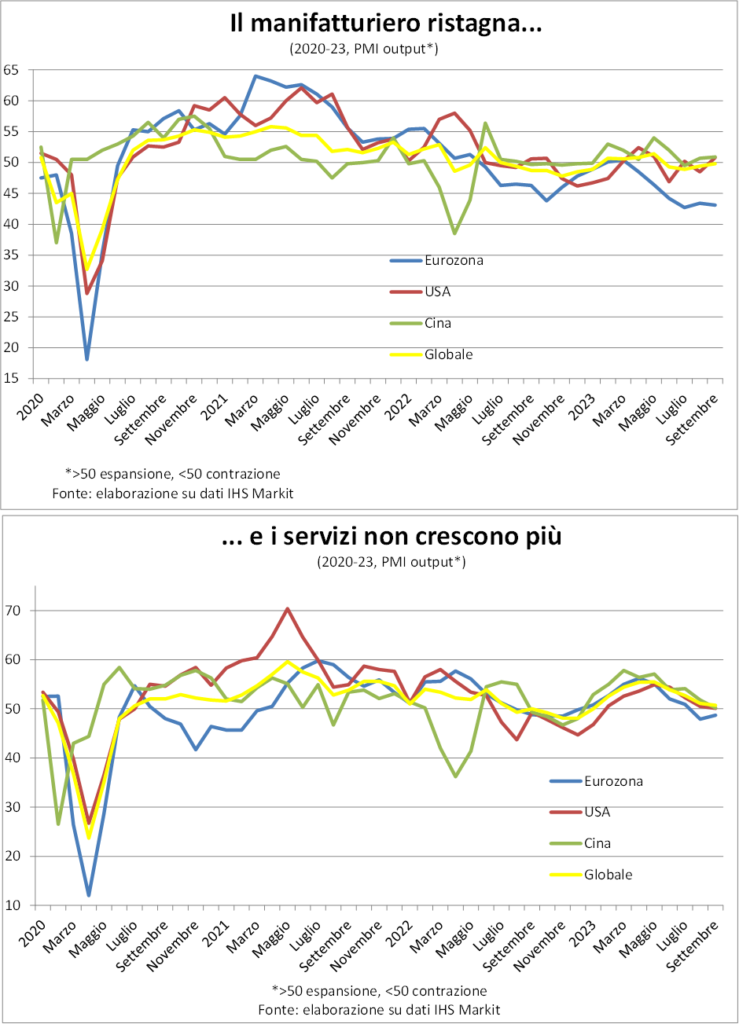
The increase in alarm derives precisely from geographical diversification: theEurozone is in recession confirmed, according to this qualitative data, for some time now, precisely since June, and in October it took a further step downwards, in the sense that the contraction accelerated. What keeps GDP a little higher is the contribution of public sector, whose services and spending at least do not go down, just as they do not push into the bright phases (at least meditate on their anti-cyclical value!).
The trend of orders in the Eurozone is still declining, indeed they are falling at the highest rate since September 2012, in the midst of a sovereign debt crisis (excluding the tragic pandemic parenthesis). So we must expect further declines in activity. Also because many businesses have started reduce the workforce, albeit in a soft way (not replacing those who leave), and after 32 consecutive months of increases, employees remained stable overall. That subtracts that sort of parachute which had supported European economic systems until now, making them particularly resilient to the hammer blows of rate increases suffered on the anvil of the rising cost of living. Before delving into what is happening in the European labor market, let's look at other areas of the world.
We must, therefore, note that, after the extraordinary exploit of the third quarter (+4,9% annualized GDP), the United States they are on course for a much slimmer but still robust 2,1-2,5% in the quarter. L'occupation continues to rise, and not much more slowly: including the over 30 thousand on strike in the auto industry (whom US statistics do not include among those who work), employed people in the three months to October rose by 1,7% annualized, in line with what has happened since April. An increase that is consistent with the still high number of vacancies, equal to 1,5 times the unemployed in September, a ratio substantially unchanged since July.
US consumer perception is also still clearly in favor of abundance of job opportunities (plentiful bat hard to get 3 to 1), so their confidence remains high and incompatible with lower spending. Few analysts, however, realize that the shortage of workers had already become apparent before the pandemic, so much so that since the beginning of 2018 there have been more jobs available, and increasingly so, than the number of workers ready to take them. . This explains the tension in the American labor market and how pressures to increase wages will persist. Let's return to the topic below, talking about inflation. And in any case the demand is kept up by the strong public spending, directly or via subsidies, in investments, to modernize infrastructures and to make the slogan of Make America great again! (It matters little that it was coined by another president).
Turning our heads to the East, we notice the zigzagging gait of the China and the weakening of Japan, while India grows at a slightly less robust rate and the other economies in the area suffer from global manufacturing difficulties. There Russia makes a story in itself: a galloping war economy that circumvents sanctions thanks to the complicity of the rest of the world outside the USA and Europe, the rest of which is actually the vast majority (sic!).
In short, the picture is one of weakness with a black hole, the Eurozone, and a still shining star, the USA. This is also why landing is more laborious and dangerous.
Let's go back to Old World. In the first ones Lancet of 2023 we discovered that, in addition to the famous jobless recovery ('jobless recovery', as in the period after the 2001 recession in America), in the current phase the economic bestiary offers a new ircodeer: the jobful recession; that is, an economy that weakens while employment continues to increase solidly.
As we have repeatedly complained, employment data in the Eurozone are very poor on a monthly level, limited only to unemployment. Which rose slightly in September after reaching the historic low (in the short history of the Eurozone) in August. While the quarterly data confirm that: GDP has not moved for four consecutive quarters, companies continue to look for employees, employment has increased. However, the creation of new jobs in the private sector stopped in October. And in Italy?
In the Bel Paese the strange couple the stagnation of the GDP for a year and the increase in employment takes on extreme connotations, because in the last twelve months the number of new workers employed has increased by 2,2% and by over half a million units. Remember the good soul's electoral promise of one million new jobs in five years Silvio Berlusconi? At current rates and without him we would be at 2,5 million. Better than job machine USA! One might say: luckily Silvio isn't there...
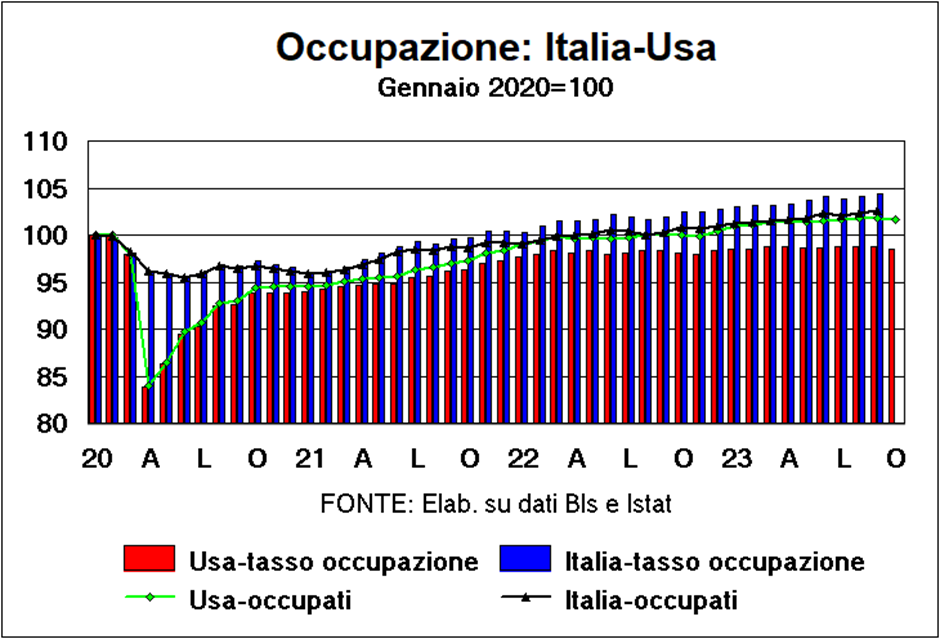

Job machine italica
What is happening? There are various explanations: recomposition towards activities with lower productivity (vision of the usual pessimists); underestimation of the GDP dynamics; occupation as delayed indicator (light of dead stars); business needs complete the staff.
The truth is probably a mix of the four: in recent times it has been mainly the services that revolve around travel and tourism; it would not be the first time that GDP has to be revised upwards; it takes some time because the fall in demand and production leads to a decline in the number of people employed; the Italian companies, like the other Europeans, the USA, the Japanese and the Australians had to leave many orders unfulfilled due to lack of staff and are now strengthening themselves to be ready for the restart.
What remains is that on both sides of the Atlantic the resilience of the labor market is working aircraft stabilizer on landing.
The lifesaver of the PNRR
The cyclical evolution It says, however, that production in the fourth quarter began to contract more violently across the Eurozone, with the exception of Spain (PMI composite output). Italy, for once, seems to be going better than France and Germany, therefore he does not report any difficulties of his own. But that's little consolation. Also because the public budget maneuver it creates more deficits but not much more growth. Once again we emphasize that we have a huge lifesaver: it's called PNRR. Use it well, use it quickly, and voters in four years will be grateful.
Inflation defeated, but not tamed
At the beginning of November the financial markets released the bulletin of victory against inflation. And they popped champagne and set off firecrackers, in the form of violent increases in stocks and bonds. Were they right?
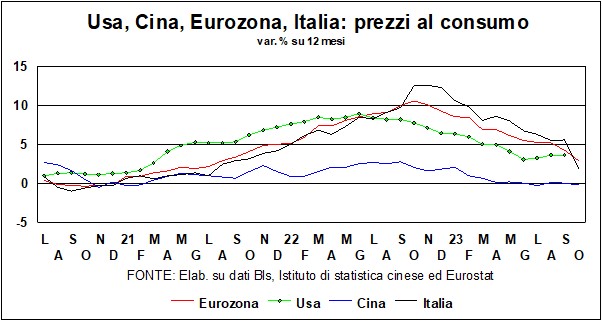
The impression is that the road to reach the desired destination of a dynamic in consumer prices that is consistent with the definition of monetary stability is not short and that the stretch ahead is perhaps the hardest, on an economic but also social level. In fact, so far the moderation in demand induced by the higher cost of money and the lower purchasing power of wages has acted above all on corporate pricing policy, who did not have great difficulty in slightly reducing the margins which had widened significantly during the phases of strong post-pandemic recovery, in which consumers they spent like there was no tomorrow, after having been afraid during the lockdowns that there really wouldn't be tomorrow.
The hardest part is convince workers to accept the lower real value monetary value of their effort and ingenuity, a value compressed by the rise in price levels. Let's take Italy: the cost of living, measured by the ISTAT index, rose by 16,9% between 2019 and last September; contractual hourly wages of 5,6%. In the USA the situation is better: +19,5% versus +21,2%, but the latter are de facto salaries, which also take into account components that the Italian contracts do not consider.
In any case, when il market is the seller's, as is the labor market on both sides of the Atlantic in this case (we saw it above), it becomes difficult to explain that it must moderate demands.
He gives a hand Petroleum. Gas, however, is not, despite an ancient advertisement that promoted the use of methane. The oil quotations have fallen in the last two months; one might believe that the Arabs are providing concrete help to the West in the war against Hamas (+Iran), pumping more than they say. There's no sin in thinking well, and you get it right!
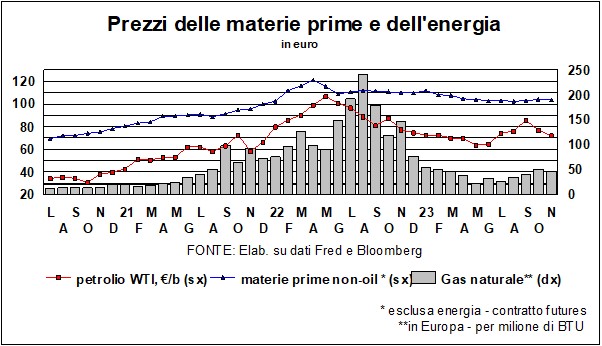
The terrorist attack in Israel he breaks their eggs in the basket of diversification towards services and entertainment (have in mind the large investments in football), to reduce monodependence on black gold which will be less and less shiny in the future. Tourism and general attraction of foreigners requires peace, not skies where anti-aircraft missiles that those foreigners carry risk flying. In fact, theOPEC exports has started to rise again and the temporary elimination of American sanctions also goes in the direction of an increase in supply Venezuela; gesture that is more symbolic than real (the oil industry there is rather decrepit), but in the Middle East no one has protested and the meaning is exactly to ensure that the new war does not cause the inflationary damage of the one that broke out in 2022 (moreover, so Russian exports are also hit). Then there is certainly also the weakness of Chinese growth to explain the drop in oil prices.
The others non-oil raw materials (and non-food) remain stable and this also contributes to the decline in inflation. In fact, the PMI component of prices paid by businesses slowed again in October. But not in manufacturing. Overall, corporate price increases have taken another small step towards normalization to pre-covid levels. However, it was no longer a world in deflation, because even then wage dynamics were accelerating in America, for the reasons explained above. Today the American average hourly wages they still increase by about one point more than then, and those monitored by the wage tracker (which follows the same individuals over time) by even more.
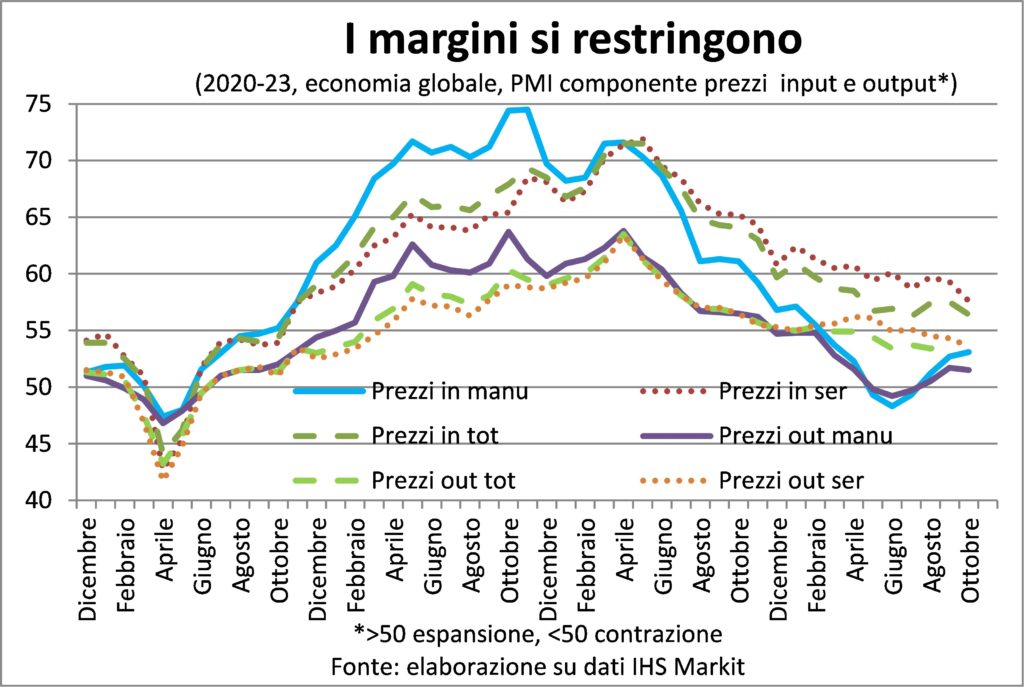
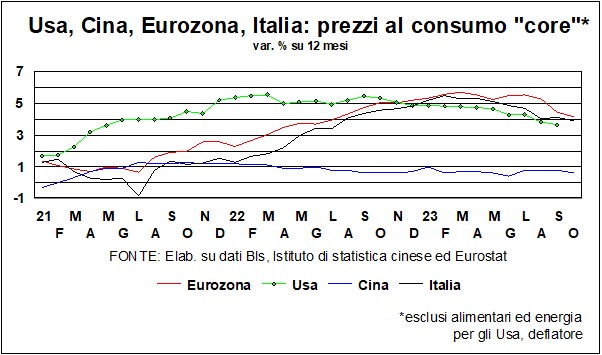
A few battles have been won against vintage inflation of the 20s, but not yet the war. They say it too inflation expectations one year, which in the Eurozone rose to 3,5% in August (from 3,4% in July) and in the USA to 4,4% in November (from 4,2% in October). It is true that they are extrapolative (i.e. they reflect past price increases), so recent drops in price temperatures should soften them, but they are also what drive wage demands and appear to be driven more by measures core than from the total ones. As if to say: You're a fool and a fool.
Remember, then, also pull up the table and put the backrest back in the vertical position…
Rates at the end of the race
La war coming to an end? We are not talking about real wars, with their sad aftermath of blood, but about those between Central banks and inflation. The long tug of war between banks intent, with a rough attitude, to stamp out inflation 'whatever the cost', and a reluctant price dynamic, is at the turning point. The bold statement rests on two events. On the one hand, it is true that inflation is falling. Both the total consumer price index and that say so core (albeit with less conviction). And the dynamics of the indices of wages, discounting some productivity, is not such as to raise fears of a price/wage spiral. On the other side - and this second side explains the reason for the first - demand is slowing: by a lot in Europe and a little less in America. Central Banks should be happy: the tireless increase in the cost of money has borne its 'fruits' (poisonous?), and the economies are in recession or pre-recession. Not to mention that in the pipeline there are still other 'fruits', i.e the effects of past restriction that have not yet fully manifested themselves, given that monetary policy acts with “long and variable delays” (copyright Milton Friedman).
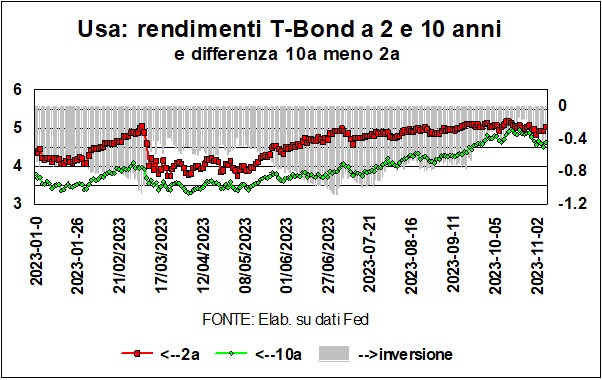
Of course, the central banks they would not agree in considering the war won. As one man (Powell) and one woman (Lagarde) warn that it is too early to declare victory, and they do not rule out other increases. Which, however they are not probable. Just a month ago, the markets were positioned on "high rates for a long time": a mantra that did not last long. The reasons we mentioned in the previous Lancets to describe the possibility that rates might not remain on the plateau for a long time have come true. Inflation fell faster than expected and the economy weakened faster too. The pauses of the Fed and the ECB were accompanied by explanations in which we read between the lines that the real economy advises against further increases. So the markets are starting to wonder when there will be a easing of monetary policy, and place it towards the middle of the coming year. American two-year T-Bond rates – which are sensitive to expected trends in Fed rates – have fallen by around twenty basis points since mid-October, and the inversion of the yield curve is easing (see graph).
In fact, the Fed she was also too 'good' at restriction. Thirty-year mortgage rates – the main instrument for purchasing homes (and for realizing theAmerican Dream) - they are close to 8%, a heavy real rate for aspiring borrowers. The difference between the key rate and thirty-year mortgage rates is at least two and a half points, significantly higher than the difference between the ECB key rate and thirty-year mortgage rates in Europe. (part of the difference is due to the fact that in America you can pay off your mortgage early - by refinancing it - without any penalty).
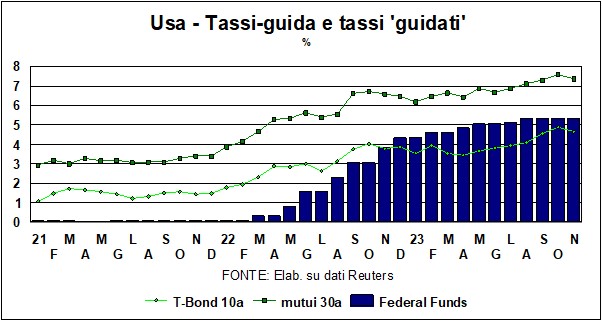
Of course, here too we need to play 'devil's advocate'. What reasons could advise central banks to continue the battle of restrictions? The restriction is not just about rates, we need to look at the overall monetary conditions. There are various versions of these "indexes of monetary conditions (for America we counted at least six), and the degree of restriction must be evaluated, in addition to the lens of the key rates, also in light of the trends of other rates, of the relative spreads, exchange rates, stock market spreads (cost of risk capital)... Financial conditions could therefore be eased – and recommend higher guide rates – if, regarding the Fed, the dollar were to weaken and Wall Street were to raise its head again. And the 'restrictive advice', again with regards to the Fed, could also come continuing strength of the economy, with consumption still increasing, driven by employment and the newfound negotiating power of workers. These 'advice' – possible but not probable for the Fed – are even less likely for Europe, where the economy suffers much more than across the Atlantic. However, the markets are quite neurotic at the moment, and the yields of the T-Bond record large variations from day to day, depending on the breaths of the Fed, which seems to be playing like cat and mouse: in the same breath it says that it is ready to increase again if inflation does not behave well, only to say immediately afterwards that the past increase in the cost of money has not yet exhausted its restrictive effects…
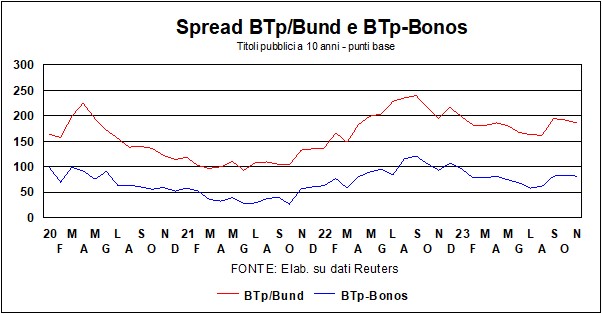
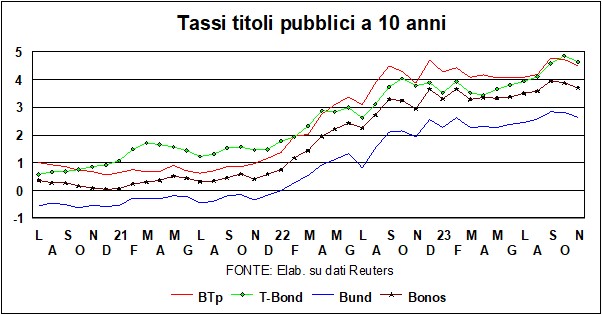
For Italy, the disappearance of “high rates for a long time” – a mantra that had greatly damaged i btp, given the implications for the public budget and for the real economy – has given breathing space to our securities, and it spread, which on some days had passed the 200 mark, is dropped sharply. The markets also appreciated the budget law - all in all prudent - and its decisive nature drop in inflation.
Let's get to the changes. For the dollar, there are reasons for and against, which means that, like Buridan's ass, it should stand still. It is true that a traditional variable that weighs on exchange rates – the long-term real rate differential – has turned against the greenback. But the growth differential and the role of safe haven currency (in these stormy weather) they play in favor.
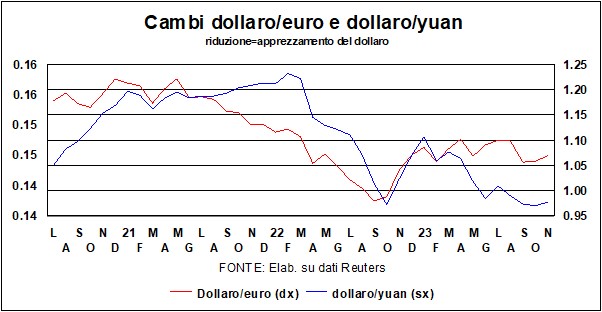
For the yuan, the exchange rate against the dollar stabilizes at more competitive levels compared to the beginning of the year. It is certainly not time for the Chinese currency to flex its muscles, which needs to accompany the difficult recovery of the economy.
Let's move on to the stock markets. The analysts' newsletters are full of anguished questions, such as; the 'Magnificent Seven' (Alphabet, Apple, Amazon, Meta, Microsoft, Nvidia, and Tesla) have gained almost 90% this year: is it time to go short? Which signals from the 'contrary bastians' are best to follow? What asset class can protect against losses on stocks now that bonds have no longer played that role? It is not our job to venture into the answers; we confirm the recommendation for drawers: stay with shares and trust in the long term (it is true that, as Keynes said, in the long term we will all be dead, but we worry about the heirs...).