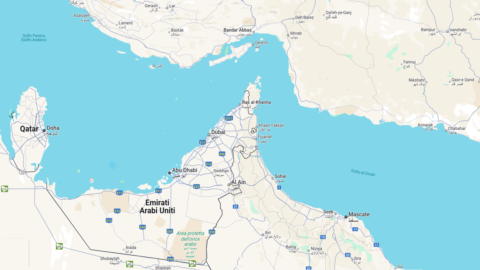
The European, American and Asian governments had not seen the tsunami coming. Hormuz, and not even the return of that of Bab al-Mandeb and not even the next one, that of Malacca CanalYet since 2024, the authoritative World Economic Forum, together with the MIT (Massachusetts Institute of Technology) and the CTL (Center for Transport and Logistics), had been raising a pressing alarm. They had indicated some very high risks in the event of conflicts or disasters.
The first one stressed the need for governments and institutions to consider the Strait of Hormuz as a laboratory to prevent the global consequences of possible blockades and conflicts, so as to be able to manage global logistics in a compensatory manner. Regardless. The second indicated the iron interdependence between the world's maritime straits and transoceanic shipping lanes, and between these and global prosperity and peace. All this is due to interaction with supply chains—maritime, land, and air.
Hormuz and more: the link that connects the Straits
That interdependence is a detonators It connects all straits, all goods, and all countries, even though each strait is, so to speak, "specialized" for certain categories of goods. The 13 main canals, for example, transport 55% of all the corn, wheat, rice, and soybeans traded worldwide. Yes, but which ones?
Hormuz, why it is also damaging for the US
Even the partial energy blockade of Hormuz, for example, damages the whole world but surprisingly also the United States. crude here extracted, in fact, through hydraulic fracturing is a rather transparent liquid, while the obsolete refineries of the Texas They can only process heavy, viscous oil, such as that coming from Venezuela, Canada, Mexico and… the Persian Gulf countries.
Hormuz, Trump and oil imports
There are other factors, even unknown ones, that pushed Trump to force the aggression against Iran and the need to keep Hormuz open. The lack of environmental protection and energy saving policies and Trump's cancellation of these policies have made the country's system four times less efficient than China and twice less efficient than Europe. Consequently, despite the US being the world's leading producer and exporter of Petroleum e natural gasHowever, they must import a significant amount of it to function, lacking any oversight of private and public consumption. Their energy label, Energy Star, for example, is equivalent to the more wasteful European "G" label.
Fertilizers for agriculture from Hormuz
If the grain trade stops – Panama and Malacca – the entire African coast will dramatically increase pirate attacks, epidemics and wars with millions of victims. As is happening. But even more serious is the partial blockade of Hormuz, of gigantic passage of fertilizers for agricultureWhich means missed sowings, missed harvests.
Fewer fish and more pirates from the straits
Il fish It is the basis of the global diet, but climate and social unrest in the straits and along the coasts are disrupting its availability. As they point out Ams Journal and the UN, sea surface temperature – due to climate change – is a shocking instrumental variable for fish production that will extend to all seas in the future. In East Africa, a higher sea surface temperature is already stably associated with a decline in fish production, which in turn increases the risk of piracy, while in the South China Sea, higher sea surface temperatures are associated with increased fish production, which in turn reduces the risk of piracy. But this also generates dangerous new "appetites" among states.
Black Sea Straits and Hunger in Africa
The war between Russia and Ukraine has significantly reduced the passage of infusion-carrying ships, that is, those of the grains and agricultural productsi, headed from Russia and Ukraine towards the "hungry" countries of Africa. Previously they passed from the Black Sea through the Bosphorus and Dardanelles canals towards the Mediterranean and Suez, with African countries as their destination. Black Sea It is also the only maritime outlet for supplies from Georgia, Romania, and Bulgaria. In short, less and less crude oil, petroleum products, natural gas, grains, fertilizers, and containerized goods are passing through.
Beware of coming famines
In Africa and other poor areas of the world, the number of frightening famines due to hungerInternational organizations and services fear disrupted food chains more than the oil crisis. This is because there is no international mechanism to manage the socioeconomic risks of a serious disruption to food supplies, as is the case in the oil markets where the International Energy Agency (IEA) operates. But the Gulf Cooperation Council (GCC) countries are particularly dependent on global food imports. They are therefore highly exposed to disruptions caused by chokepoints. These include: they have oil but are in pre-food crisis.
Panama Strait: Fewer and fewer grains and industrial goods
Due to the increasing drought, the number of ship crossings in the Panama Canal It decreased by 20% in 2024 compared to 2023. And again in 2025. It is impossible and too expensive to change its operation. From Panama they pass cereals first and then automobiles, chemicals, crude oil, gas and petroleum products. Northward flows consist primarily of South American agricultural exports; southward flows consist of machinery and vehicles from the United States and Europe. Inflation, which has been rising for about four years, is also due to the difficulties in maintaining the canal's functioning as it once did.
Bab el-Mandeb i.e. Suez
Products made in Asia for the UK and continental Europe pass through here and they are of any type, from Barbie dolls to iPhones to fast fashionAs is well known, past blockades at these chokepoints have put European retail multinationals in difficulty. Thirteen percent of world trade passes through Bab el-Mandeb.
Bass Strait between two oceans
Bass Strait separates theAustralia continental from the island state of TasmaniaIt connects the Indian Ocean with the Pacific Ocean and is of fundamental importance for regional shipping routes and energy resources. The deposits of Petroleum e offshore gas present in the area have made it one of the main energy producing areas of Australia.
Strait of Dover and Strait of Gibraltar
Currently, EU imports of cereals, soybeans, oilseeds e fertilizers They are more dependent on these channels, even though the EU was less exposed to risks than the rest of the world. "Was," that is, the situation is changing rapidly.
The Strait of Malacca
Located between the island of Sumatra in Indonesia and the Malay Peninsula, it connects the Indian Ocean and the Pacific Ocean and is considered at very high risk due to the exponential increase in piracy and the attacks by Islamic extremists that Trump's war on Iran is fueling. In terms of the quantity of ships and goods, it is the first in the world. Huge traffic flows through it with raw materials such as fuels, minerals, Iron e steelIn addition to coal, palm oil, and Indonesian coffee, it is also vital for the supply of Chinese finished goods and intermediate goods, components, and spare parts. If transit were impeded, Asian and European manufacturing would grind to a halt, especially since many products are transported back and forth.
Malacca, Makassar, and Sunda Islands: Global fishing alert
The 94 vessels that pass through them carry approximately 30% of all globally traded goods and 25% of global traded goods. But experts have raised an alarm: according to studies by the Philippine Department of Environment and Natural Resources, this area holds a third of the world's marine biodiversity and provides approximately 10% of the world's catch. According to some estimates, these marine life reserves are suffering: 40% of stocks have collapsed or are overexploited, resulting in conflicts between coastal countries.
The Port of Baltimore
Interrupted since 2024 due to the collapse of the bridge, it is the first for the US for the import and export of cars and light trucks and agricultural tractors, as well as for household appliances, clothing and furniture. Baltimore, the huge exports of the American coal to India, China, Japan e South Korea that are on the Pacific coast. The completion of the reconstruction has been postponed until the end of 2030, two years behind the initial plan. Since 2024, the logistical chaos in the United States has increased and become more costly.
The routes: a vital but expensive alternative
The straits serve to significantly reduce the time and costs of ship journeys but a significant portion of the traffic takes place along the transcontinental routes which are mostly dedicated to food and agricultural supplies on infusion-carrying ships. Shortening the routes through the straits due to increasing conflicts, the routes they become vital but at the same time very expensive.
The South America-Europe route
It is essential to supply Europe with agricultural goods and essential raw materials such as coffee, soy, fruit, as well as minerals of Iron and CopperCoffee comes from the world's leading producer, Brazil. The transatlantic route connecting North America and Europe, on the other hand, transports high-tech goods.
The intra-Asian route
Cross the region Asia-Pacific and connects the main ports of China, Japan, South Korea e Southeast Asia. The goods transported include fabrics, electronics, raw materials e agricultural productsThe intra-Asia route is critical to keeping the economies of the Asia-Pacific region interconnected and facilitates trade between some of the world's most dynamic economies.