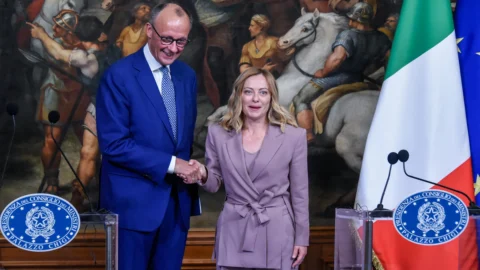
La cooperation between Italy and Germany, sanctioned in the recent meeting at Villa Madama between the Italian Prime Minister Giorgia Meloni.e. the German Chancellor Friedrich Merz and translated into a letter to the other EU leaders together with the Belgian Prime Minister De Wever in view of the top informal of today in Alden-Biesen, does not represent a threat to the European construction project but, if anything, an element to accelerate the completion of the internal market, simplify legislative procedures, reduce energy prices and implement a pragmatic trade policy. In short, the Italian Prime Minister denies the creation of a two-party directorate with Berlin that could replace the traditional Franco-German front-runner and whose main purpose is to exclude other member states and demolish the project of aFederal Europe, to the full advantage of an intergovernmental Europe.
Meloni relaunches the industrial axis as the EU balance changes
In support of these reassurances, which have all the flavour of a "excusatio not petita", Meloni lets the news leak from Palazzo Chigi that the 9 10 and April will be Tolosa for a top included in the Quirinal agreement, which provides for the signing of aagreement between Airbus, Thales and Leonardo to launch the Brando project to bring together the satellite activities of the three groups, in order to create a European champion capable of competing with major American and Chinese competitors.
The fact remains that the dynamics underway in relations between Rome and Berlin are changing the balance of power within the 27More information will be available today at the pre-summit initially announced by Meloni, Merz, and De Wever, which has now been joined by at least 15 other countries and which will precede the informal retreat at Alden-Biesen Castle in Flanders.
Although the summit does not include final conclusions (like those expected for the formal summit on March 19), according to some diplomats close to the preparatory dossier, "it should be of equal importance to that experienced for the transition to the single currency in the 1990s."
Competitiveness and the Single Market: The Draghi-Letta Plan to Restart Europe
The heads of state and government will first talk with the former prime minister and former president of the ECB Mario Draghi and then with the former prime minister Enrico Letta, which had already developed two reports on competitiveness and the internal market in the previous EU executive. The first challenge facing European institutions is to overcome low growth by exploiting the full potential of the large single market. It is then necessary to resist the strong pressure from the United States and ChinaIt's about going beyond simplification to save businesses a few hundred billion and overcome barriers to the internal market, for which national governments and parliaments are mostly responsible. Speaking yesterday at the European Parliament, the President of the Commission Ursula von der Leyen He said that “it is not only European-level regulations that need to be considered, but also national ones: there is too much regulatory overlap, there are additional layers of national legislation that further complicate the lives of businesses and create new barriers in the single market, so that different national practices exist in each Member State.”
Less bureaucracy, more Europe: tightening of costs and push to buy European
The President of the Commission, yesterday afternoon in Antwerp at the conference on European enterprises, reiterated her commitment to simplification, but lamented the slowness of the two co-legislators, the Council and the European Parliament, which approved only three of the ten omnibus measures proposed by the executive. A letter from Germany, Italy, and Belgium to the other leaders goes further, calling for the establishment of an "emergency brake," which should prevent excessive burdens from emerging during the legislative process, for example by intervening at the request of a member state.
As for the "buy European”, it is worth noting the position taken by nine hundred European companies and nearly 400 associations and unions from various sectors (energy, chemicals, steel, but not automotive) to defend the "European product" in public procurement. Governments are asked tobreaking down internal market barriers and integrating capital markets, a lever for attracting European capital. "Buy European" is one of the issues on the table today. Compared to Macron's interventionism, the German position is more moderate. According to Merz, it should be used "only for critical strategic sectors" of industry "and as a last resort." At least, that's what the German Chancellor said yesterday in Antwerp.