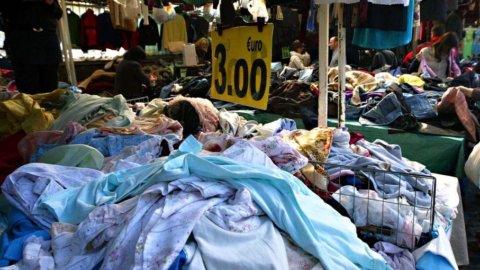
New fuss over another of Rome's main municipal utilities, theAMA, the company that deals with waste collection in the capital area. This time we are not talking about the old, but also current, problems of landfilling as much as the question of collection of used clothes through a network of almost 2000 yellow bins located throughout the city. The scandal, revealed by an investigation by Guarantor for Competition, is linked to the destination of the used clothes collected through the yellow bins since the clothes conferred by citizens at the collection points are not intended for needy people, as the writings would suggest, but for the increasingly expanding reuse market. For this reason, the Antitrust fined the Ama 100 thousand euros and other sanctions were imposed on the two consortia entrusted with the collection: another 100 thousand euros will have to be paid by Sol.co., 10 thousand for Bastiani.
In 2003 the AMA formally awarded the former Garment collection service to the ATI Roma Ambiente, made up of consortia Sol.Co and by the non-profit organization Bastiani. The Authority's report underlines how the assignment of the service "did not provide for any consideration for Ama, but only a minimum quantity that the Consortia undertook to collect, as the Company's objective was that a widespread collection be organized and full of such wastes.
In 2008 AMA separately entrusted Bastiani and Sol.Co with the garment collection service which continues today. But according to theCompetition and Market Authority the communication practices used by the consortia, which operate on behalf of Ama, to collect the clothes are deceptive. In fact, the Authority has assessed the existence of unfair business practices and hypothesized "the misleading nature of the main information vehicles used by the AMA and by the consortia assignees of the service to promote the differentiated collection of used clothing and accessories".
But what, specifically, is the point on which the Authority focused? What would be the deceptive practices?
Everything revolves around a subtle basic misunderstanding. Citizens place the clothes they no longer wear in the yellow bins, thinking of donating them to poor people while in reality, unknowingly they do nothing but feed the second-hand business. Statements such as "help us help", "materials in good condition will be recovered as clothing", "thank you for your help", affixed to the bins with stickers, would suggest that it is a collection for humanitarian and social purposes. But of solidarity, however, there is no trace.
According to the data provided to the Authority, about 100 tonnes of used clothes are collected in Italy every year almost 10 thousand tons are collected in the city of Rome alone. The material collected in the capital is sorted in storage centers and then transferred to treatment plants, where the garments are sorted and sanitized. For the Centre-South the sanitation plants are mainly in Campania while for the Centre-North they are in Prato in particular.
There are various final destinations for the garments collected in the yellow bins: 35% of the used clothes are destined for the trimming process and for the production of rags for the industrial sector, 60% of the garments are subjected to sanitizing washes and so the garments can be put on sale again. Finally, the remaining 5% is not reused and ends up in landfills. In all of this there is no trace of the word solidarityto. There is rather a considerable turnover for cooperatives and consortia that exploit the deceptive messages and the generosity of Romans and non-Romans to obtain excellent profits.
According to the data provided by one of the two consortia, Sol.co., the cooperatives that take care of the collection on behalf of the two consortia sell the clothes collected precisely to the same consortia around €0,35 per kilogram. Considering that in Rome an average of 10 tons are harvested a year, the total revenue of collection cooperatives is around 3,5 million euros a year. In turn, the consortia resell the newly purchased material to the Campania sanitization and selection plants at 0,40 – 0,55 €/kg.
In January 2014, a new tender for the collection of used clothing for a period of 36 months was once again won by Sol.Co and Bastiani and in this case Ama also started to obtain income by auctioning a figure of 30 euros per year for each yellow container, imagining a positive valorisation of the service assigned. In reality, the economic value of the yellow bins was much higher given that the four lots into which the service was divided were awarded at 462, 530, 483 and 550 euros per bin per year. This demonstrates that the generosity of the Romans is ultimately towards Ama and the cooperatives that deal with the clothing collection service. It is a pity that the citizens think they are helping those who are less fortunate.