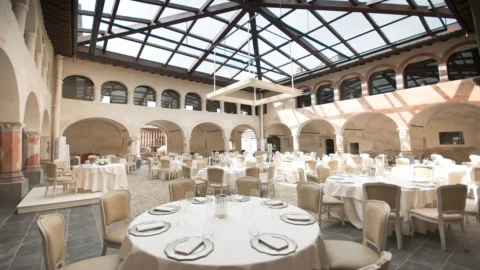

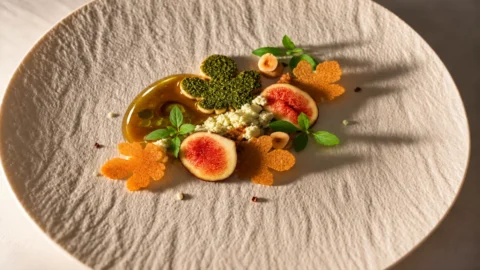
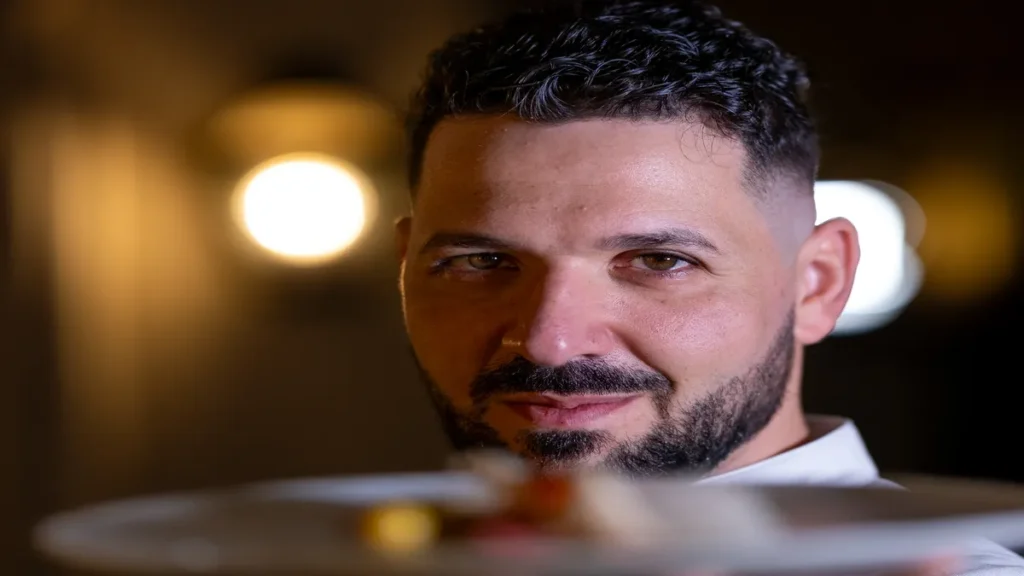
"Tra le Foglie" is the dish with which chef Francesco Nunziata, born in 1987, who took over the prestigious Re Santi e Leoni restaurant in Nola in March, bids a final farewell to the warmer months, ushering in autumn by bringing the restaurant's historic delicacies from the Nola countryside to the table. For the chef, it's a true tribute to his hometown, which he left for significant experiences at top-notch restaurants in London, then as sous chef at Heinz Beck's three-Michelin-star La Pergola, as executive chef for the Attimi format in Rome, as head chef at Café Les Paillotes in Pescara, and after four years in Tuscany at the restaurant of Castello di Fighine, a medieval village between the Val d'Orcia and Umbria, where he consistently held his Michelin star.
Upon returning home, Nunziata's first idea was to highlight two historic products of her region: the fig, a native fruit of the ancient Nola area, and the Vesuvian hazelnut, in a creation that recalls the typical foliage of the season. For Francesco Nunziata, territory and cuisine form an essential equation for the essence of his gastronomic identity, which began to form primarily in the Nola plain. Over the centuries, this plain has produced a mosaic of unique flavors, composed of a mix of rural traditions, external influences, and cultural disparities. These have integrated over time, based, of course, on two fundamental and unique contributions: the composition of the mineral-rich volcanic soil and the unique microclimate, two elements that constitute the true richness of this land. It has been said that traditional dishes born out of peasant necessity or the adaptation to limited resources become true cultural assets. This is precisely why, for some time now, having moved beyond the stage of sophisticated elaborations, haute cuisine has been rediscovering local cuisine as a profound cultural root. Focusing on the values of one's own land allows for authentic culinary culture, offering an experience that goes far beyond the consumption of a meal.
"In the Bronze Age village of Nola-Croce del Papa, charred fragments of fig wood were found," the chef emphasizes, "signifying a plant that, almost four thousand years ago, was already part of the Nola landscape. Later, in the Agro Nolano countryside, tradition preserved the memory of the San Paolino fig, which ripens in late June, the same period Nola celebrates its saint."
Today, the San Paolino fig is considered a cultivar at risk of extinction. Due to the dynamics of the modern fruit and vegetable market, its intensive cultivation has gradually disappeared. However, it survives thanks to the care of a few local farmers and the presence of isolated centuries-old trees in the Nola countryside, consumed almost exclusively by families to preserve its flavor and age-old tradition. The name of this fig is inextricably linked to San Paolino di Nola, the city's patron saint. Its ripening coincides with June 22nd, the day of the famous Festa dei Gigli (Lilies Festival) of Nola, a UNESCO World Heritage Site. These wooden tower-shaped constructions, 25 meters high and weighing over 25 quintals, are carried on the shoulders of 128 "cullatori" (throwers), who are made to dance to music throughout the city from morning until late at night.
Along with the San Paolino fig, the "Tra le foglie" dish also features the Vesuvian hazelnut, a product with ancient traditions, available in Lunga Napoli, Tonda Vesuviana, Mortarella, Camponica, and San Giovanni varieties. Specifically, the Visciano hazelnut was the first product to officially enter the Campania Region's Regional Register of Municipal Designations of Origin (De.CO). It is not just an agricultural product, but an essential part of the town's history and hilly landscape. For generations, its cultivation has represented a legacy of knowledge and traditions that mark the rhythms of rural life. Since September 2025, "The cultivation of the Marzano di Nola hazelnut" has been included in the Campania Inventory of Intangible Cultural Heritage (IPIC): the Region has recognized not only the fruit, but all the knowledge that revolves around it, from harvesting with nets spread under the trees to drying it.
But "Tra le foglie" (Between the Leaves) is a dish that, in the chef's vision, has not only a taste and aesthetic value, but also interesting nutritional aspects: "We process figs and their leaves," explains Nunziata, "also for their properties: they help control blood sugar, contribute to lowering triglycerides and bad cholesterol, and aid digestion by soothing the stomach. The foie gras takes the form of a fig leaf, dusted with the same leaf powder." Hazelnuts also have important nutritional properties, as the Humanitas food website notes: "The beneficial properties of hazelnuts have been analyzed in studies that have associated them with cardiovascular benefits, particularly the reduction of total and bad cholesterol and the increase of good cholesterol and triglycerides." Furthermore, not everyone knows that hazelnut leaves can also be used for medicinal purposes; their supposed vasoconstrictor properties have led to their use to relieve the symptoms of hemorrhoids and varicose veins. Both the leaves and the seeds have been associated with antioxidant properties. Finally, the kernel has been attributed with anti-inflammatory properties.
The foundation of this dish is the refined touch of creamy foie gras, with a lightly smoked hazelnut cream and caramelized hazelnut. "The toasted and smoked hazelnut recalls the harvest season, when the hazelnut leaves are burned," explains Francesco Nunziata. "Then we also have a chopped fig, seasoned with its vinegar, pure fig segments, and fig sauce. Fig leaf oil and oxidized fig leaf sauce complete the dish with the vegetal and bitter notes of the hazelnut, contrasting with the sweetness of the fruit. "We also process the fig and its leaves for their properties: they help control blood sugar, contribute to lowering triglycerides and bad cholesterol, and aid digestion by soothing the stomach. The foie gras takes on the appearance of the fig leaf, dusted with fig powder."
The recipe from Among the Leaves
Method
Clean the foie gras, removing any veins or impurities, keeping the lobes intact. Bring to room temperature for 20–30 minutes. Mix salt, sugar, and pepper and season the foie gras. Add Cognac and Port, cover, and marinate in the refrigerator for 8–12 hours. Wrap in a double layer of cling film, forming a regular cylinder. Press out any air, close the ends, and wrap in clean cheesecloth, tying with kitchen string. Cook in a roner at 65°C until the core reaches a temperature of 50–52°C. Cool immediately in ice water and store at approximately 4°C for at least 12 hours. 2.
For the creamy foie gras Ingredients: 200 g foie gras, 50 g cream, 30 g milk, 5 g gelatin
MethodSoak the gelatin in cold water. Combine the foie gras, cream, and milk and heat until combined. Add the squeezed gelatin and dissolve. Blend until smooth. Pour into molds, chill, and refrigerate.
For Pacojet hazelnut cream IngredientsToasted hazelnuts, salt, pepper
Method Toast the hazelnuts in the oven and let them cool. Blend until smooth. Pour into Pacojet containers and freeze. Pacojet until desired consistency is achieved and season with salt and pepper.
Fresh fig puree IngredientsFresh figs
Procedure: Wash and clean the figs, using the pulp. Finely chop with a knife and pat dry with paper towels. Form small quenelles just before serving.
Toasted hazelnuts Method Toast the hazelnuts in the oven, let them cool, and then halve them. Store in an airtight, dry container.
Caramelized hazelnuts Ingredients: 50 g sugar, 12 g water, 35 g hazelnuts in half
Procedure: Bring the water and sugar to a boil. Add the hazelnuts and cook until completely caramelized. Spread out on a nonstick mat or parchment paper and let cool. Store in a dry place.
Fig oil Ingredients: 200 g fig oil, 500 g seed oil
MethodPlace the two oils in the Thermomix and blend until smooth. Transfer to a saucepan and heat to evaporate the remaining water. Transfer to a piping bag and let it decant, separating the watery portion from the oily portion. Recover the oily portion and use it for subsequent preparations.
Maltosec Fig Powder Ingredienti, 100 g Maltosec, 50 g fig oil
Procedure: Place the Maltosec in the Thermomix and gradually add the fig oil. Blend until you obtain a dry, smooth powder. Sift and store in an airtight container.
Fig Leaf Sauce Ingredients: Fig leaves, Water, Fig vinegar, Salt, Oil, Pepper, Star anise, Honey, Orange peel, Cinnamon
Procedure: Wash the fig leaves and use an equal weight of leaves and water. Bake at low temperature for about 6 hours. Strain and season with fig vinegar, salt, oil, pepper, and honey. Add star anise, orange zest, and cinnamon and let it infuse. Strain again before serving and refrigerate.
Fresh fig
Method Gently wash the figs and cut them into evenly sized wedges. Refrigerate until ready to serve.
Walnut jelly Ingredients: 32 g Nocillo, 30 g water, 5 g gelatin
Method Soak the gelatin in cold water. Heat a portion of the water, add the squeezed gelatin, and dissolve over low heat. Add the Nocillo and the remaining water and mix. Pour into a mold and let cool until completely gelled. Cut into small, even cubes.
Brioche Bread Service: a slice of toasted brioche bread, served warm, on the side of the plate.
Yeast Ingredients, 200 g milk, 200 g panettone flour, 80 g yeast, 80 g sugar Dough Ingredients, 192 g egg yolks + 2 eggs, 800 g panettone flour, 200 g butter cubes, 150 g milk, 40 g sugar, 20 g salt
Method Prepare the starter by mixing the milk, flour, yeast, and sugar. Let it rest for about 15 minutes. Transfer to a stand mixer and add the flour, milk, sugar, and salt. Mix until smooth. Gradually add the egg yolks and eggs, allowing them to absorb completely before adding the next batch. Gradually add the diced butter, waiting until fully absorbed. Let it rise until doubled in size. Unmold the dough and divide it into small loaves. Place them in previously greased molds and let them rise again for about 30 minutes. Bake at 180°C, 10% humidity, for about 25 minutes. Let it cool, cut into slices, and toast just before serving. Serve warm on the side.
Composition
1. Arrange the previously chilled Foie Gras Cream. 2. Add the Pacojet hazelnut cream spikes. 3. Arrange small quenelles of fresh fig puree. 4. Add the fresh fig segments. 5. Finish with toasted hazelnuts and caramelized hazelnuts. 6. Add the Maltosec fig powder. 7. Arrange 4 cubes of Nocillo jelly. 8. Finish with the fig leaf sauce and a few drops of fig oil. 9. Add the foie gras twist. 10. Serve a slice of warm, toasted brioche bread on the side.
ReSantieLeoni
Via Anfiteatro Laterzio 92
80035 Nola (NA)
+39 081 2781526
ReSantieLeoni
Via Anfiteatro Laterzio 92
80035 Nola (NA)
+39 081 2781526