Among proposals in circulation, in terms of pensions, in view of the budget session, there is also the possibility of use the TFR for the purpose of purchasing the right to early retirement at age 64, an age that today seems to represent the new "Piave line" of the League of struggle and government. The idea has raised (it goes without saying) the protests by the political and trade union opposition, which instead looks with interest and complicity at the other proposal that has emerged in the debate: the suspension, starting in 2027, of the mechanism that semi-automatically links retirement requirements to the increase in life expectancy for a maximum of three months every two years (because a regulatory procedure is still required).
At the same time proposals are circulating which aim to strengthen the use of the TFR as main source of financing for supplementary pensions (The conference “Proposals for the Development of Pension Funds” will be held in Rome on September 16, at the initiative of the authoritative Centro Studi di Itinerari Previdenziali).
Observing the new functions that would be attributed As for the severance pay (TFR), the doubt arises that the debate has not adequately addressed the situation of this remuneration institution following the 2007 reform, which linked it specifically to membership in a supplementary pension scheme and its financing.
The workers' choice
The law provides for the opportunities for employees to choose whether to leave the TFR accruing in the company or transfer it to a form of private pension (negotiated or open fund, individual policy), with the aim of supplementing the public pension.
In the event of failure to make an explicit choice by the worker within six months of being hired, the redundancy mechanism is triggered. so-called "silence-assent".
Then:
- The TFR is automatically transferred to a collective pension plan established by collective agreements or contracts (national or company-level).
- If there are multiple possible funds, the one with the highest number of subscriptions among the company's employees is chosen.
- If none of these conditions are met, the TFR is transferred to a residual form of supplementary pension provision (previously held by INPS in the fund called Fondinps, later replaced by the Cometa fund).
During these six months, the employer is required to provide the employee with clear information on the available options and, 30 days before expiration, must remind him where the severance pay will be sent if he fails to choose.
When workers decide to set aside their severance pay within the company, if the company has 50 or more employees, it is required to transfer the accrued severance pay portions to INPS, which deposits them into the State Treasury account. The result is that a significant amount of resources ends up financing current public spending.
The rationale behind the reform
La ratio then proclaimed of this rule was that of prevent employers from pressuring workers to leave their severance pay in the company; in fact, with this rule, a company with more than 50 employees (smaller ones are protected) is indifferent to the worker's choice because in any case it loses the liquidity represented by the severance pay.
The other reason, perhaps more importantly, was to bring about a small benefit to public financesThis is where the reform's flaw lies, in that this portion reserved for the Treasury Fund changes its nature: it is no longer financed through individual capitalization, but moves to a pay-as-you-go system; that is, the Fund collects the severance pay accruals, administers them as current expenditure, and pays the related benefit upon maturity, using the balance between income and expenditure.
In practice, applying the principle of distribution means that the severance pay paid to INPS is considered a mandatory first-pillar pension contribution.
The Galli-Geraci study
In this regard we would like to point out one study by Giampaolo Galli and Nicolò Geraci by Title “What happens to the severance pay donated to the INPS fund?” in which the problems are highlighted and the first 25 years of the Fund itself are described.
First of all, this accounting treatment – the authors underline – has two important consequences. The first The problem is that workers cannot request that their previous severance pay (i.e., paid to INPS in previous years) be transferred to a supplementary pension plan because it has been used. From a public accounting perspective, this would be like requesting a tax refund. The other consequence It is no longer possible to launch a public campaign (repeatedly requested, but in vain) for membership of supplementary pension schemes using the tacit consent method because this would require finding adequate coverage for the INPS's lost income from accruing severance pay.
Since the severance pay (TFR) paid to INPS each year is around 6 billion euros, if even just 10% of workers in companies with more than 50 employees joined supplementary pension funds, coverage would be found for around 600 million. In essence, the government would become a party to the dispute and would be interested in the failure of private pension provision.
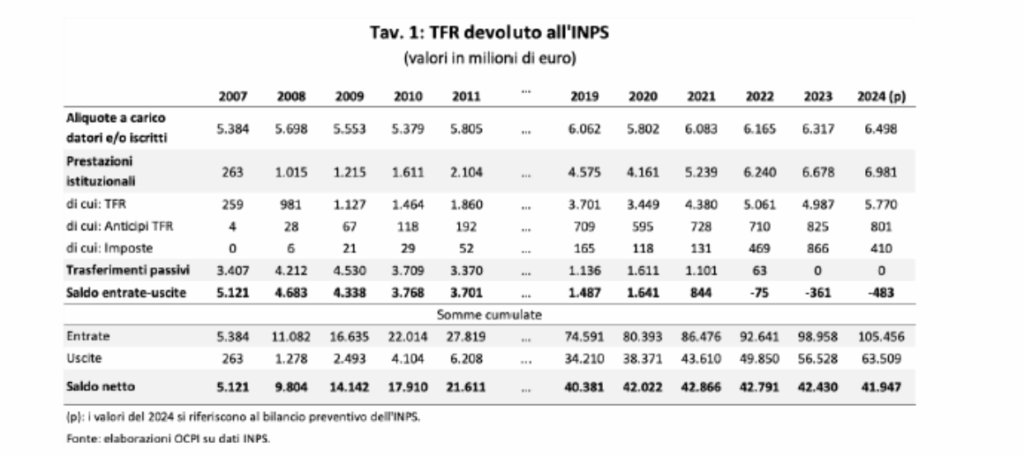
In the study, the 1 table illustrates the severance pay flows paid to INPS and the related benefits. These figures, we recall, refer exclusively to the severance pay of workers at companies with more than 50 employees who have explicitly opted to keep their severance pay in-house.
The criticality of the pay-as-you-go system
At this point comes another critical issue comes to light which is usually not explained and which comes from the change of nature to capitalization for adopt a pay-as-you-go mechanism.
In the first system, the amount is paid to a specific individual, who collects it; in the second, the benefit becomes depersonalized, so the balance of income minus expenses (the latter to pay severance pay to those entitled to it) could find itself in a situation where the number of new inflows is insufficient to cover the benefits of members from previous years.
In fact, while in the early years the balance was very positive because there was a strong income, but expenditure was not yet fully operational, over the years the balance of income minus expenditure has decreased and is now negative.
This is the case of pensions: you start with many active workers and few retirees and you have significant positive budget balances that allow for reckless operations and promises to favor current generations, then you end up dealing with a situation that is reversed: those who pay are fewer than those who collect.
The INPS Fund numbers
Le fund income in question they have always remained between 5 and 6 billion euros, while the exits have risen from a few hundred million in the first year to nearly 7 billion in recent years. last three rows of table 2 – the authors note – the cumulative sums of income, expenditure, and balance are considered. Overall, between 2007 and 2024, over €100 billion flowed into INPS.
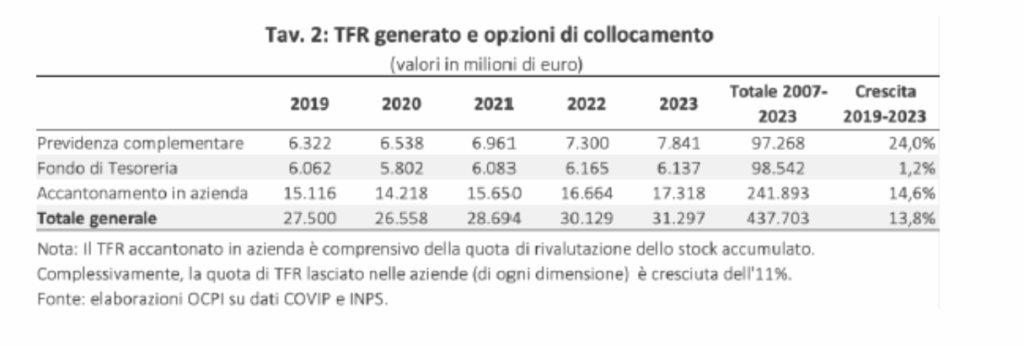
Le performance were equal to just over 60 billion, so the balance is around 40 billion. This is the amount of debt that the state has accumulated towards workers. Adopting a more convincing accounting principle—the essay states—this amount should appear on the state's liabilities as a component of public debt, no more and no less than a BTP. The fact is that these resources exist neither on the liabilities nor on the assets of the state nor of INPS because they have been entirely spent. When the severance pay remains with the company, it is accounted for as a debt and as such is recorded on the liabilities side of the balance sheet. When paid to INPS, it takes on the character of a budget revenue that serves to cover, not finance, the deficit.
In recent years the The annual TFR maturing was worth around 30 billion, the majority of which (17,3 billion in 2023) was set aside within the company. Since, by law, nothing is left in companies with more than 50 employees, this 17,3 billion concerns only smaller companies. This highlights the unequal treatment between larger and smaller companies, with the latter having been able to retain significant resources in recent years. Saving within the company remains the preferred option for employees (approximately 77% of the accumulated stock since 2007).
Evaluations on the proposals
What conclusions can be drawn from the considerations illustrated with reference to the proposals put forward? Let's start with the suggestion to transfer the severance pay to the paycheck as an additional salary. Assuming this hypothesis can take off (previous attempts have been unsuccessful), what about the small businesses that are at risk of losing 17 billion euros, now placed in their balance sheets by specific choice of employees? Let's move on to Claudio Durigon's proposal. TFR allocated to reduce the retirement age, in companies with more than 50 employees, would be subtracted from the Treasury Fund, so adequate coverage would be necessary, but since the number of potential participants is uncertain, it would be necessary to adopt the accounting method of establishing a ceiling by indicating the priority criteria of the potential interested parties. The only viable path was proposed at the time by the late Stephen Patriarch, based on an intuition that took into account the logic of the RITA: a worker enrolled in a pension fund or another scheme, approaching mandatory retirement and the payment of their private benefits, rather than collecting an annuity or lump sum, might prefer to convert the capital into an early retirement payment. This would avoid interfering with the paths chosen years earlier, and the solution could also, by providing an additional opportunity, make joining a private pension scheme more attractive.