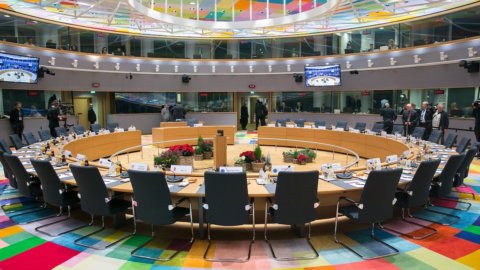
Gas, oil, wheat, security and defence: these are the topics on the table Extraordinary European Council. Two days in which the Ventisetti are called to decide on the sixth package of sanctions against Russia blocked for weeks due to the lack of agreement on the Russian oil embargo. According to some diplomatic sources there would be an opening on the ceiling on the price of gas, so dear to the Italian premier Mario Draghi (who will have a meeting with Macron and Scholz before the European summit), and toRussian oil embargo even if it's too early to sing victory. Also central is the issue of ships loaded with grain that must be unblocked to avert an unprecedented food crisis. Something is moving, in terms of declarations, but we still need to see what the Twenty-seven will decide and if they will follow up on what was achieved during the meeting of EU ambassadors.
In any case, the sixth sanctions package will be formally finalized after the European summit, presumably at a new meeting of representatives of the Twenty-seven. The package confirmed the restrictive measures against further Russian personalities and the exclusion from the Swift system of other Moscow financial institutions, such as Sberbank, and a broadcast ban on three broadcasters controlled by the Kremlin, so far excluded. But let's see what's cooking.
The European gas price ceiling
One point in Italy's favor in its battle to introduce a ceiling on the price of gas at an international level. Rome has obtained an opening on the subject after the months-long opposition from the Nordic countries, Germany and the Netherlands in the first place, always said to be absolutely opposed to a measure of this type.
The conclusions of the extraordinary European summit state that “the European Council invites the Commission to explore with international partners ways to curb the rise in energy prices, including the feasibility of introducing temporary price ceilings”. Furthermore, the executive is invited to "proceed rapidly with the work for optimizing the functioning of the European electricity market in order to resist future price volatility". This because the price of electricity it is determined on the basis of the most expensive energy source, currently gas, without taking into account the different sources and different prices.
However, as specified by the Commissioner for the Economy, Paolo Gentiloni, no decisions will be taken during the European summit on the possible ceiling on the price of gas, but it could be decided to give a mandate to the EU Commission "to analyze the possibility of doing so" in order to control bill prices.
Embargo on Russian oil: two phases are expected
There would seem to be a first compromise on the embargo on Russian oil imports: it starts from an agreement reached by the ambassadors which should provide for a waiver starting from 2023 of Russian methane that arrives from the sea (over two thirds of total imports), but also on this, according to diplomatic sources, a progressive and not immediate introduction is expected, to be concluded within the year. Instead, the main oil pipeline linking Russia with the heart of Europe would remain in operation. Druzhba (known as the “friendship pipeline”), in order to cater for some countries dependent on Russian fossil fuels.
However, this is unlikely to be a major blow to the Russian economy and certainly would not persuade it to stop the war. However, it would be the first step to unblock the sanctions package that has been on the sidelines for a month. At the base is the veto of Hungary that it has no intention of giving up Russian oil because it would be devastating for its economy. But also other countries, such as Republic czech, Croatia e Slovakia, are worried by the Russian oil embargo, as they have no access to the sea and would be difficult for them to replace. However, an explicit derogation is looming for these countries, while there should be a "political commitment" by Germany and Poland to progressively stop the use of Russian oil via pipeline to maintain fair supply conditions (and prices) in the EU.
The Ukrainian grain crisis
A delicate issue because it would also involve Moscow, but in exchange it wants a relaxation of the sanctions. There are 20 million tons of Ukrainian grain stuck in Ukrainian warehouses mostly which are in Odessa. Ships cannot travel the Black Sea because it is mined and patrolled by Russian ships. The EU is trying to unblock the situation with active measures to facilitate Ukraine's agricultural exports by land, but it will be much more complicated.