
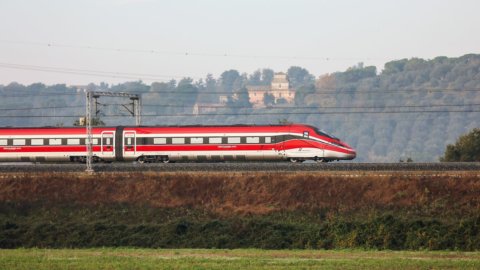
The works had been announced, but this will not make the inconvenience any less severe. From Saturday 11th to Sunday 12th April, with repercussions also on the morning of Monday 13th, one of the most important railway corridors in the country, the Rome-Florence high-speed line, will be affected by a scheduled suspension to allow for a technological upgrade deemed crucial by Rete Ferroviaria Italiana.
At the heart of the intervention is the activation of the Ertms, the European rail traffic management and control system, designed to make traffic more efficient, regular and reliable. In the short term, however, the bill will be a weekend of severe restrictions, diversions and travel times considerably longer.
Rome-Florence High-Speed Train: Where and When the Stop Will Take Place
The intervention focuses in particular on the Orvieto-Settebagni stretch, last segment of the Rome-Florence high-speed line to be equipped with new technologyThe suspension will start at midnight on Saturday 11 April and end at 15pm on Sunday 12 April on the high-speed line between Rovezzano and Settebagni. In parallel, the The conventional Rome-Florence line will be interrupted between Orte and Rome Tiburtina. from 14pm on Saturday until the early hours of Sunday.
It's this one double interruption, on both the high-speed and conventional lines, explaining the extent of the disruption. During the technical work window, trains will not be able to regularly use either the high-speed or conventional lines on the affected section, with inevitable repercussions on rail travel between Central and Northern Italy. The reopening will gradually begin on the afternoon of Sunday, April 12th, but a full return to normal service is not expected until Tuesday, April 14th.
Rome-Florence High-Speed Rail Stoppage: What's New for Travelers?
Passengers are facing a significant reorganisation of the offer.On Saturday, high-speed trains between Florence and Rome will be able to use the conventional line only until 14 pm. After that time, trains heading south will be diverted onto the Tyrrhenian route, a solution that will also be adopted in the opposite direction for trains departing from Rome to Florence.
The consequences will be fewer connections available, modified routes andsignificantly longer travel timesThe repercussions on long-distance routes will be evident: for connections such as Milan-Rome could be reached in about six hours of travel, almost double the usual high-speed times.
Even after the gradual reactivation on Sunday afternoon, some journeys will continue to experience extended travel times, while on the morning of Monday, April 13, critical situations will remain, especially on the stretch between Orvieto Sud and Settebagni.
Why everything stops: what is the ERTMS and why is it crucial?
The suspension does not arise from an emergency, but from a long-planned intervention to complete a technological transition considered strategic. At the heart of the work is in fact the activation of theErtms, the European Rail Traffic Management System, the European system for the supervision and control of train traffic, considered today one of the most advanced tools for rail traffic management.
The Ertms digitizes signalling and allows for a continuous exchange of information between the infrastructure and the train, with data arriving directly in the cabin. From an operational point of view, this translates into a more precise management of speed and distances, in greater regularity of traffic and in a better ability to limit the knock-on effect of delays. On a high-traffic line like the Rome-Florence, the goal is to make operations more stable and the entire route more reliable. And this is why the work involves a temporary discomfort, considering the price to pay to obtain a structural improvement of the network.
The intervention on the Rome-Florence line is part of a broader program of technological and infrastructural enhancement carried out by RFI, a company of the FS group. The overall investment for this operation is approximately 147 million euro, also supported with PNRR resourcesAccording to the overall plan, the planned investments amount to approximately 18 billion euros across 16.800 kilometers of network, while a significant portion of the program funded by the PNRR aims to equip approximately 2.800 kilometers by June 2026.
Expected benefits in the medium term
According to RFI, the block concentration in a single weekend will allow you to speed up the most complex processes, with an estimated savings of over 30% compared to interventions carried out during standard times. In the short term, however, the burden of the operation will fall on travelers.
Trenitalia and Italo have already updated sales channels, making tickets available with the new travel times, while in the stations involved it will be passenger assistance improvedDuring the works, regional connections in Lazio will remain guaranteed, particularly those to the Fiera di Roma, where the Romics festival is taking place until April 12.
The weekend shutdown, in short, isn't a hiccup, but rather the price already factored into a network aiming to become more digital, more European, and, hopefully, more reliable. Meanwhile, travelers can only count on a few extra hours and arm themselves with patience.