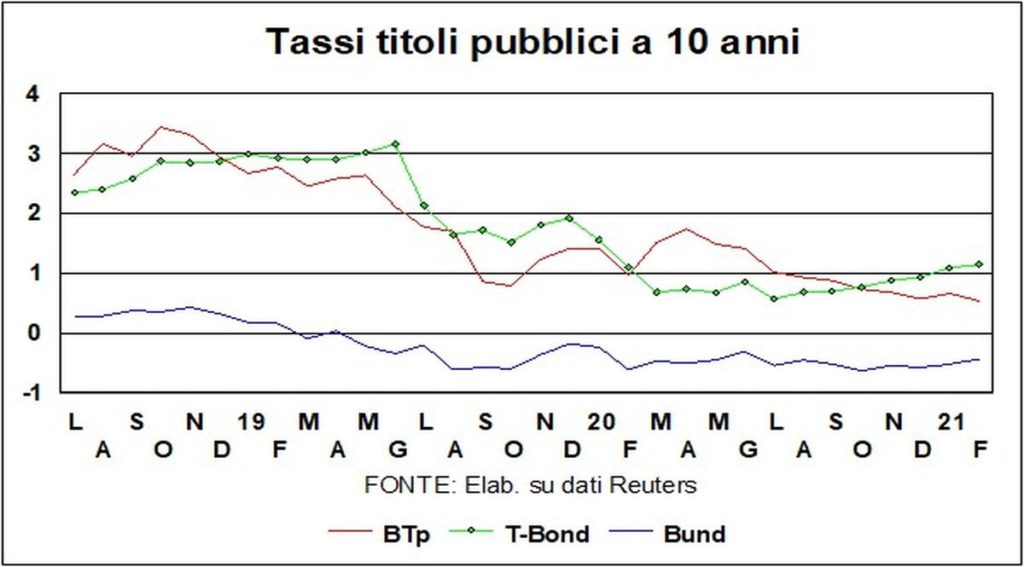
La rise in yields on T-bonds at 10 years more than 1% is confirmed and it could go on: just think that on February 5 of a year ago, when there were only 19 known cases of Covid-11 in all of America, against 27,5 million now, T-Bonds yielded 1,65, XNUMX%. Since then the stock market has risen but i T Bonds, whose yields had fallen to incredibly low levels, the lowest in American history (0,60%), have not returned to their pre-pandemic level (and there is an obvious relationship between high equity multiples and low cost of money), despite on need for Treasury funding weigh the huge deficits incurred in supporting the economy.
Funding that certainly shows no signs of slowing down, given that the Biden Administration pushes the accelerator of expenses transfer and infrastructure. But the support for these loans comes directly from Fed which, meritoriously, is no less than the ECB in playing the role of lender of first and last resort. The 'hawks', worried about the accumulation of public debt, are, of course, also in America, but more so in Congress (among the Republicans, of course) than to the Treasury, where Janet Yellen he blatantly declared that now is not the time to worry about deficits. Well done Janet!
The shrugs to the (public) accounts in red are now generalized. We have arrived, in Australia, to a Governor of the Reserve Bank who scolds the Government for wanting to bring unemployment benefits previously raised due to the pandemic back to normal levels: no, says Philip Lowe, you have to keep them high to help the poor unemployed. The world upside down, well…
When Mario Draghi had been chosen as President of the ECB, also the German tabloid BILD he had convinced himself of his Teutonic rigor, and had given him a gift of a Prussian helmet.
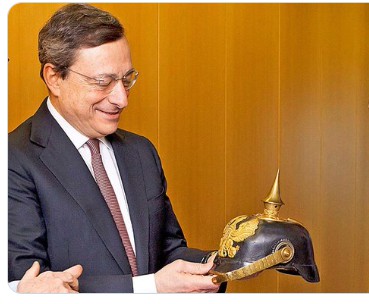
Then he turned it back, when Draghi was accused of damaging German savers with zero interest rates, but Draghi replied with a German saying: "a gift is a gift", and kept it. And today ours too shrugs off the deficits and worries – rightly – more about the quality of spending (here is his now famous distinction between good debt e bad debt) than quantity. Along the line traced by another great Italian, Carlo Azeglio Ciampi.
His simple job has already given a boost to the financial markets, by raising both the stock market prices and those of the BTPs. There's a good chance it will spread you keep going down, after having missed 100 points, taking us back to the happy times (so to speak) of 2010.
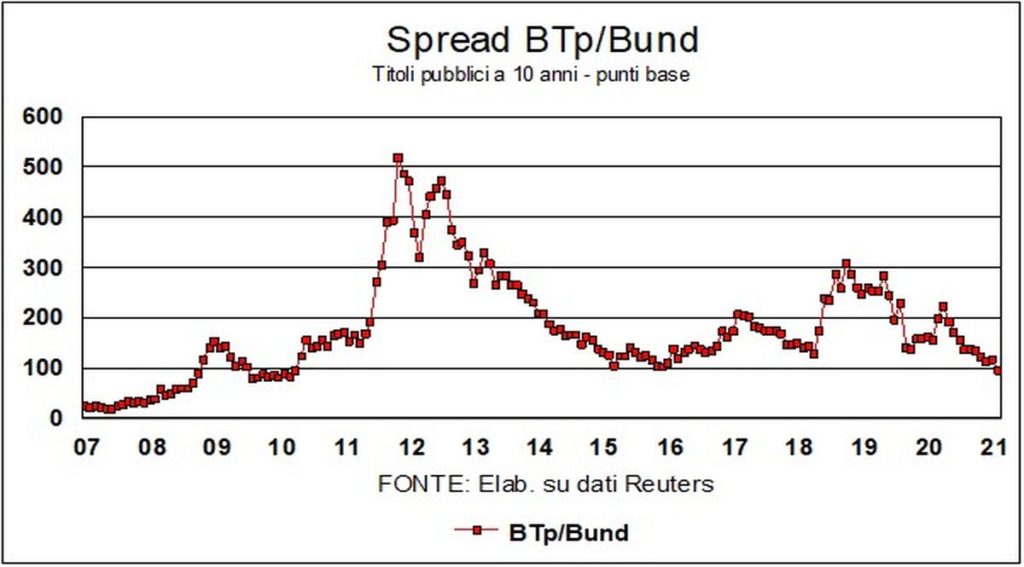
Meanwhile, the yields of Waist are slightly rising (even here so to speak, given that they are only a little less negative). Again, the economy helps, with a German GDP which managed to grow even in the last fourth quarter of 2020, when the Euro-area as a whole returned to recession.
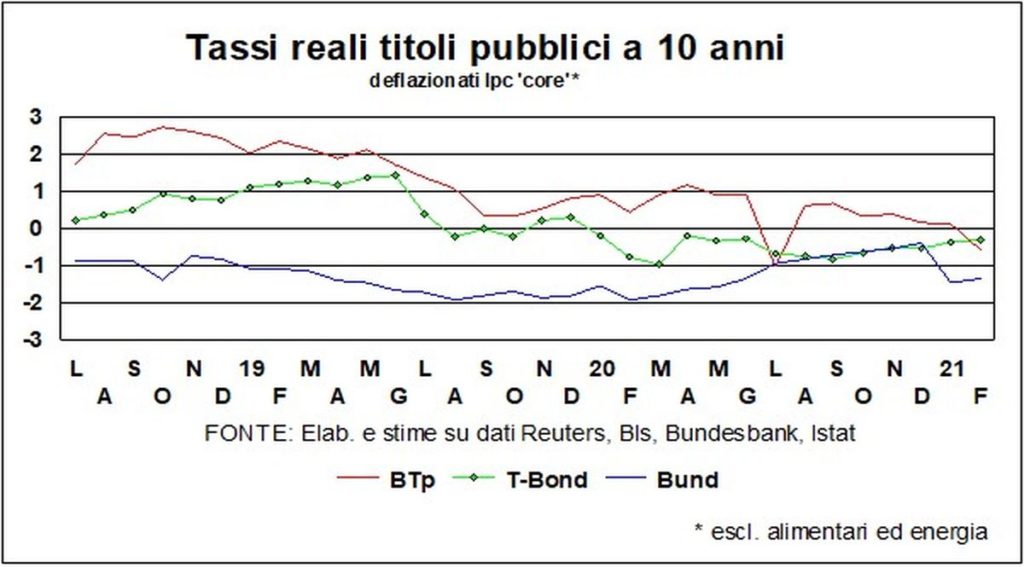
I real rates have seen a sharp drop in Europe and Italy, but only, as explained in the chapter on inflation, due to a change in the baskets for calculating consumer prices. Then the Germany he did his part, with a return of the VAT to the levels before the lowering in an anti-recession function. A tax increase, in short, which has the flavor of a first taste of a perhaps premature restriction. This higher inflation, which lowers real interest rates, will probably continue for the remaining months of the year, until the base effect kicks in next January. However, whether you look at observed or non-one-off inflation, real rates are low and, most importantly, of recovery comfort, both in Europe and America.
For the you change, the novelty lies in the return of the dollar rise, which fluctuates around 1,20, after having touched 1,23 against the euro at the beginning of the year. The one we had called, in the past Lancet, the political shame (assault on Congress) that had rumpled the greenback's reputation, was soon washed out with the inauguration ceremony – solemn and at times moving – of the new President. Within days we have seen the worst of America and the best of America.
But it wasn't just the renewed prestige that helped the dollar. There is also the growing evidence of the underlying strength of the US economy. One might have thought that the huge support in anti-virus function had mostly shored up i consumption. But the fourth-quarter data, released at the end of January, also show a clear recovery in the productive investments (this was also discussed and commented on in the past Lancet), and especially those for homes. The long-term real rate differential, which also, with the increase of 100 basis points, is in favor of dollar, is probably not a factor in this case, as it is related to the temporary lowering of real rates on Bunds (but the same would be true for a "synthetic Bund" of the Eurozone, which takes into account all 10-year yields) which was mentioned above.
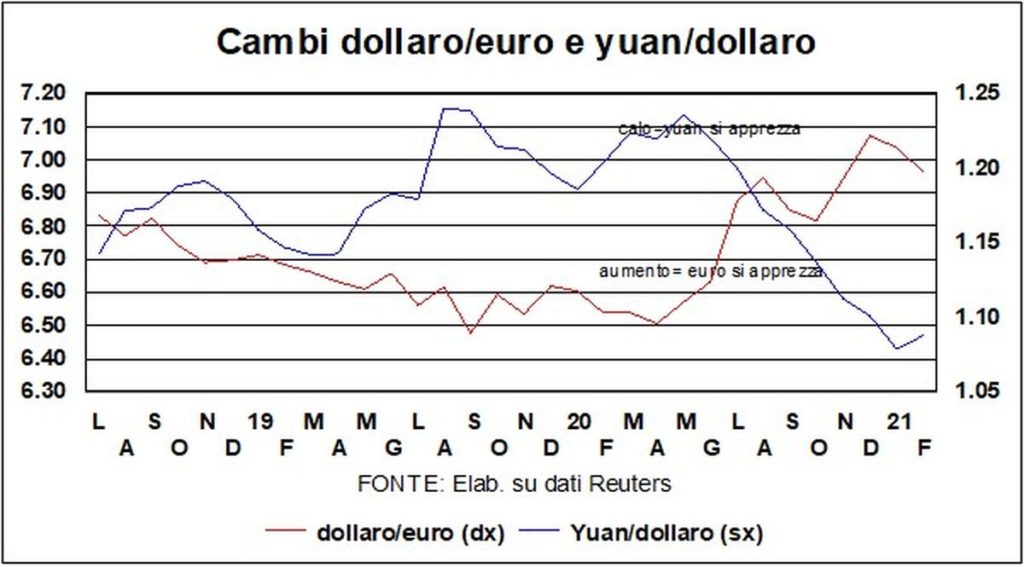
The strength of the dollar is weakness of the euro. The euro did he put his own? One might think so, given that concern has been expressed on the upper floors of the Eurotower for a exchange too appreciated, which would have favored those tendencies towards the deflation, who are (rightly) the new bogeyman of central bankers. Above all, it was the slower progress of the administration of vaccines that hinders the recovery that penalized the single currency. There chinese coin, on the other hand, hasn't moved much. It was also affected by the autonomous strength of the dollar, but much less than the euro: compared to the respective highs in January, the euro fell by around 3%, and the yuan of less than 1%.
The trend of stock markets it is much more reassuring than that of a roller coaster. The climb, for a year now, has been continuous, with just a few stops to catch your breath. And now, with the pace of vaccinations and world growth propped up by the native drive of China and the US, the perspectives I am for further advancement. Or not?
In hindsight – as we have already said – there was method in the madness of the Borse that ignored overcrowded hospitals and crowded cemeteries. But est modus in rebus, and it's possible the ride was too quick and the markets are ripe for one correction. Never 'fundamental' continue, for those interested in investments other than 'touch and run', to be favorable to investing in equity securities.
In any case, the Bags add another piece to the recovery: I'm not just a mirror of the strength of the economy, but they are also an actor: an increase in quotations lowers the cost of equity capital, and therefore favors, together with low real rates, the cost of capital tout court.