The exhibition AGNETTI. One hundred years from now, promoted and produced by Comune di Milano-Cultura, Royal Palace and Archivio Vincenzo Agnetti, curated by Marco Meneguzzo together with the Vincenzo Agnetti Archive, invites us, through a critical and "sentimental" analysis, to rediscover the artistic universe of Vincenzo Agnetti, grasping his originality, critical rigour, poetics and the extraordinary contemporaneity.
More than one hundred works are exhibited, created between 1967 and 1981, which together give a clear image of the artist's path: his poetic and visionary tension, his marked interest in the analysis of creative processes and in art as a statute, his role as a linguistic investigator and subverter of the mechanisms of power, including those of the written word, said, translated into clear and evocative images, because for Agnetti everything is language: “Images and words are part of a single thought. Sometimes the pause, the punctuation is created by the images and sometimes it is the writing itself".
The word in all his works is therefore not limited to semiological relationships, as often happens in the conceptual art of those years, rather he creates images, suggests investigations, builds narratives. Agnetti uses the visual and conceptual paradox to create interpretative short circuits ready to be elaborated and revisited by the observer, entrusting the development and meaning of what he has written and imagined to the thought of the viewer. It has always been important to him that the visitor continues to see the exhibition, in his mind's eye, even after leaving the gallery.
"With this appointment we will rediscover one of the greatest conceptual artists – says Marco Meneguzzo – His conceptualism is different from the Anglo-Saxon, American, and also from the European one; that of Vincenzo Agnetti has a metaphysical and literary aspect, full of our culture, I would say Mediterranean, if today this adjective did not appear reductive".
Agnetti's artistic parable was short, he died at the age of only 54 in 1981, but so intense and tumultuous as to make it difficult to keep track of him in a complete way. For this reason, perhaps, he is actually still little known and therefore to be rediscovered in his multifaceted complexity; the AGNETTI exhibition. A hundred years from now he's going in this direction.
The exhibition traces Agnetti's mental path, not always relying on chronology but favoring the logical thread of the artistic discourse which imposes associations and leaps between different periods to lead the visitor through the folds of the creative process.
The most well-known works could not be missing from the exhibition:
-When I saw myself, his Self-Portrait wasn't there: gray felt engraved and colored in the company of other felt, Portraits and Landscapes.
-The Axioms: black bakelites engraved with white nitro color which, through paradoxes, tautologies, illuminating syntheses of thought, are the analytical counterpoint of his production.
-The Book forgotten in Memory, the work that best summarizes his research on memory and forgetfulness.
-La Macchina Drogata, the Olivetti Divisumma 14 calculator whose numbers have been replaced with as many letters of the alphabet, following each consonant with a vowel so that all the words obtained randomly from the operations, even if they have no logical sense, were however intonation support, From a simple calculator unable to perform its function becomes a producer of works of art with a strong pictorial and iconic impact. And next to the drugged machine we find in fact a part of her production: semiosis, comets, fades and the beautiful installation of the Apocalypse.
Among the exhibited works it will be possible to admire the room dedicated to the Political Hamlet: 60 flags of all the nations of the world that surround the stage from which Agnetti's Hamlet addresses the crowd, the monologue of this Political Hamlet recited by the extraordinary voice of Agnetti who manages to make the numbers speak as if they were a speech, because the 'Hamlet Politic, like the drugged machine and his other works, is a static theater operation.
Many of his most significant works made using photography find a place: some better known such as the Autotelephoneta, All the History of Art in these three works, the Average age of A, other less known ones such as Architecture translated for all peoples and others almost never seen as a hunting reserve.
Works on the use of photography are the result of altered and interrupted procedures which explicitly allude to the medium-message relationship. The Photo-graffie, photographic papers exposed to the light and scratched to depict the landscapes of the mind occupy a particular place: they are among the latest works and among them we find Le Stagioni, accompanied by the poem I dicitori, which inaugurates a new course for Agnetti, more lyrical and poetic.
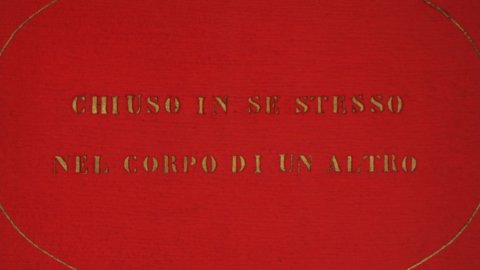
A room dedicated to the installation of 4 on-place titles could not be missing: four large sculptures whose titles are represented by photographs which are four snapshots of moments from his performance The lost letter. One of these was chosen as the image for the exhibition.
There are many important works that we are unable to mention, among these the works that refer to his research on time, one for all the XNUMXth-XNUMXth century, four fourteenth-century frescoes on which Agnetti intervened with lapidary writings.
Finally we mention the partnership with some great artists for whom he wrote and with whom he collaborated including Manzoni, Castellani, Melotti, Claudio Parmiggiani, Gianni Colombo and Paolo Scheggi with whom he signed the Throne, a four-handed work of great visual force and conceptual that will be exhibited at Palazzo Reale for the first time after almost 50 years from its first exhibition in Rome.
Vincenzo Agnetti was born in Milan on 14 September 1926, he graduated from the Brera Academy and continued his studies at the Scuola del Piccolo Teatro. From the age of 20 he wrote poetry and experimented in the field of informal painting which he soon abandoned, dispersing its traces.
From the end of the 50s to the beginning of the 60s, the attendance of a few friends including Castellani and Manzoni allows him to share ideals, projects and artistic aspirations. In 1959 he published his first “propositional writings” for the magazine Azimuth, Non comvenire atti impuri, the preface to the Assessment Tables and the Intervention for the Line by Piero Manzoni. In 1962 he began his South American period where he worked in the field of electronic automation. It is the period that he defines as 'art no liquidationism' and of which his notebooks entitled L'Assenza testify. In 1967 he returned to Italy, continued his research in the field of art criticism with some writings for artist friends such as Castellani and Melotti and with short theoretical essays both published in magazines and recited in monologues. Also in 1967 he began his artistic production which would develop with an intensity and richness that only the premonition of a premature end could explain. The production of works follows one another at a dizzying pace which does not prevent Agnetti from explaining its meaning with precise references to the structure and its genesis.
In 1968 he inaugurated the Denarratori series by Scheiwiller with the novel Obsoleto, with the cover by Enrico Castellani and published a self-edition of the Thesis, which would only see prints in 1970.
Meanwhile Agnetti left for work, first in Norway and then in Qatar, brief experiences but which fueled his artistic activity. The alternation of exhibitions and his presence in international reviews push him to try his hand at types of work that use different aesthetics while continuing the same discourse. From 73 he also opened a studio in New York, where he will live intermittently, starting that Milan-Big Apple commute which will be an important inspiration engine of his activity. On September 1, 1981 he died suddenly in Milan, leaving an unfinished work Il Lucernario and some verses, written shortly before in New York, which ended as follows: Before the brief evening / we will return to arms / We will be in Terra in Sole in Aria. / Then with the flower player. Perhaps.