
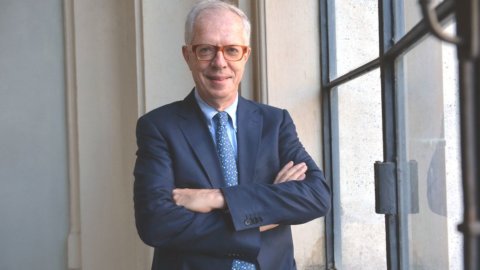
How many university students are really able to write and speak the Italian language correctly? Few, too few. The one launched by 600 academics who have sent an open letter to the Government and Parliament to urge them to quickly remedy the unsustainable linguistic deficiencies of students is not just one complaint among many and it is not a routine appeal. Other than the Erasmus generation, even the degree theses are full of grammar and spelling errors. And the appeal of the 600 is shaking public opinion. Among the signatories there is also a well-known economist, Marcello Messori, full professor of Political Science and director of the Luiss School of European Political Economy, whom FIRSTonline asked to explain the causes of the mediocre knowledge of the Italian language even at university. Here is his interview.
Professor Messori, you are the only economist among the 600 academics who signed the complaint-appeal on the widespread inability of today's university students to write and speak Italian correctly: why did you do it? What does an economist have to do with the linguistic deficiencies of children?
“It has to do with it, it has to do with it. First of all because, despite being an economist, I am an Italian and European citizen; and, as such, I know that young people must have strong roots in their country and in their culture of origin in order to acquire full awareness of their European belonging and to become citizens of the world. Knowledge of the mother tongue is a fundamental vehicle, although not the only one, for being a member of a community by interacting with other members and sharing a minimum set of basic values. Furthermore, in the eyes of an economist, knowledge of the mother tongue (in our case, Italian) is essential for refining logic and reasoning, i.e. those skills that allow us to measure ourselves even with complex and technical texts such as those of economy".
As Sciascia said, "Italian is not only Italian, but it is reasoning".
"That's it. That's why we have to be concerned about the deterioration of our students' language skills. It is unacceptable that the very "Erasmus generation", capable of 'getting by' in two or three foreign languages, cannot write and express themselves adequately in Italian. I repeat: you don't become an aware Italian and European citizen if you don't master the language of your own country or of the country in which you live".
Have you also found blunders even in degree theses?
“In my now long period of university teaching I came across errors of various kinds, both in the written exams and in the degree theses. In theses, spelling errors are decreasing also thanks to the "automatic correctors". In the last twenty years, on the other hand, I have found worrying increases both in the improper use of the terms used, and in the erroneous construction of sentences, and in the sequence of reasoning. Especially the last two types of error reveal an insufficient knowledge of logical analysis”.
But where does this decline in the ability of today's children come from, even in the last phase of their training, to express themselves correctly in Italian and to write and speak in their language without errors?
"I think it derives in part from the crisis of the school, which is no longer able to overcome or mitigate the steps induced by the different family origins and which has difficulty in appreciating the growing multicultural presence of students, and in part from social disintegration".
And that is?
“The ineffective scholastic organization certainly has a heavy responsibility for the deterioration of the language skills of the children. The basic school has not been able to adapt the teaching of the foundations of the Italian language, from spelling to grammar, to the evolution of forms and learning skills of young people who have lived and are living in a rapidly changing society. To carry out such a complex task, the basic school would have had to be the subject of effective planning and investment strategies by those in charge of economic and social policies and by representatives of the teaching staff. On the other hand, teachers' professionalism has been degraded for some time and their social role has become marginal. In this last regard, it suffices to consider how much the relationship between teachers and students' parents has deteriorated with the result that too many (although, fortunately, not all) teachers of literature and other subjects have adapted to a work of mere routine. These are crucial aspects of the problem; but, in my opinion, they are only part of the problem. While running the risk of falling into generic arguments, I would like to argue that our kids don't know Italian, even for more general reasons”.
In what sense?
“As I mentioned before, there are at least three causes, in addition to those internal to the organization of the school with respect to the teaching of Italian, which underlie the students' dramatic linguistic deficiencies. The first is the loss of knowledge of one's roots; which makes communicating with one's own community irrelevant and leads to closure in small self-referential groups. The second cause lies in a consequent and growing disincentive to organize one's thoughts and reasoning according to a rigorous logical thread. It was once said that "those who speak badly" tend to "think badly"; yet today there seems to be neither help nor loss of reputation for the "bad talker."
And the third cause?
“It's the more complex and somehow encompasses and extends the other two. This third cause has its roots in the disintegration of our society. Especially in the era of the mixing of different peoples and cultures, speaking and writing correctly in Italian could become essential tools for integration, social cohesion and democracy. On the other hand, however, learning Italian requires a minimum basis of social cohesion. Thus a vicious circle is created: without cohesion, the correct use of the language does not spread; without an adequate knowledge of the language, it is difficult to reproduce and strengthen social cohesion especially in a phase of rapid change like the current one. The result risks being a progressive social disintegration, which fuels mutual distrust and prevents the sharing of a minimal set of values and ideals. In this light, the linguistic incompetence of young people become the cause and expression of the problem. As Tullio De Mauro has often stated, in the years of the economic boom television was a formidable instrument for spreading linguistic knowledge among Italians and thus contributed to social cohesion. For some time now, television no longer plays this role. What is the aggregation tool now?”
Don't you think that the spread of laxity in schools and families has also contributed to obscuring the value of the discipline in study and the importance of merit as the founding elements of a school which, unlike today, was also a sort of social elevator?
"Yes of course. While living in the "knowledge society", learning in general is no longer perceived as a positive value. In the absence of an adequate basis for social cohesion, study and education cease to be both a tool for understanding the world and a vehicle for individual promotion based on equal opportunities. Social affirmation thus becomes the result of a family inheritance (to return to the problem of language: "I speak Italian well because my parents are university graduates or because I live in a house full of books") or, still and much worse, the fruit of “amoral familism”.”
Has the diffusion of a lifestyle based on haste and approximation and induced by a distorted use of the Internet and Twitter also contributed to ensuring that children speak and write our language incorrectly?
“I would reverse the discussion. The distorted use of the Internet and Twitter are not the cause but the effect of a poor knowledge of the language. Brevity does not necessarily lead to approximation; on the contrary, if it were combined with a robust capacity for logical analysis, the synthesis, to which new technologies push us, could lead to the utmost refinement. As the philosopher Biagio Pascal said: "I didn't have the time to be brief". We have fantastic technological tools that we are not able to use properly due to the loss of cultural and social cohesion and due to school failure. If schools want to produce language skills and knowledge for their students, they must make massive use of new technologies. In short, to mend an increasingly torn social fabric, the school must know how to change by breaking old patterns of transmission of knowledge; it must, however, continue to transmit basic rules and knowledge. It's a long-term job. However, if Italy wants to halt its dramatic economic and social decline, the re-enhancement of schools is a good starting point. It's about opening your eyes and starting."