Growth stunted? Premature prediction
At the outbreak of the war against Iran, theworld economy was marching. Almost as if he were Monsieur d'la Palisse, who «Un quart d'heure avant sa mort,/il était encore en vie». However, Marshal Jacques de Chabannes he certainly died in the Battle of Pavia (1525), which definitively changed military strategies by putting heavy cavalry to rest. Instead, decree the end of economic growth today because it is inevitably hit by a new energy crisis, it seems premature.
Indeed, they are the combinations are disproportionate between the current situation and that of fifty years ago, when the Arab-Israeli Yom Kippur War (1973) led to the oil embargo. From the list of the six main differences between now and then, the reason for downplaying the economic consequences of the ongoing events, which are undoubtedly tragic, is clear.
Six crucial differences
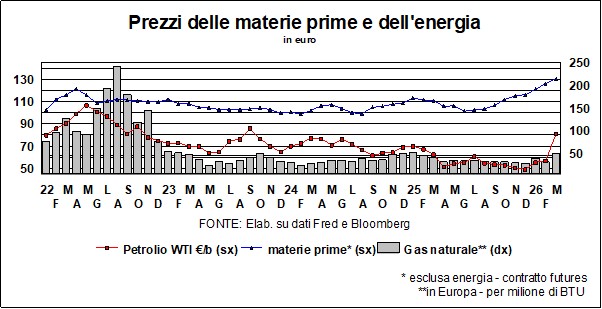
- In 1973-74 the oil prices quadrupled, today it rose by 43% (compared to pre-war prices, WTI quality) on March 12 and recorded an increase of 44% as of the 13th (5:00 PM). European gas did worse: +75%; however, in the 2022 energy crisis it rose tenfold (and oil by +72%).
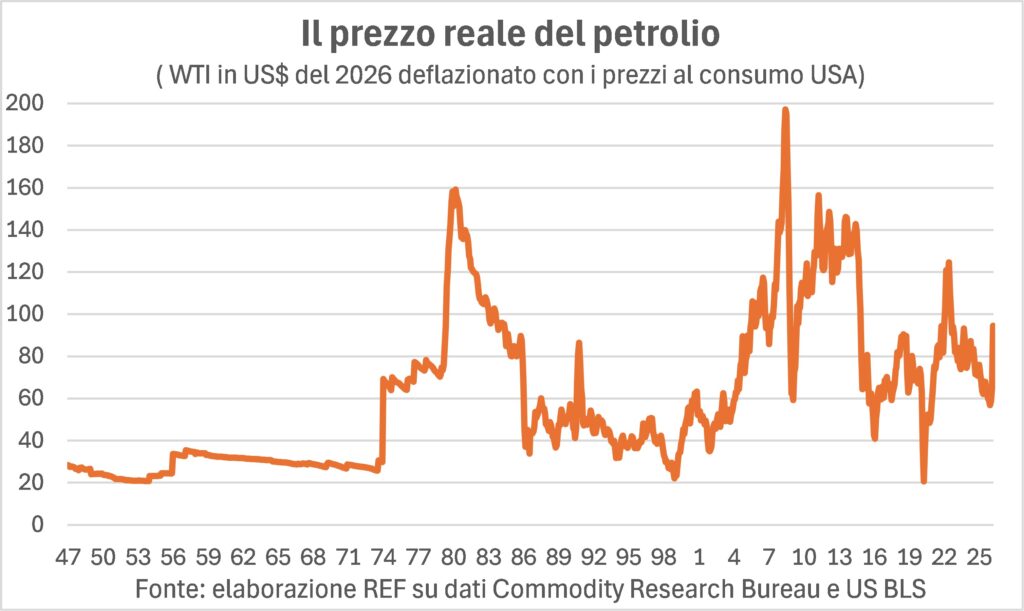
- Il real terms level The price of crude oil, which is important for getting a rough idea of how much it impacts the lives of people and companies, at its peak today is three-quarters of that of 22, less than half that of 2008 and 40% lower than that of 1980. Moreover, the real price was significantly higher (by more than 50%) than current values also in the winter of 2012 in the wake of the Arab Spring, and remained there for a long time, without anyone talking about an oil shock as we do today.
- The energy intensity In advanced economies, the share of energy consumed has shrunk significantly: in the US by almost 70% and in Italy by almost 60%. That is, we produce a unit of GDP with 60% less energy. This energy is increasingly derived from less and less oil and increasingly from gas and renewable sources.
- In 50 years the mitigation policies The effects of energy shocks have been significantly mitigated, starting with the establishment of the IEA (International Energy Agency) and the accumulation of strategic petroleum reserves (equal to 1,8 billion barrels as of early March in IEA countries, which do not include China).
- In the 1973 the Arab world was united in turning off the oil taps, today it is in wanting to keep them open and in taking a stand against Iran.
- The context in which the first oil shock occurred was that of the «warm autumns», that is, of great claims and strong wage dynamics: In 1973-79, hourly wages increased by an average of 8,6% annually in the US, 12,3% in Japan, and 10,9% in what is now the Eurozone (22,1% in Italy). The surge in oil prices added fuel to the fire. Today, wage increases are a fraction of those just indicated.
Uncertainty is the absolute master
All this does not mean that the situation is under control or free of economic and geopolitical consequences. "I don't like wars: their outcomes are uncertain," says Elizabeth I, Queen of England, in Shekhar Kapur's film. Here and now theuncertainty is the absolute master, because the effects on economies depend on the duration of the conflict and the closure of the Strait, from damage to extraction plants (especially those caused by the interruption of the extraction itself) and to the refining plants and crude oil processing (in particular for the production of urea, an essential component of fertilizers) and the repercussions of all this on trust of consumers and businesses and on financial variables which affect spending decisions directly (cost of capital) and indirectly (wealth effect).
On the duration thick fog
The duration of the conflict, just to complicate matters, is made less visible because they were different objectives indicated: overthrow of the Islamic regime or destruction of its missile arsenal or annihilation of the nuclear program? Furthermore, the American domestic politics plays against the protraction of the war, with elections in November, and the majority of Americans are dissatisfied with the war operation itself and with its direct effects on the cost of living (more expensive gasoline and food), with betrayal of the electoral promises on both sides ("No more wars abroad", "I will reduce the price level"). Israel will vote in the fall and Prime Minister Netanyahu needs significant military results to stay in power, even at the cost of fighting for a long time. So there is a risk of a clash between the two leaders.
The pre-war context: solid growth…
I economic data more recent ones indicate that before the war the global growth was on the rise, albeit with divergences and differences, also due to extreme weather events (for example, in USA February's winter storms caused the largest number of flights to be canceled since 2020).
One promising aspect is theincrease in manufacturing and tertiary orders, even foreign ones. The latter are fine in Asian economies (with the exception of theIndia) while they remain weak and mostly contracting in the rest of the world. In Asia China and Japan they are progressing at a good pace, together with the group of South-Eastern countries.
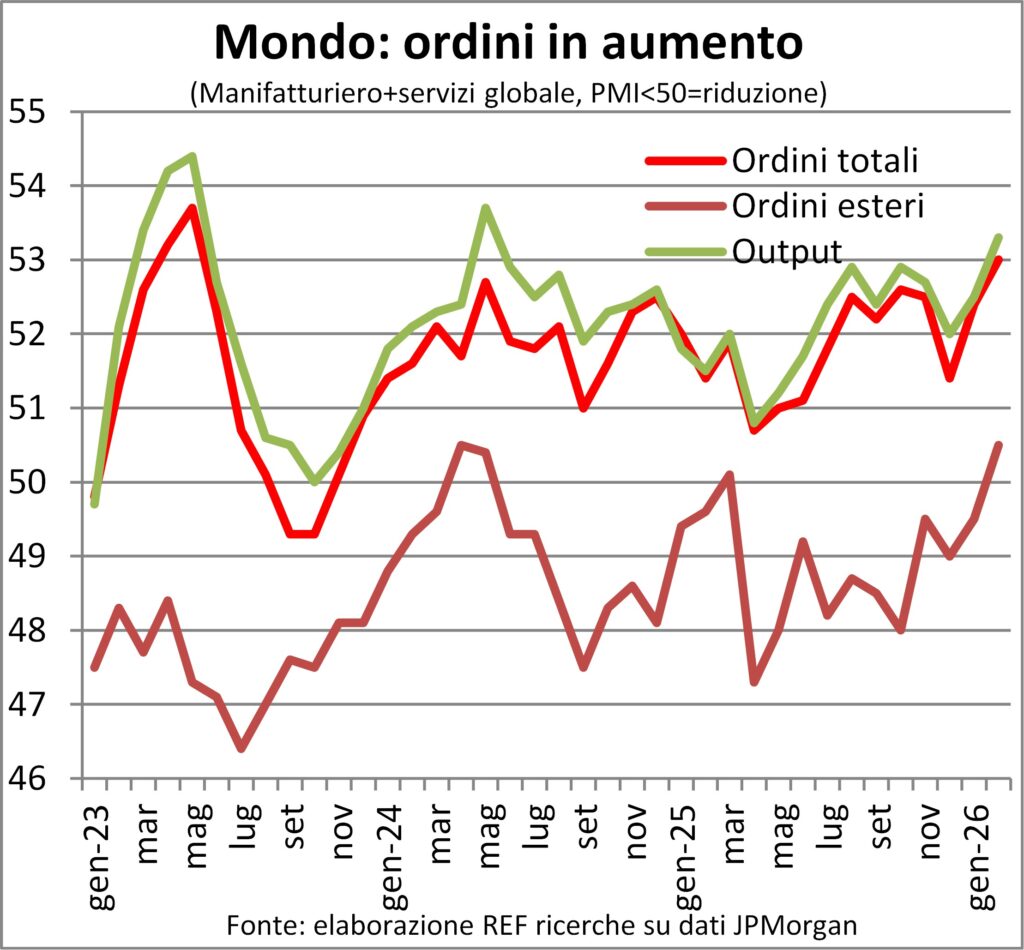
The US labor market is sending mixed signals: depending on the statistics, it appears either solid or fragile. However, this isn't enough to hamper growth, which continues to trend closer to the upper 2-3% range.
Inside Europe UK is doing well, with composite production (manufacturing + services) increasing at its highest since August 2024, and the Germany, braking the Spain and in acceleration theItaly, who enjoyed the effect Winter Olympics.
…and contained inflation
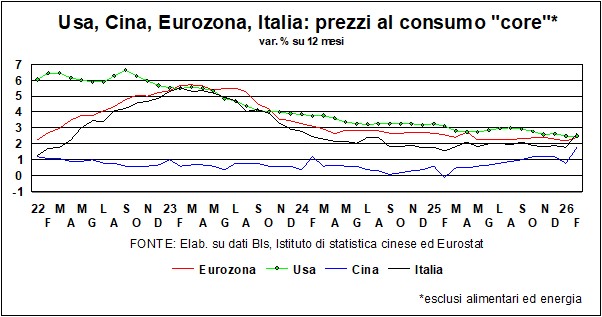
La consumer price dynamics it was basically stable in February, that is, before recording the violent jolts of energy raw materials, and not only. USA there was a further, almost imperceptible, cooling on an annual basis, because the monthly variations were lower than those at the beginning of 2025, despite the tail of tariff increases. China the annual increase rose to its highest level since March 2019, a sign that domestic demand is not so weak, even if certainly the New Year has had an impact (in the lunar calendar it is not fixed as in the solar one and in 2026 it fell 19 days later than in 2025). Just as the Milan-Cortina effect was felt on Italian price lists which in the core measure have accelerated by just under one percentage point per year.
Over this calm before the storm looms… the storm, indeed. In the form of fossil fuel price increases but also of fertilizers e various metals of which the countries bordering the Persian Gulf have become producers and exporters. Furthermore, there is the risk that production chains will suffer interruptions for various reasons: rising costs and shortages of naval transport, shortages of certain commodities, and so on.
The water on the fire is represented by the salary increases, which are contained or being contained almost everywhere. On the one hand, this prevents the onset of a true inflationary spiral; on the other, it slows domestic demand because the increase in workers' purchasing power is low.
The impact of the war on the markets
Yet another 'black swan' It hit the world economy like a boulder in a pond and generated shock waves on prices, rates, currencies and markets. 'Black swans', really, should be rare, but unfortunately wars have become (too) frequent: from 2022 onwards Ukraine (and it still lasts), to 2023 Gaza (and still lasts), to 2026 in Iran (how long will it last?).
Let's leave aside—as diligent and cynical economists—the suffering and deaths of innocent civilians, and first look at the effects on interest rates. These are, of course, tied to the effects on prices, discussed above.
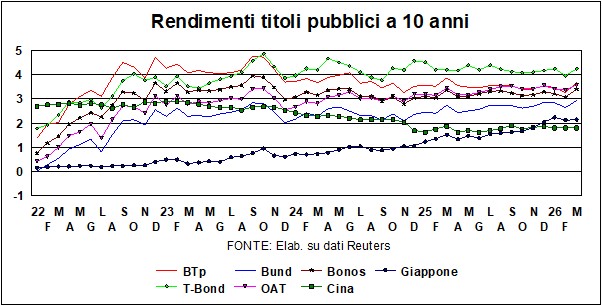
The most sensitive barometer of rates – 10-year government bond yields - I'm increased, as expected, almost everywhere (except in China). Which, incidentally, decreases a tombstone on hopes of drops in key interest rates (the ECB , Fed are expected to decide in the coming week). Given the serious uncertainties that weigh on the war developments in the Persian Gulf, it is likely that the Central Banks they stay at the window. Looking beyond, in the worst case scenario – confidence falling for businesses and households, threats of recession and rising inflation – the ECB and the Fed will once again find themselves facing the usual dilemmaThe economy needs stimulus and lower interest rates, but inflation is well above the famous 2%. However, in this case, monetary easing should win, since the rise in inflation would be due not to excess demand but to an external factor. best case scenario – end of the war, Hormuz cleared and free, oil returns to pre-apocalypse levels – the dilemma remains, although with different features between ECB (who has his finger on the trigger of the rates) and Fed (the next Presidency aims to lower interest rates, but will face worsened budget deficits due to war spending and the rising cost of debt…).
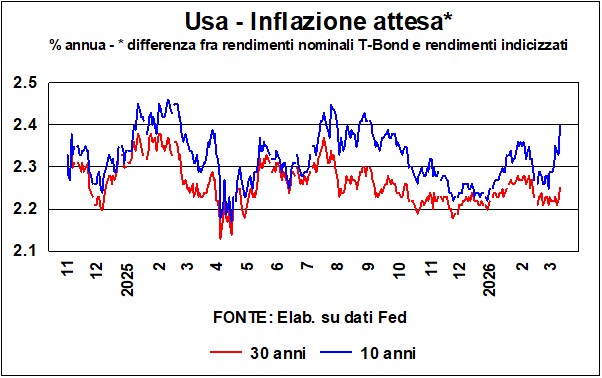
Existing inflation is important, but even more important are inflation expectations of families, businesses and markets. The possibility of a price-wage spiral which would transform a one-off shock into a permanent step in price dynamics. It's still too early to know the results of household and business surveys; for now, we only have assessments of the American markets (see chart), which tell us about expected inflation in the 10- and 30-year futures. There has been a Increase in expectations, but modest (0,15 percentage points) and not much different from past trends. It's also comforting that the longest expectations (those at 30 years) have barely changed.
Looking at the American market and beyond (simple average of the yields of T-Bonds, BTp, Bund, Gilts, OATs, JGBs, Bonos), How yields have increased from the day before the war to today, let's see that those at 10 years old have increased by an average of 26 basis points, those at 30 years old by about 10 points less. Some of these increases threaten to be permanent, not so much because of fears of inflation, but because these sad events make it increasingly necessary to increase the defense spending, for many years and a bit everywhere.
A separate note deserve the btpIn the past we have noted with pleasure the progressive improvement of the spread and rating that the agencies were assigning to Italy. But a saber rattling (and much worse) in the Middle East was enough to hit our titles and worsen the spread towards everyone (towards the yields of Bunds, Eurobonds, French and Spanish bonds, etc.). There are three observations to make in this regard. First, the level of spreads the day before of the attack marked a at least for many years; the rise is not welcome but does not affect the downward trend. Second, some might argue that the increase is also influenced by disappointment over the fact that the deficit/GDP ratio in 2025 did not fall below 3% (Istat puts it at 3,1%) and Italy therefore remains under the excessive deficit procedure. But this interpretation is also excessive. All estimates for the current year and the following year they give a deficit/GDP below 3%, and anyone who knows how to read between the lines knows that Italian public finances continue to be under control (Italy is the only G7 country with a primary surplus).
Third observation: the btp they paid for the fact that the level of yields rose, and when yields rise, the spread also rises because the cost of debt servicing is rising for a country with the public debt we know.
The dollar strengthens against (almost) everything
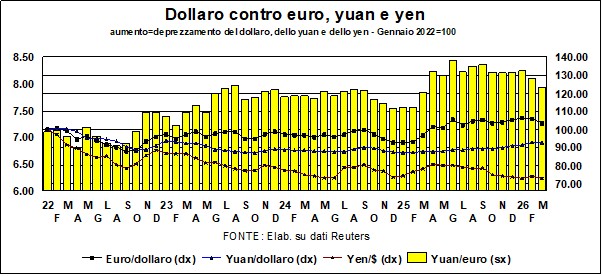
As – here too – was to be expected, when diplomacy ceases and cannon fire begins, the first military power on the planet benefits: and the dollar – United States business card – becomes a safe haven againBut in the past it had benefited more. Between the day before the war and the latest data, the dollar gained about 2,5% against the euro and somewhat less (about 1,5%) in effective exchange rate against 64 currencies. But the American currency continues to be 'under the thumb' of the fundamentals, which are not favorable to her.
Also the yuan has gained, even against the dollar. The strong increase in exports and the trade balance in the first two months of this year is evidence of this. 'economic' explanation, and the desire to defuse, with a controlled appreciation, the criticisms of the countries that have paid the price of China's mercantilist aggression, is the 'political' explanation.
As far as the 'Japanese anomaly already highlighted in the past – the change of the yen depreciated against the dollar, despite the difference between the yields of T-Bonds and those of Japanese bonds (JGBs) narrowing – this anomaly has started to be less anomalous: after the outbreak of this second Gulf War, the increase in T-Bond yields was higher than that of JGBs, and the yen exchange rate weakened to almost the record high of June 2024.
Bags bend but don't break
«Frangar, non flexar», the ancients used to say, as a symbol of moral integrity: 'I break but I do not bend'. But the stock markets, hit by the winds of war, preferred a «Bend, don't break»They gave in, aware of St. Augustine's advice: "Flectamur facile, ne frangamur." Wall Street has dropped by approximately 3% compared to the day before the attack: the rest of the world instead left 5% on the field. This 'least bad' America's performance has reduced the 'the more the better' of the non-US stock markets that was previously in force (see graph, which compares the indices in dollars – but the trends would be similar with the indices in local currency).
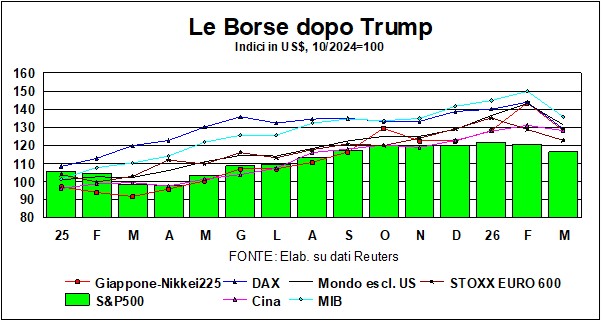
It is not surprising that when, as mentioned above, the cannonades, bombings, missile launches… begin, America becomes a refuge again, and not only for military reasons: the splashes of the Oil prices they stain everyone, but America is self-sufficient in the field of oil in particular and energy in general. That said, the conditions for further 'bends' are still thereAs mentioned above, there's a lot of uncertainty about the duration of the conflict, and we won't venture any predictions. In any case, we reiterate our last suggestion, and not only that: to paraphrase Renzo Arbore, “diversify people, diversify!”.
How did the other consolidated and ancient ones react ( ) and ambitious and new (Bitcoin) safe haven assets? In truth, Bitcoin and its other sister cryptocurrencies are safe haven assets only for lovers of extreme sports: to give an idea of how 'extreme' Bitcoin's gyrations are, this is dropped by 43% about the highs of a few months ago (it had reached $124720 on October 5th). However, the landslide he met some reboundThe latest data shows Bitcoin at just under 73, up around 9% from its pre-war level.
For their, the story is different. As we know, the yellow metal is recovering from a long and incredible gallopFrom $2000 per ounce at the beginning of 2024, it steadily rose above $5000, peaking at $5355 on January 29th at the beginning of last year. Since then, it has been pounding the pavement: the day before the war, it was $5248, and the latest data shows it shrugging off missiles and bombings. he allowed himself the luxury of going down (about 3% less, a price that, however, becomes practically unchanged in euros, given the concomitant appreciation of the dollar). In short, just when the need for refuge soars, gold refuses to accept the need. It's difficult to explainPerhaps he looked back and thought it was pointless to make another leap forward, given the gallop he'd been through. Perhaps the aforementioned 'thick fog' (not knowing where to go, better to stay still) prevailed over his fear. Perhaps...