At the intersection of art and technology
The emblem of Aldine editions of Manutius shows a dolphin coiled around an anchor attached to a garland of fruit. Manutius had obtained this emblem from a Roman coin given to him by Bembo. The motto of the Aldine editions is “festina lente” (make haste slowly). This emblem has been revived in modern times by the New York publishing house Doubleday Books, now part of the Penguin-Random House group.
At the origin of the art of printing is Aldo Manuzio, the man who combined art, technology and manufacturing and left a "longer-lasting legacy than bronze", as the title of an exhibition held in New York in 2015 for the fifth centenary of his death. For those who read and publish Manutius is as good as Michelangelo for those who model the material.
Steve Jobs did not fail to say that technology is an aspect of artistic creation. It is more design than engineering, indeed it is design tout-court. Vikram Chandra, a naturalized American Indian writer developer and also known in Italy, wrote a book, Sublime geek. My life between literature and code (Mondadori), to show us that writing code is a sort of literary genre, something equivalent to writing a story or a poem. Just like writers and poets, software developers are obsessed with the elegance and style of the words they use.
Well Manutius was not the first artist-technologist, but he was the first to add a third pillar to that winning combination, marketing, because the Venetian publisher had a very strong sense of business and enterprise, as befits to the inhabitants of Venice at the time. Which never hurts in an artist. He worked in Venice at the end of the fifteenth century, a city that stood, like Paris and New York, at the junction between culture and business, between art and the market.
Who is Manutius?
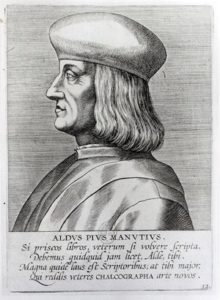
Manutius he's a character indeed important for those who deal with publishing, but not only. Born in a Lazio village, Bassiano, whose name curiously recalls places and painters of the Venetian Renaissance, yes moved precisely a Venice, after the years of training humanistic spent between Rome e Ferrara, between 1489 and 1490.
Find yourself at Venice in that crucial decade for the development of the city it meant being part of the most powerful maritime republic, crossroads of creativity e metropolitan inspiration, mitigated by strictness of characters like the Cardinal Bessarion that the city had given its amazing code collection, or of Ermolao Barbaro who made his own available to scholars big library.
Without forgetting that, in addition to a rich, ambitious and cultured aristocracy, a few years later, at the dawn of the sixteenth century, some of the most skilled minds and hands of Renaissance painting would arrive in Venice: Lorenzo Lot, Tiziano Vecellio, Tintoretto.
A perfect balance between technique, art and market
Anyway, Manutius finds himself in one of them lucky coincidences space-time in which, to anyone who wants to deal with crop, business they can only go well (lucky them!). Greek grammars, dictionaries, complete editions of the works of Aristotle, Lucretius e Plutarch, works of Story and treated of oratory begin to come out of the skilled hands of about fifteen workers and from you are wine presses in S. Agostino district.
If from a content point of view there were few crucial works included in the editorial plan of printing house of Manutius, even on a practical level many were his successes: from the development of characters such as Bembo, an example of refined elegance and proportions based on depth knowledge of the coevals humanities studies in architecture, such was the unanimous opinion recognition ofart of Manutius to be the first to be plagiarized, with shops of imitators who "fake" his books.
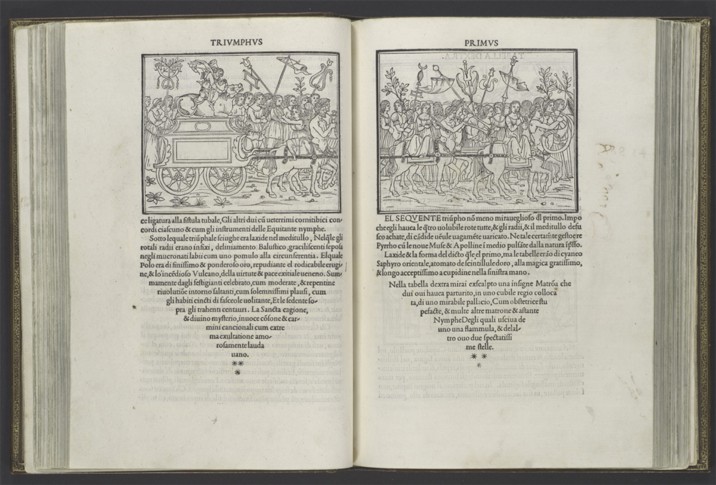
And the composition of one of the most studied works of the Italian Renaissance dates back to this period, theHypnerotomachia poliphili, attributed to Francesco Colonna but still debated in every detail to this day and the subject of an impressive bibliography on the five continents. The peculiarity of the Aldean volume, in addition to the complex and mysterious content, certainly lies in theart of combining the good 172 illustrations engraved on wooden matrices with the vernacular text.
The portable booklets
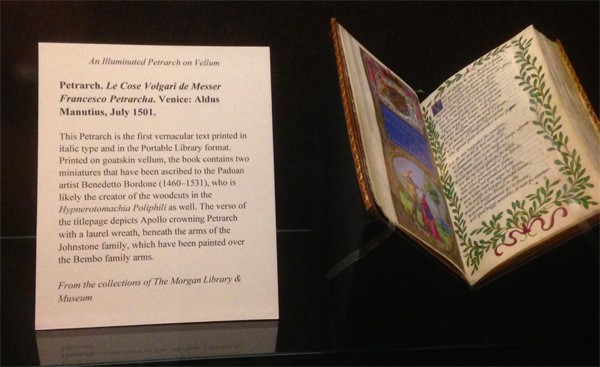
Furthermore, at the beginning of the sixteenth century, Manutius he invented - perhaps to remedy the economic crisis partly due also to the wars through which Venice tried to get by while maintaining its independence - the first ones "portable" books, or gods pamphlets of size contained which allowed for release la reading bybe oneoccupation purely connected to the moments of studio or to specific designated places, thus giving life to one modern conception of the reader.
The laboratory of the modern publisher
Manutius also introduced theuse of punctuation borrowing its use from the Greek and introducing accents, semi-colons and apostrophes and also created a famous emblem for his workshop: an anchor and a dolphin held in an embrace sealed by the motto "Slow Festina” (hurry up calmly) still used today by the publishing house Doubleday.
In of Manutius, those too take shape forms of bargaining between The authors ed publishers that still characterize modern publishing today, i.e. the purchase promise of one stock of books by the The authors or of the clients in order to guarantee il economic return with expense di publication to publishers.
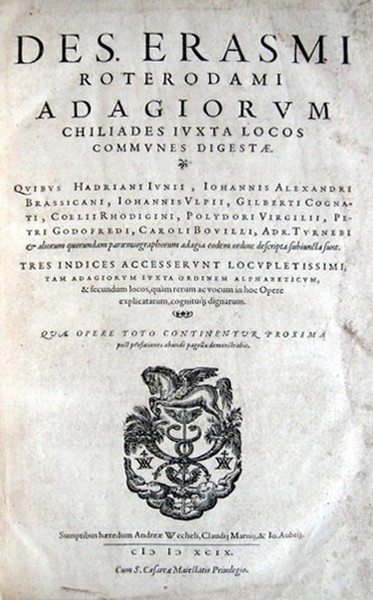
A Manutius was even the famous Erasmus of Rotterdam to ensure the acquisition of 200 copies of his edition Lay down in 1507, Erasmo who also suggested that he carry out the work in italic, contributing to the creation of that character set that is still called today italics in English, a hidden homage to our Manutius.
The Grolier Club, the place for bibliophiles
Plaque of the Grolier Club in New York, on East 29th Street.For lovers of the art of books and bibliophiles, the ideal place to immerse yourself in the age-old art of book manufacturing is the Grolier Club of New York, an club dedicated precisely to this art.
Founded by Robert Hoe since 1884, takes its name from the famous French collector Jean Grolier, an inspirational figure for the eight founding members of the club who in his mission includes goals such as supporting the study of books and paper works, keep a library, publish books occasionally, organize exhibitions and disseminate book culture among the general public - not forgetting the art (really unknown to most) of compile bibliographies.
The club's collection includes 100.000 books about…books! The Grolier also owns 60.000 catalogues of sales and auctions of books collected over a hundred years by the most important European and American booksellers. What better place for those who want to learn more about the subject?
Aldus and the birth of Desktop Publishing
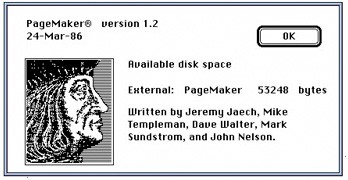
The credits screen of Aldus Page Maker, the first page layout software for the Macintosh. The introduction of the Page Maker started the Desktop Publishing phenomenon that changed modern typography from a manufacturing industry to an automated one.
Back in 1985, a Seattle software house named Aldus Corporation began marketing a software for the layout of texts and images named PageMaker, writing a fundamental page in the history of typography and publishing.
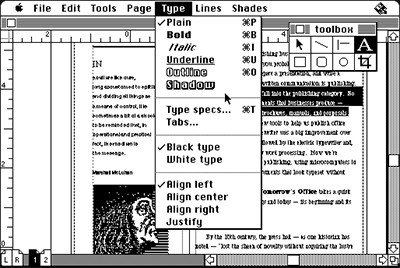
It was Aldus PageMaker himself who made the desktop publishing revolution possible because, to use a more recent term, he helped transform the Macintosh (launched the year before) into an excellent platform for the production of all types of publications, including books.
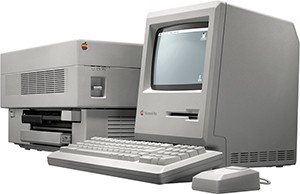
Steve Jobs, thanks to his passion for calligraphy which we will deal with in a future post, I had equipped the Mac with a set of wonderful typographic characters (including the Palatino and the Bookman) that the Laser Printer (the printer connected to the Mac) reproduced with almost typographic quality thanks to Adobe's PostScript description language. The PostScript language had the extraordinary ability to reproduce on a sheet of paper what could be constructed and seen on video with the ever more numerous and sophisticated graphics and design programs added to the initial set supplied by Apple. All this resembled, very metaphysically, the Edizioni Aldine printing house. There were the same things, in an immaterial form.
The PageMaker and Apple's Laser Printer were released on the same day on January 23, 1985. This date can be marked as the date of electronic publishing.
The founders and developers of Aldus had wanted to pay homage to the founder of modern typography and publishing, first of all by calling the company "Aldus", the first name of Manutius and the root of Edizioni Aldine, and then adopting as the logo of the companies and emblem of PageMaker himself, the stylized face of Manutius, handed down through a famous engraving. They lived in Seattle, on the other side of the world, they were young engineers and they didn't deal with publishing or art. But the Venetian humanist's legacy was more enduring than bronze.
Aldus, yet another prime example of the conjunction between art and technology. The right way to the future.
Thanks to Valentina Sonzogni for having contributed to this post.
Valentina Sonzogni, architecture and art historian, obtained a PhD at the Universität für Angewandte Kunst (Vienna) in History and Theory of Architecture. You have worked for numerous institutions, including the Kiesler Foundation (Vienna) and The Guggenheim Foundation (New York), you have written in architectural magazines and catalogs and have lectured at Italian and foreign universities. Since 2008 you have been collaborating with the Castello di Rivoli Museum of Contemporary Art (Rivoli-Turin).