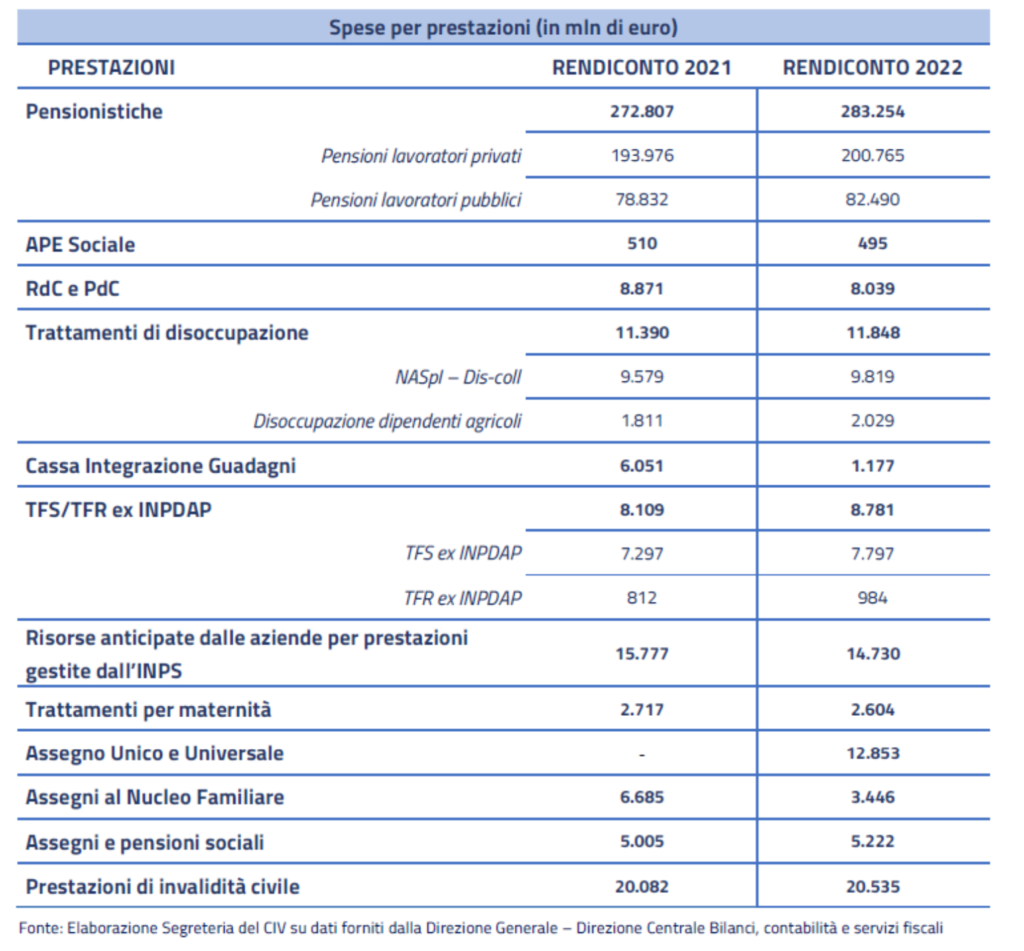
The latest Social Report of the Steering and Supervisory Council (CIV) of the INPS - which we have also plundered in the previous columns - suggests new considerations (see the relevant table) with regard to spending on services in the transition of the health emergency and with regard to the effects of the support measures taken in that period of time. Even with the necessary caution, it is possible to notice increases in spending which between 2022 and the previous year do not show particularly significant changes or in any case are justified by the measures taken by the government. There is an increase in pension spending of around ten billion (7 in the private sectors and 3 in the public sectors) which, in addition to the automatic revaluation in line with inflation, could be attributable to the experimental measures launched in favor of early retirement for a three-year period (2019 -2021) from Count 1. If the disbursements already made were worth 100, it must be remembered that the block on ordinary advance treatment was fully operational. Also noteworthy is the stability of retirement palliatives such as the social Ape. The layoff freeze regime, extended until April 2022, is reflected in the uniformity of unemployment spending over the two-year period (Naspi and Dis-coll). Then, as we remember, at the deadline, instead of observing a recourse to mass dismissals, there was a clear prevalence of resignations, so much so that the melodrama of Great thank you or the Great resignation. This phenomenon was circulating in developed countries starting from the USA (but we also made ourselves known) as if it were an ''escape from Egypt'' of an exploited people, who had escaped from the new plague, who were escaping the yoke of work, looking for a new lifestyle. Even the Association of Personnel Directors, in their research, dealt with the ''Great Escape'' bringing it back to a more practical dimension and motivations - the recovery of the labor market (48%), the search for more favorable economic conditions in other companies (47%) and the aspiration for a greater balance between private and working life (41%) - which, first of all, depended and still depend on the distortions of a labor market in which those seeking employment do not he finds it and those who want to hire are unable to do so, indeed they struggle to retain the employees who are indispensable to them.
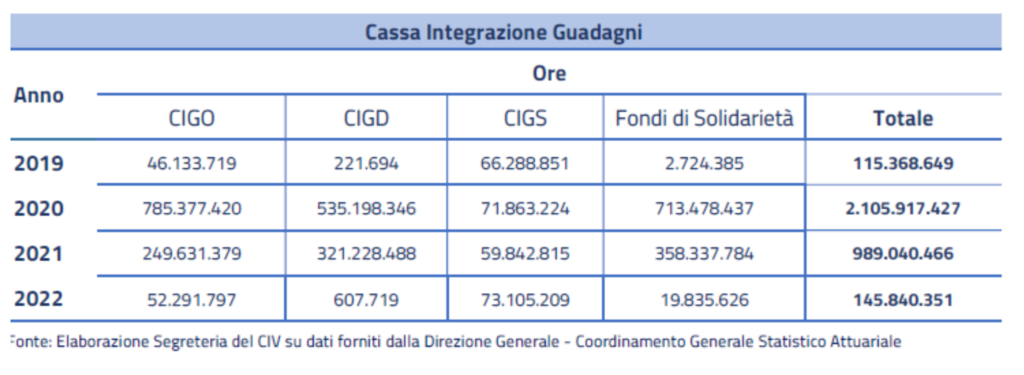
A further very significant figure is that relating to the expenditure for the Redundancy Fund which has seen a notable reduction, connected to the economic recovery and the release of the employment protection measures (Mario Draghi said that the most effective economic intervention would have been the reopening of companies).
The change that has occurred (starting from April 2022) in family policies deserves particular consideration, in the sense that we move fromFamily allowance (ANF, introduced in 1988 as a reform of the previous regime taking income and household composition as a reference) toSingle universal check (AUU) adjusted to the number of children. The ANF remained in force for pensioners. As you can see, the increase in spending is notable. And taking back the slow motion of the news, we can say that the predictions were spot on.
The Parliamentary Budget Office (PBO) had previously dealt with the AUU, taking into account the effects of the transition from the existing institutions (family allowances and tax deductions for dependent children under the age of 21 who are absorbed) to the new instrument . And he had in practice shared the results that the Mef collected retrospectively in a study. From the PBO's analysis, in fact, it emerged that the AUU would have been generally more generous than the measures in force even for high family incomes given that the amount does not go to zero for medium-high incomes (as instead happens for the measures in force). The benefit would have been particularly relevant for minor children with disabilities, compared to a more limited gain for adults. In the transition, all other conditions being equal, from a single-income household to a two-income household, the new regime would have become generally more favorable than the current one due to the specific increase. The advantage would have been lower for high family income levels at which the increase disappears.
The presence of assets relevant for the ISEE (i.e. higher than the deductibles) would have made, for the same family income, the family unit richer for the purposes of the indicator, however determining smaller AUU amounts which would have left households with assets for mostly indifferent or disadvantaged in the transition from the old to the new regime. The greater the assets, the more likely there would be a loss. As can be seen, no significant deviations emerged between the forecasts of the PBO (which also took into account the indications of the Technical Report of the measure) and the first assessments carried out by the Mef with regard to the benefits provided, as well as the final data of the CIV. In the evaluation of the PBO the overall cost of the introduction of the AUU for 2023 (going beyond the two-year period considered by the INPS) stood at just over 18 billion, of which approximately 6 of additional resources compared to those previously disbursed, in line with what is indicated in the Report technique of the measure. According to the PBO, the measure would have concerned almost 7,3 million families and 10,8 million children and brought an average benefit per family of just over 1.000 euros (almost 700 per child).
92% of the families involved would have been advantaged or indifferent compared to the current regime, in relation to the universal nature of the AUU and, above all, the use of additional resources.