During the Pleistocene, the first geological epoch of the Quaternary period, between approximately 2,58 million and 11.700 years ago, the entire Castelli Romani area was affected by intense volcanic activity from two major eruptive centers, the Sabatino and Albano. The development of the Alban Hills Volcano manifested itself in a series of tuff lava flows containing blocks of lava, other tuffs, and sedimentary rocks. During glaciation, enormous caverns were formed in the depths of these caverns, eroded by underground waters. Over the centuries, this network of caves proved crucial for the local populations, who were engaged in pastoralism and agriculture, as well as for the storage of goods and animals. But above all, the network of caves, partly natural and partly carved into the tuff, was crucial to the production of Frascati wine, which dates back to Roman times, when the so-called "Tusculum wine" was renowned. Grown on the volcanic soils of the Alban Hills, this white wine has ancient roots, cited as early as 160 BC by Cato the Censor in his De Agri Cultura, establishing itself over the centuries as the traditional wine of Rome. Prized in the Imperial era, it was known as the wine of Tusculum (present-day Frascati). Marcus Terentius Varro mentions the Vinalia, festivals dedicated to this wine. In the Middle Ages, production continued thanks to monasteries. Later, Pope Paul III (16th century) imposed Frascati wine on papal tables, increasing its fame. Its uniqueness derives from the volcanic soil on the northern slopes of the Alban Hills.
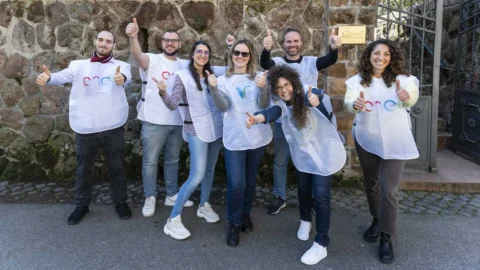
Many Tusculan villas and many restaurants today still use those caves to store wine at constant temperatures. The ConTatto restaurant, run since 2020 with an imaginative touch and a desire for research and experimentation by Chef Luca Ludovici, has gone beyond the use of a comfortable environment as a cellar or as a shelter for goods but has transformed the underlying caves, which extend for 170 linear meters of extension with a constant temperature throughout the year between 12°C and 15°C and controlled humidity, crossed by natural air recirculation, into true gastronomic research laboratories offering sustainable and local cuisine, pushing the concept of "kilometer zero" to that of "kilometer below zero".
The recipe we're sharing with Mondo Food readers this week is based on a study of the reaction between rice aged for three months in a cave and its unique combination with Fiuggi water, a tribute from the chef to his native land, a native of the Frosinone region. This pact of love, a true manifesto of his cuisine and also presented at the Identità Golose conference, takes shape in a risotto made with Carnaroli rice aged in a cave for three months, allowing the grain to lose some of its starch, hydrate (hence shorter cooking times), and acquire flavors similar to those of brown rice. Added to this is the use of Fiuggi water, a low-mineral water, low in calcium and rich in purifying, anti-inflammatory, and anti-aging properties. Water becomes the key ingredient in the preparation of a Parmigiano Reggiano rind broth. The cheese, in addition to adding flavor to the broth, also serves to provide minerals and calcium, two micronutrients naturally lacking in Fiuggi water. The dish is complemented by two aromatic herbs—sage and rosemary—and a vegetable charcoal, made from the trimmed vegetables not used on the menu.
Born in 1986, Luca Ludovici developed his passion for cooking at a young age. After hotel school and various experiences in luxury hotels, he worked at Michelin-starred restaurants such as La Torre, Le Gavroche in London, and Le Calandre, at Osteria di Birra del Borgo with Gabriele Bonci, and at The Pantheon Iconic Hotel. He joined ConTatto four years ago with Lorena Cavana, born in Bologna in 1988, who trained as a lawyer and later converted to sommelier, his partner in life and work. He chose a cuisine that is entirely focused on discovering the values of the region and celebrating its history. And he soon attracted the attention of the Michelin Guide experts, who recommended his restaurant with these words: "In this small town just a few kilometers from the capital, two passionate young chefs offer dishes rooted in the local tradition with contemporary twists, such as cuttlefish, asparagus, and béarnaise sauce. A fascinating visit to the tuff cellars, where the chef experiments with age-old preservation methods and unique flavorings, is also worthwhile. Furthermore, every year, the premises are "lent" to a modern art gallery owner for exhibitions."

Risotto recipe, Fiuggi water, sage extract, rosemary, and vegetable charcoal
Ingredients for 4 people:
360g of cave-ripened Carnaroli rice
2 liters of Fiuggi water
400 gr of Parmesan
Fine salt
60 g Lemon puree
50 g of sage
50 g of rosemary
80g Parmesan rinds
100 g of potato peel
100 g of spring onion
50ml extra virgin olive oil
Method
Bring the Fiuggi water to a gentle boil with the Parmesan cheese cut into pieces, separating the rind for about 3 hours.
Strain, setting the crusts aside. Once cooled, cut them into cubes of about half a centimeter to obtain a broth that will then be left to settle in the refrigerator for at least 8 hours.
After eight hours, a solid portion will rise to the surface; separate it from the liquid and cut it into 2-centimeter cubes. The Parmigiano Reggiano water will be filtered until it is clear and free of impurities.
In a saucepan, blanch 5 lemons 10 times, starting with cold water. Once cooked, blend and sieve them to obtain a puree. Toast the spring onions with the potato peels in the oven, blending until the mixture becomes a charcoal-like powder.
Heat the oil to 60°C and blend it with a portion of the sage until you obtain a green oil with a hint of sage. Finely chop the remaining sage and rosemary. Toast the rice with salt and cook it with just the Parmesan water.
Once cooked, mix with lemon puree, the solid part cut into cubes and the aromatic herbs.
Finish with vegetable charcoal