
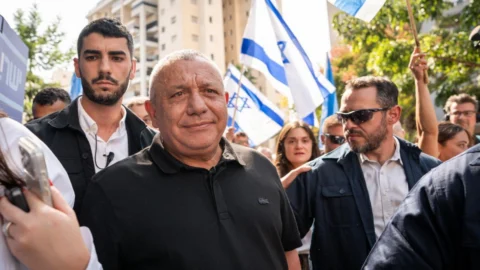
In Israel il change of government there hasn't been one yet, but the challenge to Benjamin Netanyahu has already produced the first concrete result. Matan Kahana, member of the Yashar party led by Gadi Eisenkot, Was elected Speaker of the Knesset, the Israeli Parliament, with 66 votes out of 120. He beat Ofir Katz, Likud's candidate, stalled at 52 votes after more than seven hours of right-wing obstruction. The support of the 19 members of the Arab parties, the Joint List and Ra'am, was decisive.
The nomination represents a significant victory for the camp aiming to end Netanyahu's long political career, but it doesn't mean the prime minister has already been replaced. The elections will be held on October 27. in fact they did not assign a clear majority and neither of them The coalition still has the numbers needed to govern. Eisenkot, appointed by the president, Isaac duke to form the new executive, he must find an agreement that guarantees him at least 61 seats.
Israel: Why the Knesset Presidency Is So Important
Winning the presidency, however, gives Eisenkot an immediate advantage. Speaker of the Knesset He does not limit himself to directing the sessions: he has a role in organizing parliamentary work and in defining the agenda, helping to establish which proposals arrive in the chamber and in what timeframesA position that allows one to influence Parliament's priorities and the path of legislative initiatives.
This is the first concrete change in the Israeli political balance. With Kahana leading the assembly, the anti-Netanyahu front It can begin to implement some of the promised reforms, even before the new government is formed. Eisenkot's camp has also won several strategic commissions: Avigdor Lieberman will lead the Foreign Affairs and Defense Office, Roy Folkman the organizational one and Liran Avishar Ben-Horin She will chair the Finance Committee, the first woman to hold the position.
Who is Matan Kahana and what changes does he want to support?
Kahana, 54, has about twenty years of experience in the Israeli army, where he served as a fighter pilot, lieutenant colonel, and member of the special forces. He entered politics in 2019 with the right-wing party YaminaHe served as Minister of Religious Services in the Bennett-Lapid government between 2021 and 2022. In that role, he attempted to promote reforms in the ultra-Orthodox world, encountering strong resistance. In 2025, he joined Yashar, the party led by Eisenkot.
Kahana is a exponent of the religious center-right, not a representative of the left. In 2025 he supported an agreement to free the hostages and end the war on Gazawhile on the West Bank maintains a tougher stance and supports Israel's settlement policy. The expansion of settlements is precisely the focus of international criticism: on November 17, the United Kingdom announced sanctions against several companies involved in the construction of settlements in the West Bank.
In his inaugural address, Kahana promised to be president "of all Israeli citizens," regardless of religion, ethnicity, or gender, and assured that the Knesset would continue to respect the decisions of the judiciary until the new government is formed. Eisenkot called him a man of "absolute integrity," urging him to represent the entire assembly and to respect minorities as well: "We know what it means to be a minority, and we must not forget that."
Israel, Netanyahu's reforms under scrutiny
The new deployment is now aiming to review some of the measures more controversy promoted during the Netanyahu governmentSince November 18, the Knesset has begun the consideration of five chapters of legislation: the rules for the appointment of judges, the powers of the government's legal advisers, investigations into police officers, the media reform promoted by Shlomo Karhi, and the minister's prerogatives over the police. At the heart of the conflict are the balance between politics, the judiciary, and institutions.
The objectives also include the establishment of a State Commission of Inquiry into the October 7, 2023, Attacks, called upon to shed light on responsibilities and security breaches, and the introduction of a term limit for the prime minister. Netanyahu has always opposed an independent investigation, while Kahana has supported its establishment: his election could therefore facilitate the start of the parliamentary process.
Il Likud, meanwhile, continues the battle in the classroomOfir Katz has presented two proposals: one to protect the wearing of tefillin in public spaces and schools, and the other to strip parliamentary rights of MPs who do not recognize Hamas as a terrorist organization. The initiatives confirm the ongoing conflict over the role and legitimacy of Arab representatives in Parliament.
Israel, what happens now: Eisenkot must find 61 votes
Winning the Knesset is not enough to form a governmentEisenkot's bloc has 48 seats and, to reach a majority, could seek an agreement with the ultra-Orthodox partiesUnited Torah Judaism's seven deputies would bring the total to 55, while Shas's six would bring the total to 61. United Torah Judaism's abstention from voting for Kahana leaves this possibility open, but the issue of exemptions from military service for students of religious schools remains to be resolved.
Another way would be to rely on the 19 Arab deputies, reaching 67 seats. Lieberman, however, opposes a government that depends on their support. The vote for Kahana demonstrates that Arab forces can collaborate with the opposition on individual parliamentary initiatives, but it does not mean they are already part of a governing agreement.
On November 18, the five leaders of the Pro-Change Front—Eisenkot, Naftali Bennett, Yair Golan, Lieberman, and Yair Lapid—met to discuss the next steps. Dialogue with the Likud also remains open: according to a party source cited by the Israeli press, a rotation at the helm of the government has even been discussed, allowing Netanyahu to return to prime minister at a later date. At this time, however, no agreement has been confirmed.
Eisenkot has time until December 6th to form the new executiveHerzog may eventually grant him another 14 days, until December 20th. Until then, Netanyahu will remain in office, and the emergence of a new majority is far from certain. Winning the Knesset has given the pro-change camp the first tool to influence Israeli politics; transforming this parliamentary victory into a new government will be the decisive step.