Originating in the hinterland of the province of Reggio Calabria and, in particular, from the Grecanica or Bovesìa area from where it spread throughout the province of Reggio, the native populations of the Aspromonte Goat, a bit like with the Pig, have never thrown anything away: in addition to the meat, musical instruments such as bagpipes and tambourines were obtained from its skin, and in times past, clothes and wineskins used to preserve and transport liquids such as oil, water, wine, etc. were produced.
But the Aspromonte Goat has always been appreciated above all for its milk, which allows the production of excellent cheeses such as Musulupu, Canestrato dell'Aspromonte, Caprino dell'Aspromonte, Caprino della Limina, as well as delicious ricottas, such as Ricotta di Mammola, originally from the area of the same name.
The consumption of adult goat meat, or nulliparous goat meat, is obviously not only lean but also rich in protein, iron, and zinc, making it ideal for slow cooking, stews, or braising. This meat has also become particularly important in the province of Reggio Calabria, to the point that, in terms of the quantity consumed, its popularity, and the numerous recipes typical of the province, it is undoubtedly unique in Italy.
It is therefore no wonder that goat cheese made from the milk of Aspromonte goats has become part of the Slow Food Presidia.
Aspromonte, the southernmost mountain range in mainland Italy, emphasizes Mariella Crucitti, Slow Food coordinator for the new Presidium, and is an extremely diverse territory: "both in altitude—from the coast, it rises to nearly 2,000 meters—and in climate, with significant differences from one side to the other. This diversity is also evident in the alternation of environments encountered: from Mediterranean scrub to holm oaks, from chestnut forests to grasslands used for grazing. A territory that is "wild and rustic, yet preserves precious testimonies of gastronomic and artisanal traditions."
The Aspromonte goat, registered as a native breed, is at risk of extinction, partly because it produces little milk compared to other goats: about a liter a day, but it has the advantage of being very rich and high in protein. The Slow Food Presidium, explains Francesco Saccà, breeder and cheesemaker, coordinator of the three producers participating in the project, was created to protect and promote goat cheeses, but also with a view to enhancing the entire mountain ecosystem. "The pastures we have here are not like the Alpine ones, green and rich: on the Reggio side, they are dry and barren, while rainfall tends to concentrate on the Tyrrhenian side," he adds. "And on the Ionian side, the conformation is even different, with a mountain that slopes more gently: they are all spontaneous pastures, but very different from each other." And, inevitably, the cheeses are different too: "They are all raw milk cheeses, but there is no single recipe. Each company processes milk respecting the traditions of its own place."
These cheeses are at real risk of extinction. In recent decades, the abandonment of inland areas and the disappearance of shepherds have jeopardized production. The few remaining cheesemakers struggle to pass on their knowledge to new generations, and local breeds—such as the Aspromontana goat—are threatened by standardization. The Slow Food Presidium, through the recovery of the Aspromonte goats, aims to defend ancient knowledge, revive the Aspromontana breed, promote biodiversity, and restore dignity to a territory that has been marginalized for too long.
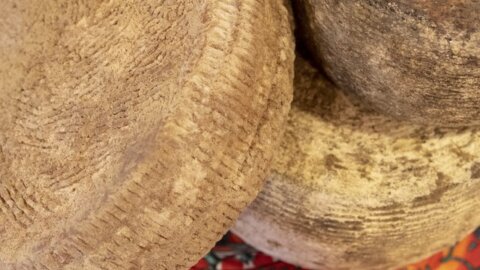
Aspromonte goat cheese is produced according to an ancient tradition passed down orally. Raw milk is heated fresh from the cow's milk and kid rennet is added. After coagulation, the curd is finely broken, placed in rush (or plastic) baskets, and pressed by hand. The cheeses, generally small (between 800 g and 2 kg), can be eaten fresh or after a few days. The larger ones, weighing 3 kg or more, are aged for up to a year. The flavor is bold, with vegetal notes and a lingering finish that evokes the mountain pastures. In addition to cheese, another excellent product of the Aspromonte region is ricotta, available both fresh and salted and aged. Worthy of mention among Aspromonte goat cheeses is Musulupa, a cheese pressed in black mulberry wood molds that can be shaped like a female figure or an udder, and which has its roots in Greek-Byzantine pastoral culture. It was prepared in conjunction with the Easter holidays as a wish of fertility to the beloved woman.