
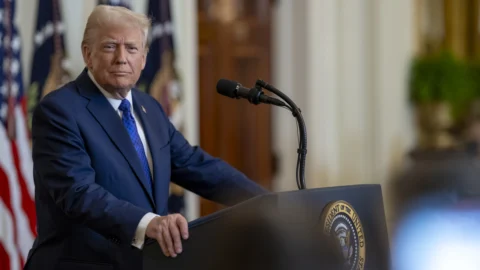
In the midst of war in Iran, President Donald Trump declared that the United States has achieved a agreement with Iran on 15 main points, including an Iranian commitment to to renounce the development of nuclear weaponsThe president, speaking to reporters before leaving for Memphis, called the talks with the Islamic Republic "very positive and productive" and assured that discussions would continue throughout the week, with the stated aim of to end hostilities and prevent further escalations in the region. Strait of Hormuz it could reopen "with possible joint control", the US president specified.
Trump reassures: "Since the halt to the raids, things are going very well."
I talks would have been conducted with Mohammad Bagher Ghalibaf, Speaker of the Iranian Parliament, without involve the Supreme Leader Mojtaba Khamenei"We're talking to a respected leader, not Khamenei. We want enriched uranium from Tehran," the US president clarified, adding that the Strait of Hormuz could reopen, "perhaps under joint control, if that works." He reiterated: "We have agreement on almost all points, but I don't want Khamenei killed."
Trump tied the announcement of the agreement to theextension of an ultimatum addressed to Tehran: initially Washington had asked for the reopening total of the Strait of Hormuz within 48 hours, threatening attacks on Iran's nuclear power plants and energy infrastructure if they do not. However, this morning the president said he had postponed the planned attacks for five days, linking this decision to progress—at least according to the United States—in ongoing negotiations. "After the halt in the raids, things are going very well," he added.
The president reiterated his determination to reach an agreement: "We are firmly committed to reaching an agreement; there has been a regime change." He also emphasized the discrepancy between his statements and those of the Iranian media: "We also had talks last night; I don't understand the Iranian media."
Iran denies negotiations with the US, goes on high alert
Despite American optimism, Iran denied any negotiation direct with WashingtonTehran's Foreign Ministry called Trump's statements "tools to lower energy prices and buy time for military plans." Pasdaran They reiterated that any attacks on the energy grid would be retaliated, while the Iranian Defense Council reiterated: "They will only pass through Hormuz with our approval. If we invade, we will mine the Gulf."
On the ground, the situation remains critical. US and Israeli air raids They have hit military facilities and prisons, causing civilian deaths and injuries, and a toxic cloud hangs over the capital. Iranian ballistic missiles have been fired toward Riyadh, while strategic infrastructure in the Gulf has been damaged.
In the rest of the world there is maximum alert: the Russia calls for an immediate cessation of hostilities and a political solution that takes into account Iranian interests, while theEuropean Union strengthens cooperation with the Gulf countries. Meanwhile, the United States have issued a global warning of caution to their citizens, and'International Energy Agency warns that the world faces its worst energy crisis in decades, with more than 11 million barrels of oil being lost per day.