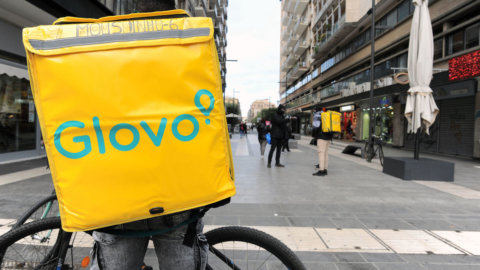
Glovo ends up below judicial control in Italy. There Italian company of the Spanish giant, Foodinho Srl, was reached by an urgent decree from the prosecutor Paul Storari of Milan Public Prosecutor's Office, carried out by the Carabinieri of the Milan Labor Inspectorate. The reason? Working conditions which investigators define as "below the poverty line", with wages and contracts that are clearly in violation of the law. The goal is to ensure compliance, regularize workers, and prevent the recurrence of exploitation. The judicial administrator is coordinating the intervention. Andrea Adriano Romanò, appointed to support the company in its day-to-day management.
The main accusation is caporalato, contested both by the company and by the sole director, Pierre Miquel Oscar, investigated for having "employed workers in exploitative conditions, taking advantage of the workers' state of need". Foodinho-Glovo is also under investigation for administrative liability of entities, since the organizational model adopted would be clearly contrary to the principle of legality and aimed at profiting from exploitation.
Glovo: Riders paid by self-employed workers but managed as employees
The measure concerns riders who work in Milan and throughout Italy: around 2.000 in the Lombard city and 40 thousand nationwideAccording to the Prosecutor's Office, many of them receive wages up to 76,95% below the poverty line and up to 81,62% below the minimum wages established by national collective bargaining agreements signed by major unions such as UGL and Assodelivery. These data highlight a significant disparity between the work performed and the compensation received.
The riders, although formally self-employed with VAT number, are in reality managed as employees through a digital platform. The platform continuously geolocates them, evaluates their availability and performance, and links this data directly to their wages. This system is defined by the Prosecutor's Office as an "algorithmic hetero-organization," i.e., a structured control of the work typical of subordinate employment, disguised as self-employment. These conditions violate Article 36 of the Constitution, which guarantees a salary proportionate to the quantity and quality of work and suitable for ensuring a dignified life.
Judicial review: how it works and what changes for Glovo
Unlike a seizure or closure, judicial review does not suspend business activityA judge may appoint expert administrators to assist management, authorizing only those actions necessary to prevent situations of serious exploitation and sub-threshold wages. The decree must be validated by a investigating judge within 10 days, with the aim of ensuring regularity in employment relationships without interrupting the company's operations.
The Glovo case brings to mind Uber Italy, the Italian subsidiary that operated the Uber Eats food delivery service, was placed under special administration in 2020 after riders were paid piecework rates of 3-3,5 euros, deducted tips, and even recruited from reception centers. Former managers received suspended sentences and compensation was awarded to the workers.
Similarly, the world of Italian fashion has its skeletons in the closet: as many as 13 brands have ended up under investigation for gangmastering in subcontracting, where workers exploited in hidden workshops demonstrate that even prestigious supply chains can hide serious violations of workers' rights.