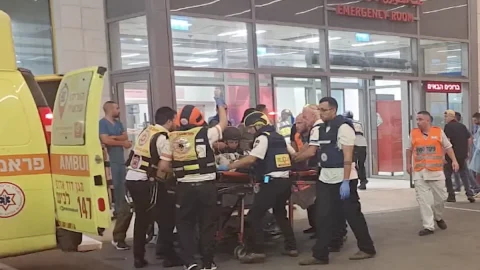
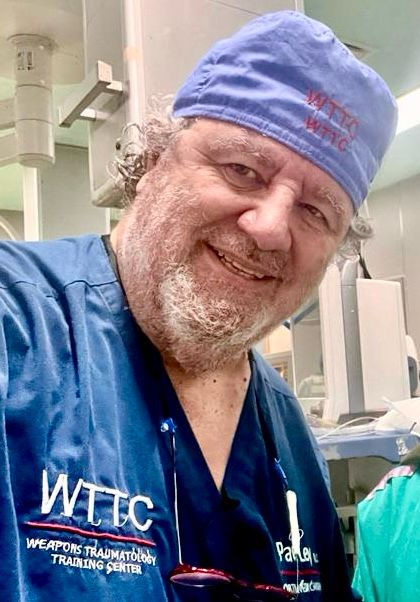
Paul Ley, orthopedic surgeon of the International Committee of the Red Cross, 61 years old, Italian-French, with long experience as a surgeon in places of war and terrible conflicts, since 27 October he has been working atEuropean Hospital of Khan Yunis in Gaza, uninterruptedly, with breaks for short rests but without ever going out, dealing with amputations, extremely painful dressings of burns and frightening wounds, without the necessary drugs to prevent infections and operating without anesthesia. In an apocalyptic scenario that Ley tries to describe in its tragic dimensions. He is part of the team working on UN mandate for assistance to war victims, made up of two surgeons (one of whom is Him), an anesthetist, an instrumentalist and two nurses. And everyone will continue to operate and treat for other weeks until they reach a maximum of six before being replaced by another team.
The story of surgeon Paul Ley from Gaza
The pace of interventions and treatments – so to speak given the lack of everything – is stressful, we can't even know how many patients there are present in the large hospital. “Maybe two thousand, but here the displaced continue to arrive and stop everywhere, even in the elevator, and perhaps there will be 5-6 thousand. Of the two thousand hospitalized patients, 700 are those with serious orthopedic problems that I have to follow in four operating rooms. And what it feels like in the background are the screams of pain, the desperate requests for drugs to avoid suffering…And as a much louder, deafening soundtrack that never ends, the bombings, the shots, the drones that pass above constantly. We are always under fire. They haven't hit us yet because we are, to use a new term, "deconflicted" but 150 meters away everything is under the target of the Israeli attacks" which responded to the Hamas terrorist attack on 7 October.
In this gigantic circle of hell someone must also think about the displaced people who populate every little space of the hospital. “We share with them – he underlines – water and food”. The chaos is total, for two weeks the wounded have been arriving here who were never treated by a collapsing healthcare system, which is now non-existent. But also This health facility is exhausted. The patients are also lying on the ground on mattresses and in the misfortune of pain and uncertainty of their fate, at least they have an advantage that the splinters coming through the windows do not hit them". Bitter observation.
Ley from Gaza: "We are all targets, there is nothing left in Gaza"
"We are all undirected targets, but we are. But at least we know that they will get us out of here in a few weeks but not them. Everyone, doctors, nurses, and those present, will meet the end, they only know how to suffer this fate. I say this with enormous dismay - Ley confesses - I don't know what will happen, I know thatthe damage is and will be enormous, this is a population that will be made up of disabled, traumatized and sick people with no hope of being assisted because here in Gaza there is nothing left, these are poor countries and populations, without resources."
Let's try to get some numbers to give objective evidence of the immeasurable damage that Gaza will have to suffer for a very long time. “These people will have very serious consequences due to untreated wounds, unassisted trauma, infections that will cause pseudarthrosis, it will weigh on the population an entire generation of disabled people with unreconstructed limbs.” It is the first time that Ley really describes in its tragic reality what Israel's official statements describe as "collateral damages”. How many disabled people will there be? “At least two thirds of the population is without assistance. As I have already said, here is the 4th0% of burn victims are children under 15 years old. Our intervention, despite being non-stop, is a drop of water in the face of the immensity of the damage, but the doctors at the hospital are very grateful to us because our presence and our commitment are of enormous help, both physically and psychologically. And often our advice is also precious to them. But they are often exhausted, after continuous amputations with the wounded arriving without interruption, they ask to be replaced. They can't do it anymore."
What will happen once the war on Gaza is over? "I repeat, a huge legacy of disabled people. I have always operated in very difficult conditions, throughout South America, in Africa, I worked with Gino Strada and always in zones of war or violence and civil wars. But an intensity of bombing like this, concentrated in such a short time, and on such a small strip of surface, only 15 km of the total of 39 in Gaza, has never occurred. Never ever like this."