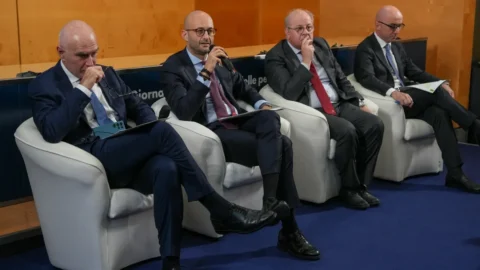
Silicon Valley lands in Veneto. To be precise, in Cison di Valmarino, in the province of Treviso, where Ambrosetti gave birth in the splendid setting of the castle of Castelbrando to the first edition of the Technology Forum, an appointment dedicated to innovation and "technological transfer", which saw the participation of numerous entrepreneurs and companies from the North-East.
The North-East – as is known – is at the forefront in terms of productivity, but still behind – like the rest of the country – in terms of innovation. That is why, in the fortress formerly owned by the Brandolini family and in 1997 taken over and renovated by Massimo Colomban, former patron and founder of Permasteelisa (present at the event with the current CEO Nicola Greco), was also invited Lee Burton, professor of European business and innovation at Stanford University.
"Silicon Valley is a strategic place for Europe: it is the place where the whole world learns new approaches to innovation first”, says Burton at the beginning of his speech. Indeed, SiliconValley concentrates 40% of US investments in venture capital, employing one million and 300 thousand people in sectors such as energy, media, medical devices and biotechnology.
How can the North-East, Italy, Europe copy this model? In his speech, Burton suggests an entirely new instrument, just approved (a month ago) by the Obama administration with a law that has been in the pipeline for two years and which regulates the so-called crowdfunding. That is, seeking funds from investors for startup companies and in general for new projects related to research and innovation.
The models proposed by the Stanford professor are two: the classic one, through the collection of equity, and the completely new one consisting in the financing not by buying shares in the company but through the upfront purchase of the product to be created. It's the crowdfunding product: all directly through the internet, with an agile, fast formula, accessible to all; "and precisely for this reason - explains Burton - at a high risk of fraud, which is why the US government quickly regulated the activity, setting some limits such as the ceiling of one million dollars in collection for the portals".
The leading crowdfunding portal is the US kickstarter.com, a funding platform for creative projects, which precisely gives the "kick-off" to several young companies launching technological products. Going to the site's home, you notice the simplicity of the tool: kickstarter offers a series of products from companies all over the world, which receive subscriptions and offers in real time. They range from simple artistic projects to real technological innovations, such as that of Pebble, a design company from Palo Alto (Silicon Valley, once again), which for his e-paper watch for iPhone and Android he has already collected 67 thousand supporters and the beauty of 10.172.556 dollars, starting from the minimum bid of 1 euro.
Portals of this kind are already starting to appear in Europe (and should also be properly regulated): from the Finnish growvc.com, to the British seedsrs.com and the Portuguese ppl.com.pt. It's Italy? Still back. Even the rich Northeast. But according to Professor Burton, the problem starts upstream, "from the universities, which do not invest sufficiently in research and innovation and are Europe's bottom line". The role of universities and research centers is in fact fundamental, and not only Burton says it: it is one of the most recurring topics in the speeches of the various speakers present at the Ambrosetti Forum, including various representatives of the academic and scientific world.
A Stanford for example, the university where the US speaker teaches, the students are less than 16 thousand and yet the budget reaches 4,1 billion dollars, of which 1,4 are destined for research and innovation. The Politecnico di Torino, on the other hand, has almost double the number of students (28) but the dedicated budget is only 62 million euros.
How do you explain? Could it be the fault of the excessive democratization of Italian and European universities? “Low-cost access – explains Burton – was at the basis of the formation of Western society. Perhaps the $60 required to enroll at Stanford is too much, but excellence needs to be funded, while keeping it accessible to the most. Even looking for different solutions. In the USA, for example, it is very frequent to provide loans to students, in Italy and in Europe, on the other hand, nothing similar is seen”. Especially in Italy, one might say, given that the universities of Tallinn and Riga (Estonia and Latvia) have respectively 14 and 17 students and allocate 95 and 264 million for research, much more than Turin, the Italian leader.
The all-Italian malaise then expands on other data. According to those provided by ProTon Europe, for example, the percentage of inventions coming from universities is only 9% in Italy, worse than Spain with 15% and far behind the European leaders, Denmark (22,8%) and the United Kingdom (22,6%), where almost one invention out of four comes from the benches of excellent training.
And the reflection inevitably comes on the impact that scarce research has on the corporate fabric. According to Eurostat data, Italy is only the 19th country in Europe in terms of collaboration rate between universities and companies: only 22% in those with more than 250 employees, 8% in those with 50-249 workers, 4% in those with 10-49 employees. In this ranking, commanded by Finland (and in general by the Scandinavian countries) with 70% of companies with more than 250 employees who cooperate with university research, we only do better than Greece: Spain, Hungary, Ireland and Portugal do better than us.