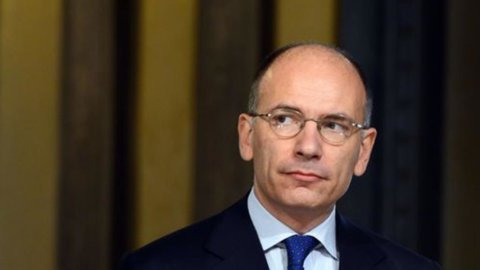
This morning, in the historic hall of the Italian Society for International Organization (SIOI) in Piazza San Marco in Rome, the former premier, Enrico Letta, returned to the public scene, giving a very crowded Lectio Magistralis on international scenarios. The theme was supposed to focus on Italy's ability to attract foreign investments, but the well-known events of yesterday night necessarily diverted the focus of the discussion on the new challenges - and risks - posed to the European Union by the victory of Tsipras' radical left in the Greek elections.
In his introduction, the President of SIOI Franco Frattini underlined how important the Greek scenario is for Italy, which is the third creditor of Tsipras' debt, and recalled the forthcoming European electoral deadlines, highlighting how realistic it is that a convergence of anti- -euro in Holland, France and Spain, where Podemos looks a lot like Syriza.
External conditions
“In the aftermath of the Greek vote – Letta began – it is clear how it is necessary to weigh the words and promises of leader Tsipras and the relative responses arriving from Brussels. These words traveled like two trains in opposite directions, on a clear collision course". But everyone's goal can only be to "avoid the third crisis within seven years" by avoiding too much rigidity from both Tsipras and the Troika. “The romanticism with which the Greek situation has been addressed, especially by the press, must be transformed into realism. Europe, but also Greece – Letta recalled – must first of all thank the former Premier Samaras, who has brought the Greek people out of the worst period of the crisis”. However, Letta described Tsipras as a "pragmatic" person who made his promises to win the elections. “Now we need to find the right mix between the two souls of the situation: if Tsipras' promises are kept, the third crisis in seven years will be inevitable and we will all get hurt a lot. Therefore, every effort must be made to keep Greece in Europe, because the domino effect would be unpredictable and catastrophic. In this scenario, Italy is called upon to play an important role, but all parties must take steps forward because Syriza's program cannot be combined with the four-year - and still ongoing - commitment of the creditors". The same logic of dialogue rather than confrontation must apply between Europe, Russia and Ukraine.
In Letta's speech there is also room for a comment on the necessary reforms to the activity of the European institutions. “We need to internalize the logic of a two-speed Europe: the euro area must become a whole both financially and economically, as well as politically. Growth is a European matter and not just a national one, and the recipes must be common. First of all - for Letta - it is necessary to facilitate cross-border mergers between the large groups of European countries, which are now almost non-existent. Just think of the mobile telephony sector: In America there are 4 operators like in China, while in Europe we have 70. Those 70 companies will never be able to compete globally as the four American and Chinese ones will be able to. We need to understand that the barriers and differences between the 28 are a clear limitation and not an advantage for European competitiveness”.
Internal conditions
Letta, analyzing the internal problems of the Italian economy, recalls how the international economic system is divided into companies that operate mainly or exclusively on internal demand and companies oriented towards trade policies on an international scale. The former are in clear difficulty, while the latter are growing more and more, even managing to cope with the problems dating back to the losses of internal trade. "From this point of view - continued the former Prime Minister - it must be clear that attracting investments and striving to be competitive in exports is a single issue: the two actions must go hand in hand, like two sides of the same coin ”. In the same speech, Letta also included the theme of emigration and immigration, which must return to being a value: "We must exploit all the benefits, facing the inevitable difficulties". In this regard, he recalls that the percentage of immigration in Italy is the lowest in Europe, at 6-7%, while the impact that the related problems have on public opinion is extremely strong.
Three gaps to fill
Bearing in mind that the goal of Italian trade policies must be to internationalize the economic system as much as possible, Letta explained what Italy lacks to be efficiently competitive. First of all, innovative financial instruments are needed as the main incentive for development towards internationalisation. Among these, of course, Minibonds and Eurobonds. The financial system must essentially become less bank-centric.
The former President then raised the problem of size of Italian companies. “Small and medium-sized enterprises must complement the awareness that too small does not work in the globalized international system. Therefore, growth in size is fundamental and instrumental to internationalization”.
Finally, Enrico Letta has identified a serious shortcoming in Italian commercial strategies in the total absence of Italy in the retail sector. On the merits, he cited some examples of large groups such as LeClerc, Auchan or Carrefour, denouncing how in Italy we have always been concerned only with where the made in Italy products should be positioned on the supermarket shelves. “One should rather ask oneself how important it is for Made in Italy to reach even distant markets and impose an offer which will then necessarily also convey demand”.
A final joke on the Quirinale could not be missing. Letta did not name names, of course, but clearly expressed gratitude for Giorgio Napolitano's nine years of service at Colle, indicating continuity with his presidency as the essential characteristic for the new head of state.