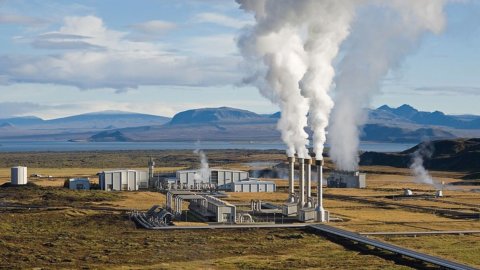
Tuscany has achieved its good result in the energy field. He approved the new law on geothermal energy and now feels strongly about relaunching the sector at a national level. He is asking the government to take concrete steps forward, looking at what and how it has been possible to do by collaborating also with a large company like Enel, consolidated here. Only around the Amiata mountains, where the plants are located, an estimated turnover of around 30 million euros a year. Resources that mainly go to the Municipalities and that the new law strengthens in the distribution principles.
The central part of the provision approved by the Regional Council affirms the need to block new plants and protect the landscape. Two sustainability goals intertwined with investment and social peace. The entire geothermal business is regulated with the distribution of funds to the territory to develop and increase the economy of the areas concerned. Nor is the way in which concessions and authorization profiles will be assigned for new plants secondary. In short, the first real case of circular economy on a regional basis, as confirmed by all those involved. In times of extreme monitoring, the law could not miss the continuous one on the plants, heavily entrusted to Asl and Arpat. All the observations on emissions into the atmosphere connected to geothermal energy have, in fact, been implemented by law and even environmentalists can feel more relaxed. There are new and strong limits on pollutants. In the sense that there must be less and less ammonia, mercury, sulfuric acid and boron in the atmosphere and woe to not respect them. There is a risk of plant shutdowns.
The political value of the law is articulated in the declarations of these hours. The context and green energy strategies are the heritage of all of Italy. It is no longer acceptable that the Italian path of integration between fossil fuels and renewables is among the least pushed at European level. In the specific case, it is useful to integrate the specific legislative decree for geothermal energy. The undersecretary of the Ministry of Economic Development Davide Crippa is asked, in fact, to immediately reopen a discussion table. We await the convocation of the promised table from the undersecretary, explains the Tuscan councilor Federica Fratoni. We will continue to fight nationally to ensure that geothermal energy is adequately encouraged from the point of view of a Region that is directing its choices towards sustainability and liberation from traditional fossil sources. An operational protocol will also be passed shortly with Enel which manages the activities.
Geothermal energy is among the renewables, perhaps the least encouraged. But its cultivation has excellent economic and employment repercussions for the territories involved with attention to the environmental and landscape assets. In Tuscany, it satisfies more than 30% of regional electricity needs, but at a national level it barely reaches 2% of consumption. It certainly needs to be encouraged and Enel is aware of this, with plants also managed outside Tuscany. Here the Committees do not abandon the territories, on the basis of the controversies and doubts about the technologies used to manage the production cycle. From the province of Pisa to those of Grosseto and Siena with the great underground wealth that is connected to the value of the historical discoveries in the area of Lardarello and to the magma of Monte Amiata. Technological reassurances, above all for the benefit of those who contested the current systems, are the other economic and successful lever in the hands of the Region. If the operator-concessionaire does not comply with the regulations, the concession will be revoked. "Amiata mother land", it was said after the passing of the law, to be taken as an example. Certain. Especially from the government.