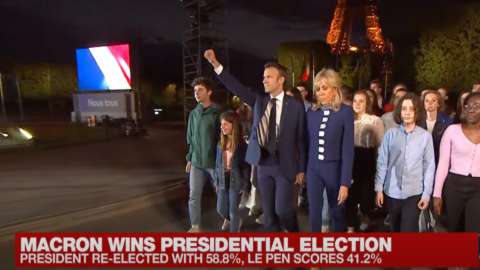
“A new era opens for France. No one will be left at the side of the road. We will build a great ecological nation. And a more just society”. Emmanuel Macron, re-elected president, resumes his dress as a man of the reformist left because the next five years will not be a simple "continuation of the first ones". This is what was expected from many quarters. And not just because he is about to start a new electoral campaign, that of the legislative ones, which will take place in just over a month, on June 10th. But also because Macron now has the task of healing the great popular rift, as has been observed by many in the newspapers, between those who have gained the most from the various crises and those who have been devastated by them.
Macron stopped populism at the gates of the Elysée, beating Marine Le Pen with 58,6% against the 41,4% achieved by the challenger, after one of the toughest fights in French history.
Macron wins and Europe celebrates
Even Europe was able to breathe a sigh of relief. Not by chance Ursula Von Der Leyen e Mario Draghi they were the first to express their satisfaction with the result of the vote, the Italian premier calling it "splendid news for Europe".
Until the last second there was enormous fear that France was ready to do like Great Britain with Brexit or the USA with Trump. Because never before has Marine Le Pen been insidious, becoming a credible candidate for the Elysée. And the result was not lacking: the far right achieved the highest number of votes ever, almost 12 million.
Marine Le Pen was the first to comment on the result, after phoning Macron to accept defeat. She said she has "neither resentment nor hard feelings" and that "more than ever she continues in her commitment to her." You have made an appointment for the legislative meetings when "there will be another turn" because "Macron will do nothing to change the conditions of the French".
The second to speak after the vote was Jean-Luc Mélenchon, also ready to open the new electoral campaign: “Le Pen was beaten and it is good news – he said – but Macron is the most poorly elected president of all, he navigates between a flood of blank votes and abstention. And so he – he concluded – went to the legislatures to vote to change the Assembly and elect me prime minister ”.
Macron at the Champ de Mars: "No one remains on the sidelines"
Finally, Emmanuel Macron spoke, welcomed on the Champs de Mars, the capital's most historic gardens, with the Eiffel Tower, the very symbol of Paris, behind it.
He approached the stage on foot, together with his wife Brigitte and about twenty young people, while the music played the Hymn of Joy, that of Europe. Television commentators immediately underlined the difference with 2017: then he showed up only in the courtyard of the Louvre, still to the notes of the European anthem.
Then he thanked the French numerous times for the new trust and announced the great change of vision: France will have to become a country where one is happier. And to do this it will be necessary that "no one remains on the margins".
The new electoral campaign has already begun for him too and all those French who have chosen Mélenchon's radical left and the more fragile who let themselves be taken by Le Pen's promises need to be convinced.
To change, however, you have to start from what has been built.
What kind of president was Emmanuel Macron?
Despite being one of the least loved French heads of state since De Gaulle introduced the Fifth Republic in 1958, many successes can be attributed to him. And the press has granted them all.
France today is a modernized country, inventing startups and launching itself into hydrogen. It has reduced unemployment to an all-time low for fifteen years. The country's growth, despite the war, could reach 3% in 2022. Taxes have been cut by 50 billion, of which 25 for families. And inflation is also among the lowest in the West, leaving purchasing power, the main theme of the electoral campaign, increased by an average of 300 euros a year.
However, Macron failed to unite the French
Never before has the country shown to be "fractured" as this time, as analysts have explained in all guises. And this was confirmed by the enormous abstention rate, over 28%, the highest in the second round since 1969.
This will be the toughest task that awaits Macron: reunite his country. Erasing the hatred of the left which considers him right, and of the right which hates him because he considers him responsible for his defeat.
The only place where he has only Macron admirers is Europe where he exercises a strong and recognized leadership. Also from a lexical point of view. The terms "European sovereignty" and "strategic autonomy" are from him, taken from the speech at the Sorbonne he made after being elected in 2017.
Leadership evident even more if you look at the neighbors: the German chancellor does not yet have the charisma sufficient to impose himself at the table of 27; while Italy, despite Draghi's strong and important role, is entering an electoral campaign whose outcome is unpredictable.
In short, observers argue that after the German hegemony, which lasted for the entire period of Merkel's chancellery, the time may have come for the French one.
But all in its time. Now that someone who believes in the future of the Union is left in Paris, a new agenda can be written.