Here are the Giorni della Merla, the last three days of January that according to tradition would be the three coldest days of the year. Surrounded by many legends about the origin of the name, from a white blackbird that with her chicks had taken refuge in a chimney to protect herself from the terrible cold and then came out completely blackened by soot, to the myth of Demeter and Persephone, to the story of an old Apennine that unleashes his wrath against the blackbird with rain, snowfall and freezing wind, but keeping the tradition of the giorni della Merla alive is the fact that the fateful days at the end of January allow with their progression to predict how long the winter will last and when we will be able to benefit from milder temperatures.
Cold is cold as the temperatures of these days attest and here is the idea of the organizers of the Bagna Cauda Day to replicate the initiative that was attempted between November and December last year with a Bagna della merla that will be proposed again from Wednesday 29 January to Sunday 2 February 2025, on the occasion of the days of the blackbird in about a hundred places, throughout Piedmont with some trips abroad. The logo of the event is a blackbird in flight that carries a head of garlic in its beak, confirming the ironic streak that is also found in the bib given as a gift with the motto “Esageruma nen, il mondo è di tutti”.
Why that name and so many traditions?
"The formula doesn't change" confirms the Astigiani Association that for 12 years has proposed the Bagna Cauda Day with growing success. "We decided to do the Bagna della Merla three times at the request of many places that have already received reservations and especially of the bagnacaudisti who have told us what they wanted by answering the online questionnaire Vota la bagna".
Each participating venue offers reserved seats to bagnacauda diners, offering bagna cauda at the base price of 30 euros per person. Reservations are made by calling the venues listed by territory and on the bagnacaudaday.it website. The bottle of wine is offered at 15 euros and, speaking of wine, all participating venues are invited to join the “Buta Stupa” formula, which allows patrons to take home the unfinished bottle.
And there is no shortage of support from abroad: at the Osteria Pomo d'Oro in Budapest (Hungary) the Bagna della Merla inaugurates the new headquarters of the Order of the Knights of the Truffle and the Wines of Alba: on Saturday 1st February the investiture of the new knights will be celebrated with a large Bagna Cauda.
The Bagna Cauda della Merla also organized abroad
The Astigiani Association has promoted “Bagna alla lavagna” (Drink on the blackboard) in the schools of Asti, a research dedicated to changes in nutrition between generations. The initiative aims to solicit interviews and essays that will help young people understand how nutrition has changed: what did our grandparents eat? And our parents, and us? The essays, drawings, videos, and posters will be awarded on Friday, January 31 at the Kor space in Asti.
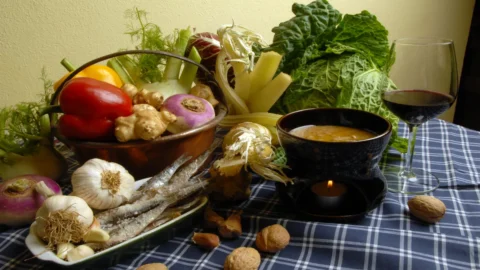
Bagna cauda is a traditional and convivial dish spread throughout the world wherever there are Piedmontese. A hot sauce of oil, anchovies and garlic that welcomes all types of vegetables from the garden, “dipped” in fujot and accompanied by bread and wine. There are cardoons, but also cabbages, turnips, red biarava, boiled potatoes and onions, leeks, Jerusalem artichokes, celery. Bagna Cauda has accompanied the winters of dozens of generations of farmers. It is an ancient ritual that has become current again with the addition of an ingredient: irony.
The BCD flag is the fabric bib designed this year by the young artist Giorgia Sanlorenzo who interpreted the motto “Esageruma nen il mondo è di tutti” as a call to defend planet Earth which is given as a gift to all bagnacaudisti
To find out which venues are participating in the original formula, simply go to the website www.bagnacaudaday.it and scroll through the lists, divided by geographical area: Asti, Monferrato, Langhe, Torinese, Alto Piemonte and more. For each venue, a sheet is published with the number of places available, telephone and email to book.
The three versions: red, the classic “as God commands”, yellow for the “heretic” with diluted garlic and green for the “atheist” without garlic.
You have to follow the traffic lights that indicate the type of bagna cauda offered: red for the classic version “as God commands”, yellow for the “heretical” one with diluted garlic and green for the “atheist” bagna without garlic.
There is also the possibility of having bagna cauda at home, ready-made with all the right vegetables from the places that offer the “Sporta a ca'” version. The bagnacaudaday.it website also lists hotels and agritourisms that offer stays at special prices for the most fragrant weekends of the year.
Among the scent of fujot and the colors of vegetables, Bagna Cauda Day also celebrates experiences that have left a mark. For this reason, since 2016, the Astigiani association has awarded the Testa d'Aj Prize to people who in life have demonstrated, with tenacity, passion and a touch of irony, that they know how to go against the grain. In the roll of honor we find, among others, the names of Guido Ceronetti, Antonio Ricci, Enzo Bianchi, Carlin Petrini, Margherita Oggero, Oscar Farinetti, Alice Sotero, Giorgio and Caterina Calabrese, Carlotta Castelnuovi, Luca Mercalli, Fulvio Marino.
The Bagna Cauda Day, in addition to financing concrete actions of social solidarity, also invests in environmental protection. "We believe in the concrete action of planting trees - they explain to Astigiani - The Bagna Cauda day will help finance the creation of the Bosco degli Astigiani on the hills of Viatosto on a land of over 5 hectares made available to the Municipality of Asti by Banca d'Asti. Going to eat bagna cauda will thus contribute to giving life to a large public park in the name of environmental sustainability to protect biodiversity".