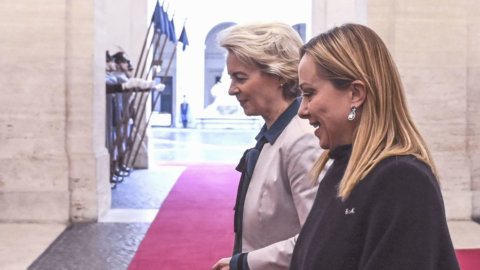
Maybe they weren't entirely wrong. Emmanuel Macron and Pedro Sanchez but also numerous Italian economists – from Marcellus Messori a Guido tabellini e Lorenzo Bini Smaghi – who recommended keeping a straight back in the negotiations on tariffs with the American President Donald Trump, putting the right cards on the table. Of course, there's no proof of how things would have gone if the advice had been followed, but there is certainly evidence that the soft strategy implemented by the German President of the European Commission, Ursula von der Leyen and recommended by the Italian Prime Minister, Giorgia Meloni, Extremely concerned not to upset Trump, she didn't pay. Let's face it: the outcome of the tariff negotiations looks more like a surrender to the tycoon's arrogance than an agreement. Made in Italy pays a high price – especially in the mechanical and food sectors, but how much will American energy and weapons purchases cost us? – and Meloni's hope of receiving preferential treatment from Donald, who could not be there, was in vain. Countries will pay the price above all – like Germany and Italy – who have a strong trade exposure to the USA.Inspi He calculated that Germany could suffer a GDP contraction of 3% and Italy of 0,2%, but then we must add the devaluation of the dollar against the euro and its effects on our exports: "For an Italian exporter, adding together the tariff and the unfavorable exchange rate, the total burden reaches 21%."
Now some say that a bad deal is better than no deal because businesses and markets finally find certainty in the US-EU agreement and because the costs of a trade war would have been devastating, but these are unconvincing arguments, as the initial reaction of the European stock markets testifies.
Tariffs: the EU is already seeing a terrible result, but who can guarantee that 15% is the target?
First, where is it written that the choice was between a bad tariff deal and a trade war? Who said better negotiations couldn't be made—with a straight back, indeed!—and that von der Leyen's capitulation, focused more on defending German interests than European ones, was inevitable? If there aren't adequate compensatory measures for companies subjected to the tariffs, life will be tough for Made in Italy. But there's a second point, highlighted especially by Bini Smaghi, that casts a disturbing shadow over the entire game: who can guarantee that the 15% tariff is the end point, not the starting point, of Trump's delusional economic strategy? Unfortunately, no one can guarantee this, just as no one can know where the unpredictability of the arrogant White House occupant will lead in the future. And it's extremely short-sighted to say, self-consolingly, that ultimately it's just a matter of holding out until 2028, when Trump will exit the scene. Yes, but at this rate, many Italian businesses will disappear or be brought to their knees, unless Sunday's cold shower teaches Europe and Italy a lesson. Better late than never, but without courage and political independence, one can only reap defeats.