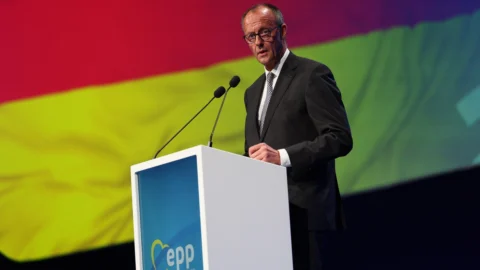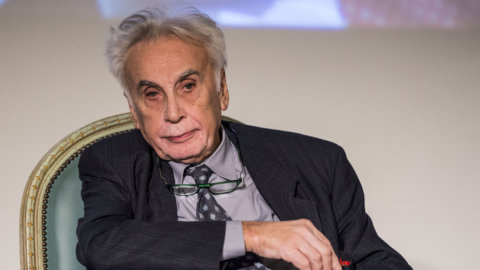
" European defense it is a decisive element, but not alone. The process must be political and must concern the entire governance of the Union”. Biagio DeGiovanni, one of the most acute Neapolitan philosophers and politicians in our country, he lived important and exciting moments in the life of the Union, having been a European deputy for ten years and in crucial times, from 1989 to 1999, when the communist world imploded under the Wall of Berlin and, as the main scaffolding came down, Soviet Russia dragged half of Europe into the dust. And even in blood in some cases, as in Yugoslavia, where - from 1991 to 2001 - five inter-ethnic wars took place (Slovenian, Croatian, Bosnian, Kosovar, Macedonian).
Conversing with FIRST online, De Giovanni is keen to maintain that he agrees with those who believe that never before now, overwhelmed by two wars which risk undermining the very democratic framework of the Union (and of the West), that of Russia against Ukraine and that of Gaza, it is necessary for Europe to equip itself with its own military defense. However – at the same time – he believes that it is not a question of armies, but of politics.
Prof De Giovanni, the picture that emerges from the analyzes of numerous study centres, starting with the Cesue (Centre for studies, training, communication and planning on the European Union), photographs an absurd situation: Europe has enormous military costs to have a non -Defence. The 27 member states together, in fact, have the third highest military expenditure in the world (268 billion dollars), after the United States (811 billion dollars) and China (298 billion dollars), but they are not able to defend themselves. Concretely, the Union spends 1,5% of GDP on defense (European Defense Agency data), i.e. one and a half times the entire community budget, but this spending is almost entirely wasted. This is because in Europe there are 27 armies, one per state, and an excessive number of weapon systems. We have many more military personnel than the US, but they are less trained and less equipped. While we ship for personnel (salaries) more than we do for research, innovation or armaments, the opposite of what happens in America. We also allocate significant funds to purchase vehicles, but then we do not guarantee their use: for example we purchase planes, but the number of hours in which our pilots can use them is much lower than American ones. In short, professor, if not now, when?
“European Defense is a decisive element, I fully agree, but not alone. The process must be political and must concern the entire governance of the Union. Creating a European Defense requires the Union to have a real foreign and security policy because - as is clear to everyone - having a European military instrument and never being able to use it due to a decision-making system that assigns the right of veto to each country member would be ridiculous. The link between foreign, security and defense policy is therefore evident. This involves the creation of a government structure responsible for foreign, security and defense policy. That is, of a Union that truly speaks with one voice in the world. It's impossible? I am notoriously pessimistic, but I will simply say that the process will certainly be long. If you look at recent history there is no doubt about the complexity of this road. On the UN resolutions on the ceasefire in Gaza, member states were divided into those in favor, against, and abstentions. Yet the diversity of opinions in politics is normal, we do not need an unrealistic homogeneity of views, but institutional tools to decide democratically. That is, it is necessary to change the decision-making process, going beyond the unanimity rule in the Council, where the governments of the member states sit, to move on to the qualified majority. This is essential to be able to make decisions in a reasonable time, especially in the face of crises."
Do you also think that this time the vote on 8 June to change the European Parliament is really important?
“The greatest importance of these elections derives from the fact, as it seems obvious, that since the world picture has completely changed, caught as we are between chaos and wars, either the nature, the very function of the Union changes, and it is transformed by thinking as a plurinational power, as they say in geopolitics, first of all changing its functioning, I repeat, starting from mandatory unanimity on decisions, or it leaves the circle of those who count in the world. Leaving space not only for democracies like the USA, but also for China and Russia, which are not democracies at all. Precisely at the time in which we pass from the era of peace to that of non-peace, as the title of the beautiful book by the American scholar Mark Leonard states”.
Yet the times she lived through were no less important: in that case the very physiognomy of Europe changed, with new states regaining their lost identity, like Germany first and foremost, which was reunified with the eastern part, and all those countries that had been incorporated into the Soviet Union at the end of the Second World War in the division of the world that had brought peace: the Baltics, Poland, Hungary, to name just a few. What were those times?
“There was a prairie in front of us. Someone spoke of a Europe up to the Urals while the smaller states of the USSR were pushing to join the Union because Europe appeared to be a great territory of freedom, democracy and peace. Even Russia seemed to be heading down a path opposite to the one it had followed in 70 years of communism. Even though Delors, the commissioner at the time, warned us: don't make a myth of Europe, first deepen the ties between the founding states and then broaden them to the others. Prodi, on the other hand, followed another path, he wanted to open the doors to everyone. The generous spirit that this decision suggested was understood, and still is understood today, but the consequence was that now it is difficult to stay together because the culture of democratic and common rules are not shared. Just think of how much he rows against Hungary for example, how he blocks the most important processes to only gain national advantages or, worse, those of the party of those in government. In my opinion, this prevents us from moving quickly towards a common Union policy. This is why I remain pessimistic: the process of complete integration still remains long, uncertain and very problematic. And this has repercussions on public opinion which appears distracted, distant and disinterested. Obviously I hope to be proven wrong, first of all by participating in the June vote."