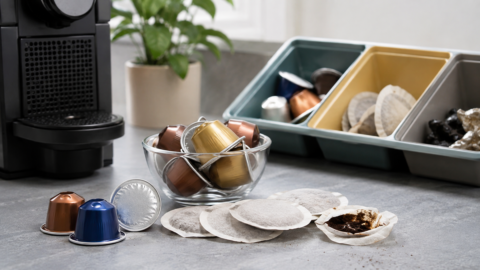
From 12 August 2026 Capsules, pods and single-serving sachets used to prepare coffee, tea and other drinks will officially enter the "packaging" category. The new regulation, foreseen by new European regulation on packaging and packaging waste, will bring clearer indications on packaging and new obligations for companies. However, there will not be a single container valid throughout Italy: correct disposal will continue todepend on the material and the collection system adopted in your municipality.
Capsules and pods become packaging even with residues
The change introduced by the Packaging and Packaging Waste Regulation, the so-called PPWR, is primarily a legal requirement. Until now, the classification could vary depending on the characteristics of the capsule and the manner in which it was disposed of. Products intended to be disposed of with used coffee could, in fact, be exempt from the regulations applied to packaging.
Starting August 12, this distinction will be abolished. Both permeable pods and single-serving units that become soft after use, as well as rigid aluminum or plastic capsules used in home coffee machines, will be considered packaging. Tea bags and other single-serving beverage preparations will also be included in the same category. The presence of coffee or tea left inside will therefore not prevent the packaging from being classified as packaging. packagingThe new approach takes into account the most common behavior of consumers, who generally throw away the capsule without separating it from the residual contents.
More information on the label, but the municipality still decides
The most immediate consequence for those who buy these products will be theenvironmental labeling. Packages intended for the Italian market must report the identification code of the material and the instructions relating to collection, according to the rules already established for other packaging.
Consumers will therefore be able to verify whether the product is made primarily of aluminum, plastic, paper, or compostable material, without having to determine this independently. Any separable elements, such as wrappers, closures, or tabs, can be individually identified and accompanied by the relevant instructions.
However, a completely uniform graphic system will not be available immediately across all EU member states. The harmonized European labeling envisaged by the PPWR should become operational from August 12, 2028, barring any delays related to the adoption of technical acts. In the meantime, the national system will remain central in Italy, supported by the provisions of individual municipalities and local managers.
Plastic, aluminum or organic waste: where should they be thrown away?
La new classification This does not mean that, from August 12th, all the capsules can be placed in the same bin. The procedures will continue to change based on the composition of the product and the ability of the plants present in the area to select small and light objects.
Capsules and pods made of biodegradable and compostable plastic, certified according to the EN 13432 standard, can be disposed of in organic waste, where applicable. In this case, the wrapper and coffee grounds can be treated together in composting facilities. However, the wording "biodegradable" alone will not be sufficient: compostability certification and an explicit indication of this on the label will be required.
for hard capsules in traditional plastic or aluminum it will be necessary instead check both the packaging and the instructions from the municipalityThe possibility of including them in the packaging collection does not guarantee that every facility is already capable of recovering them. In Milan, for example, aluminum capsules can be placed in the plastic and metal bag even with the coffee still inside. This system is made possible by the Muggiano facility, which is capable of intercepting even the smallest aluminum particles. Similar experiments have been launched in some areas of the provinces of Lecco and Monza Brianza, but the model cannot yet be automatically extended to the entire country.
Where adequate facilities are lacking, they will remain drop-off points can be used Organized by manufacturers or the solutions indicated by local managers. Disposing a capsule in the plastic or metal bin based solely on its material may not be sufficient to ensure effective recycling.
New obligations and costs for companies
Il regulation will also involve producers, called upon to take greater responsibility for the management of end-of-life products. The inclusion of capsules and pods in the packaging system will require the application of extended producer responsibility and the payment of the Conai environmental contribution.
The amounts will vary depending on the material used and will be used to finance collection, sorting, treatment, and recycling. Aluminum capsules will initially receive a contribution of €12 per ton, rising to €120 starting October 1, 2026, through an additional contribution aimed at developing recovery facilities and systems. Plastic, paper, and bioplastics will follow their respective contribution brackets.
Furthermore, a new one will start in August experimental phase, lasting up to twelve months, to assess the actual costs of managing the capsules. The initial fees can then be adjusted based on the specific difficulties encountered in collecting and processing the various products.
A further deadline is set for February 12, 2028By that date, permeable sachets, pods, and single-dose units that soften after use must be compatible with industrial composting. This requirement will not automatically extend to hard capsules, for which Member States may intervene if they have organic waste collection systems and suitable facilities.
For those who prepare coffee at home, therefore, the fundamental rule will remain oneRead the label and check your municipality's instructions. The final destination may vary from one area to another, but the goal of the reform is to reduce the amount of recoverable capsules that still end up in unsorted waste.