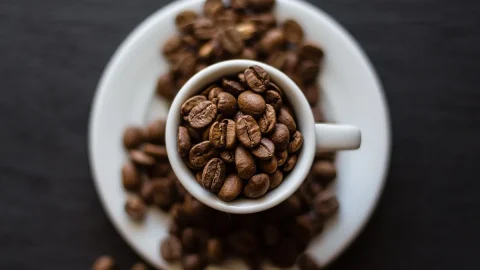
International prices of the arabica coffee have reached new all-time highs, surpassing $3,60 a pound, as Brazil, by far the world's largest producer, has very few beans left to sell, while worries remain about the next harvest.
Traders say 80-90% of Brazil's current Arabica crop has already been sold and new transactions are slow, according to a report ReutersBrazil produces nearly half of the world’s arabica beans, a high-quality variety typically used in roasted and ground blends.
Recently the climate The country's crop has been more favorable, after the severe drought that hit it last year. However, the next harvest is expected to be 4,4% lower than the previous one, according to Brazil's food supply agency. Conab. "The global supplies of coffee remain limited. The Vietnam it is proceeding slow with sales of its Robusta crop. And also the Arabica harvested in Central America and Colombia is taking longer to get to market and Brazilian farmers aren’t showing much interest in selling more,” broker HedgePoint Global Markets said yesterday.
Arabica coffee futures on the ICE exchange, a contract used globally to set the price of physical coffee trades, have reached a historical maximum of $3,6945 a pound at first, bringing gains for the year to nearly 15%. The contract then closed below its peaks but still up 2,5% at $3,6655 a pound. Robusta coffee, a generally cheaper variety used mostly for making instant coffee, rose 0,9% to $5.609 a ton.
Coffee exports from India, the world's fifth-largest robusta producer, are expected to decline by more than 10% in 2025 due to lower production and lower carryover stocks from last season's harvest.
Traders say farmers in both India and Vietnam, the world's top Robusta producer, are holding back sales in anticipation of further price increases, and that about 80-90% of the current crop has been sold in Brazil.
Broker Sucden said in a report that Brazilian farmers are also prioritizing local sales over dollar-priced exports, despite the latter yielding more, as their financial situation has improved significantly in the past two years.
He added that the country's current reserve stocks have eroded to around 500.000 bags, compared to around 8 million bags traditionally, meaning any further weather disruptions could have a disproportionate impact on global coffee prices. Sucden expects the global coffee market to see the fourth consecutive deficit in this season.
Sugar and cocoa also on the rise
Among other traded soft commodities, the raw sugar rose 1,1% to 19,45 cents a pound, rebounding sharply from last week's five-month low, while white sugar rose 2,2% to $522,90 a tonne. Futures on the New York Cocoa rose 3,3% to $11.745 a tonne, while the London Cocoa rose 1,6% to 9.138 pounds per ton.
In Italy the price of a cup has already gone up
According to the recent survey carried out by Assoutenti and the Training and Research Centre on Consumption (Crc), the price of a cup of coffee served in Italian bars continues to rise, so much so that at the end of 2024 the average price of an espresso in Italy reached an average of 1,21 euros, up +18,1% on 2021. After all, the price per kilogram of roasted coffee has seen an average increase of 42,8% over the last three years. At the end of 2024, the average was 12,66 euros per kg, compared to 8,86 euros in 2021.
Bolzano firmly leads the ranking of Italian cities where espresso costs the most, with an average of 1,38 euros per cup, followed by Trento (1,35 euros) and Pescara (1,34 euros), the city that also recorded the heaviest increase (+34% since 2021). The price rises to 1 euro in the cheapest city, Catanzaro, 1,12 euros in Rome. With 6 billion cups of espresso sold each year in Italy, the total outlay for consumers reached 7,26 billion euros in 2024.