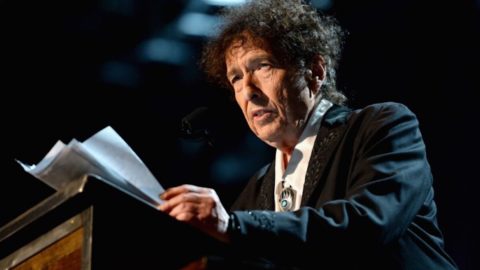
Born in 1941 in Duluth, Minnesota, whose real name is Robert Zimmermann, he spent his childhood in Hibbing, a mining town about a hundred kilometers from the border with Canada. His father, an appliance dealer, gave a piano to his sons Bob and David in the late XNUMXs. A little later, self-taught, Bob learned to play not only the piano but also the guitar and harmonica. In middle school he put together a band and started playing music rock-n-roll, which was becoming popular at the time. After school he decided to give himself an artist name, that's what he became Bob Dylan and left home. He enrolled at the University of Minnesota, but he didn't like studying much, he preferred to play in clubs. So he decided to leave the university and travel hitchhiking, stopping wherever he could and offering to play in clubs.
He had his idol Woody guthrie, the singer-songwriter who became famous in the late twenties. Knowing that he was ill, he decided to go to the hospital where he was hospitalized and they immediately became friends. And it is from him that Dylan drew that melancholic and discursive style with that dragged popular cadence.
In 1961 he arrived in New York, began to go to the cafes of Greenwich Village; in his folk songs yearning melancholy mingled with a feeling of protest. One day a representative of the Columbia Records she heard him sing and immediately signed him to a recording contract. In 1962 he composed Blowin' in three winds, and it was the real conquest of the public. That song was Dylan's first big hit, and was recorded by more than fifty singers and ensembles. He joined the American civil rights movement and actively participated in marches and rallies in the South, singing at charity events.
The rhythm of his shows became unceasing, he got on and off planes and in the evening he performed non-stop. Dylan himself declared that he began to take drugs in order to keep up that exhausting pace. Despite his popularity, he was always reserved about his private life. He hardly talked about his family or the time he devoted to them. He wrote wherever he happened to be, from the motel to the taxi, he just needed to be inspired to compose and any moment could be propitious. “I try to write songs when they come to me".
His music continued to evolve continuously, each record seeming to go in a different direction, winning new admirers and sometimes losing older ones. In 1965, during a performance at the Newport Festival, he was booed because he showed up with an electric guitar equipped with an amplifier. But he conquered a very young audience who began to imagine music only if accompanied by psychedelic lights. In 1966 he had a serious motorcycle accident and remained immobile and isolated for a long time, while his fans imagined him paralyzed to the point that he could no longer perform. It took about two years for Dylan to emerge from his isolation to sing in a benefit show at Carnegie Hall. After touring around for five years, he convinced himself that he was no longer using drugs and began to live a quieter, more private life with his wife and five children.
The critic Alfred Arnowitz one day she said about him ” It almost single-handedly changed the shape of American popular music. He gave birth to a new generation of poets and helped make contemporary music the literature of our time."
Dylan is one of the most famous songwriters, but he remained that serious and reserved boy, despite the success and idolatry of millions of young people then and today. In 2016 Bob Dylan won the Nobel Prize for literature. He was awarded the highest prize by the Swedish Academy "for having created a new poetic expression within the great tradition of American song".