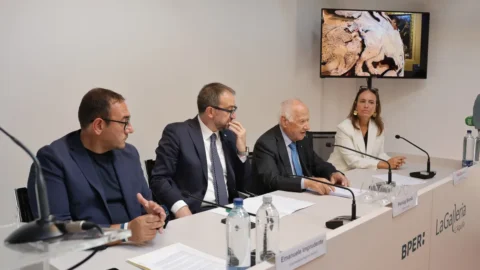
The review, curated by Luca Zuccala and Andrea Tinterri, which develops in the least accessible places of the fifteenth-century structure, from the cells and chapels of the central courtyard to the prison gallery, offers the works created during the residency for artists Lido La Fortuna, curated by Luca Zuccala, coordinated by Caterina Angelucci, with the support of Giulia Giommi, promoted by the Cultural Association Contemporary beach, in collaboration with the Municipality of Fano – Department of Culture and Cultural Heritage – and RTI Fano Rocca Malatestiana, which took place last May, in the hinterland of Fano, at the Symposium of Cartoceto (PU).
The exhibition – whose title echoes the “almost impossible unstable equilibriums” of the work of Eliseo Mattiacci, a sculptor born and raised in this area, overturning its meaning and giving a vision of hope - takes the form of an act of restitution to the area and to the community and focuses on the themes that were faced during the period of residence, such as the concept of the Renaissance window, the architectural measure, the Renaissance as a laboratory, the search for elsewhere, the landscape as a work of art, the painted earth, connotative of the hills of the Fano hinterland, the uniqueness of the local language , the theme of the return, the reflection on the community, the dialogue and the fruitful contamination between artists, languages, artistic practices, hybridization and interdisciplinarity of the research, the residency as resistance from the spectacularization of the art system and the schizophrenia of the market, the silence as a state, the fertile relationship between center and periphery.
Lydia Bianchi (1992) explores the Fano landscape avoiding the spectacularization of beauty, photographing almost monochrome theatrical scenes (Flowering elderberry walls) that allow her to defuse the horizon and elaborate a new story. In They arethe fireflies are back, Paolo, the narration is centered on the public/private dualism – history/biography, which recalls family reminiscences and the famous written corsaro by Pierpaolo Pasolini who denounced the disappearance of fireflies from the Italian landscape.
Silvia Bigi (1985) triggers, with his photographs, an unprecedented relationship between sleep and algorithm, a nocturnal, close-knit, grayscale dialogue.
oscar contrerasRojas(1986) focuses on a painting with soft earth tones, from which figures with uncertain features emerge, faces that are erased. Evocations of historical memories that characterize the area, episodes of Fano history, memories of Carthaginian elephants, bronze finds, modern fishermen.
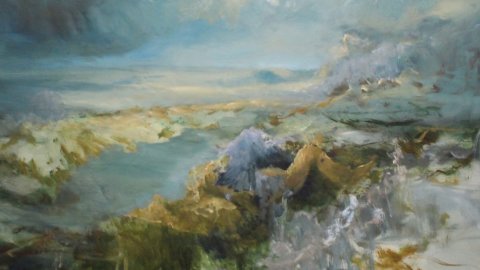
Jingge Dong(1989) works on evocation. His pictorial research does not restore reality, rather it alters its connotations by presenting a chaotic landscape, internalized, torn to pieces and glued back together in its own image and likeness.
The photographer Rachel Maistrello (1986), for over a year, has been involving marine biologists, sound engineers and professional freedivers to collect data and testimonies from which to inspire them to create a series of works on man's relationship with the marine world. The man-sea relationship, in the work-project blue diamond is made of attraction to the unknown, searches for pattern recurring with an unknown meaning and a desire to overcome one's limits and one's nature.
Sophie Westerlind(1985) looks at painting with a Nordic sensibility and adapts his poetics to the landscape of Fano. During the residency you kept a sort of logbook, a notebook in which you drew and wrote down what you encountered. In parallel, she paints outdoors, a fast painting, in which imprecision is part of the work, of the atmospheric conditions. Hills, trees, portraits, a timeless, ecstatic everyday life.
After the appointment in Fano, the exhibition will move to Pergola (PU) at Casa Sponge, from 20 August to 5 September 2021, and subsequently, from 7 to 17 October 2021, to Milan at the headquarters of the Artcurial auction house.
As Luca Zuccala states, “A multitude of stimuli has seen the artists perpetually on the move and at work in the area: from the thousand-year-old stones of the medieval villages to the harmonies of Renaissance perspectives; from the Adriatic to the Apennines, passing through the Metauro river, the ancient Via Flaminia and the Gola del Furlo. From visiting precious local treasures, the Cartoceto Bronzes in the city of Pergola, to studying the centuries-old history of the Fano navy; from the morphology of the coasts of Fiorenzuola di Focara to the silence of the Hermitage of Monte Giove and the Monastery of Fonte Avellana, just to name a few. Epicenter of the “journey” the city of Fano, with its dense historical, social and cultural stratification”.
“Through the contribution – continues Luca Zuccala – of a heterogeneous range of professionals – historians, archaeologists, botanists, university professors, art and literature historians, marine biologists and curators of contemporary art – it has been possible to make available to the artists a multifaceted and transversal baggage of knowledge and investigation of the peculiarities of the place. A territory that "speaks" that of the Fano brand, in which the landscape is cultural stratification, iconographic memory. It is in this context that the process of appropriation/restitution that the artists have implemented takes shape using different, apparently antithetical languages that problematize the landscape and its history".
LIDO THE LUCK
Lido La Fortuna is a three-year project, with its epicenter in the city of Fano, coordinated by Caterina Angelucci -with the support of Giulia Giommi- and curated by Luca Zuccala, which aims to promote and support the work of Italian and international artists under 35 in the Fano area, in a comparison with the identity and intrinsic peculiarities of the place and with the whole community. It will be a dialogue whose primary objective is to enrich a unique land, such as the hinterland of Fano, highlighting the scope and value of the multiple languages of contemporary art .
The project has seen the involvement of personalities who belong to important cultural and social realities of the place, who have contributed to providing the artists with historical-cultural investigation tools, for a vast and in-depth knowledge of the territory. All this took place through round tables, comparisons, contributions and multiple points of reflection. The figures who participated in the Residence are Emilie Volka (Director of Artcurial Italy), Anna Maria Ambrosini Massari (Full Professor of History of Modern Art, Carlo Bo University of Urbino), Roberto Danovaro (President of the Anton Dorhn Zoological Station, Naples and Director of the Life and Environmental Sciences, Polytechnic University of Marche), Corrado Piccinetti (Scientific Head of the Fisheries Sector at the Marine Biology and Fisheries Laboratory of Fano), Alessio Canalini (CO-Founder&Ceo – The Sea Opportunities, Ca' Foscari University, Venice) , Marina dei Cesari (Fano Yacht Club), Andrea Angelucci (Professor and President of the A. Bianchini Cultural Club, Fano), Giorgio Cassoni (A. Apolloni Art School, Fano), Lucio Pompili (Chef Symposium), Andrea Tinterri, (critic and curator), Giuditta Giardini (lawyer expert in art law and journalist), Giovanni Gaggia (artist and artistic director of Casa Sponge, Pergola), Massimo Puliani (professor and artistic director of Fano Rocca Maletestiana).