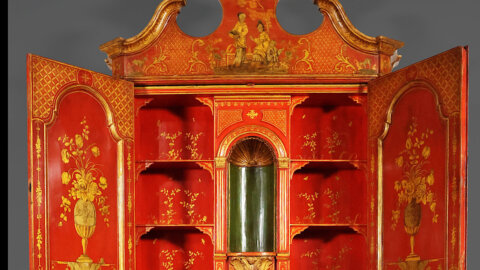
Have you ever wandered through the halls of an antiques show, or gotten lost among the shelves of a private collection? Among the objects on display, some immediately catch your eye. They are the Venetian lacquered furniture, with their deep, glossy surfaces, vibrant colors, and meticulous decorations—often chinoiseries—that tell stories of distant worlds. Centuries ago, these marvels were already symbols of power and prestige: rare and precious objects in the homes of patrician families, true jewels of craftsmanship and refined elegance.
The history of Venetian lacquered furniture
Their birth is the fruit of an extraordinary encounter between Venice and the OrientIn the 16th century, the Serenissima Republic was the center of Mediterranean trade: Venetian merchants brought back from ships arriving from China and Japan not only spices and fabrics, but also lacquered objects and precious resins. Local master craftsmen, fascinated by these innovations, began experimenting with similar techniques, reinterpreting oriental motifs according to European taste and adapting them to local woods such as walnut, lime, or cherry. The result was small but extraordinarily refined furniture: chests, caskets, and cabinet desks, decorated with landscapes, birds, flowers, and stylized figures. Each piece was not only useful, but also a symbol of social and cultural prestige, capable of describing the rank and taste of the owner.
Furnishings for aristocratic homes
As the decades passed, and especially in the 17th and 18th centuries, Venetian lacquered furniture established itself as one of the most distinctive elements of aristocratic homes. It was not uncommon for these pieces of furniture to be displayed during receptions or banquets, where their shine and gilded details became part of a a true ritual of representation, capable of conveying power, wealth, and refinement. Every color, every gold thread, every miniature scene was designed to surprise and impress guests, transforming the piece of furniture into a means of cultural communication as well as a functional object.
Yet even then, the rarity and value of these pieces of furniture gave rise to a phenomenon that continues to this day: imitations and copies. As early as the 19th century, European collectors and dealers sought to satisfy the growing demand for "Venetian lacquer," creating reproductions, reinterpretations, and fakes that could easily confuse even the most expert eye. This phenomenon continued in the centuries that followed: the glossy surfaces and refined patterns of lacquered furniture have always attracted collectors and enthusiasts, increasing the risk that a seemingly antique piece is actually a more recent copy or a heavily restored one.
Today, when faced with a Venetian lacquered piece of furniture, the question of authenticity becomes almost inevitable.
Simple aesthetic observation is no longer sufficient: a multidisciplinary approach, which combines historical, artistic, and scientific expertise. Microscopy and spectroscopy allow us to identify the resins and pigments used, while dendrochronology allows us to date the wood and verify its consistency with the historical period. X-rays and ultraviolet light reveal hidden layers, restorations, and subsequent interventions. All these tools, combined with the observation of materials, construction techniques, and historical documentation, allow us to draw a reliable picture of the authenticity of each piece. But scientific analysis, while essential, cannot tell the whole story: the history of each Venetian lacquered piece of furniture is also a history of cultural encounters, art and society, where the craftsman's skill intertwines with the tastes of the clients and the fashions of entire centuries. It is this history that makes each piece of furniture unique, regardless of its age or state of preservation. Even a 19th-century copy, if carefully crafted, tells us something about the taste and historical reception of Venetian lacquered furniture, adding a further chapter to the long history of this extraordinary art. Ultimately, Venetian lacquered furniture fascinates us not only for its aesthetic beauty, but also because it is material witnesses of a complex and cosmopolitan culture, symbols of a continuous exchange between East and West, between craftsmanship and collecting, between aesthetics and social power. But for those who wish to approach this collecting, Venetian lacquered furniture offers a fascinating and versatile dimension, almost comparable to that of a painting.
History, culture, Italian craftsmanship
It's not just about owning an antique, but about bringing a piece of art into your home. history, culture and craftsmanship that can interact with contemporary furnishings, transforming the environment into a living, narrative space. This form of collecting is particularly interesting because it combines aesthetics and cultural investmentEach piece of furniture tells a story, from the origin of the materials to the hand of the craftsman, from the social symbols imprinted on the surface to the transitions that have brought it to the present day. The possibility of integrating a lacquered piece of furniture into a modern context also stimulates creativity in the arrangement of spaces, enhancing the contrast between antique and contemporary and giving the furniture a unique and personal character.
The tools available to avoid making investment mistakes
Anyone who approaches this passion must be ready to combine curiosity, historical research and scientific tools, avoiding the purchase of undocumented pieces or copies devoid of historical value. In this sense, collecting Venetian lacquered furniture becomes a true cultural and educational trip, which requires attention, patience and a love for the history of art and craftsmanship. Furthermore, this type of collecting offers the opportunity to participate in an international circuit of enthusiasts, markets and exhibitions, creating links with museums, restorers and scholars, and contributing to the valorization and protection of an artistic heritage that would otherwise risk being forgotten or lost. In this sense, Venetian lacquered furniture confirms itself as a form of contemporary collecting of great charm, capable of combining history, art and everyday life in a single object, making the experience of collecting not just a hobby, but a true cultural and sensorial experience.