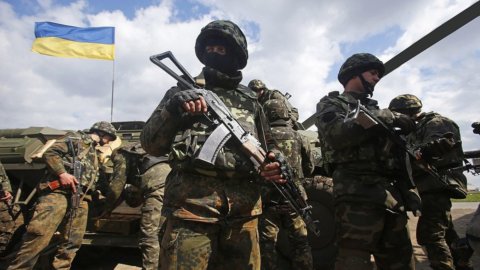
Both sides, right e left, have a major problem regarding the ongoing war in Ukraine. They should supply it with war material to support the fighting against the Russian aggressor, given that the war continues to cause deaths, injuries and destruction.
The Prime Minister, Giorgia Meloni, had committed, at European level, to send weapons to Ukraine, while it has taken a position contrary about the possible sending our soldiers, once the war ends.
Military spending: how much can Italy afford Ukraine?
But do we have the resources to help Ukraine? The increase in expense for defense will not impose waivers on other items of balance, from healthcare to education and welfare, because it will be subject to early exit from the excessive deficit procedure. In this situation, a "national safeguard clause” which allows for an increase in defense spending at low rates, with loan repayment later in the year.
The Minister of Economy, Giancarlo Giorgetti, recalls that "Eurostat will certify an Italian deficit of less than 3% of GDP in 2025 based on the final data expected by Istat in March." By virtue of the aforementioned clause, a greater increase in spending than that agreed in the Budget Plan will be tolerated. The Economic and Financial Document provides for a maximum increase in spending of the defense equal to 0,15% of GDP in 2026, to reach 0,5% in 2028.
The political crux: the League blocks the shipment of weapons.
That said, for the government the sending of weapons creates a problem because the Alloy she has already declared herself contraryAnd to think that the war continues to cause so much suffering to the Ukrainians. It would therefore be urgent to decide on the dispatch. However, the time to approve the decree It has been extended because the government, in addition to being busy with the budget, will have to try to overcome the opposing position of the League.
Il Senator Borghi He continued negotiations with other members of the government. The starting point was the old decree, used in previous years, but the goal was to avoid the dispatch of military supplies. The working group led by Borghi agreed that the priorities were civilian, healthcare, and defense aid, as these were the best way to convey the idea of a change of direction. Senator Borghi expressed satisfaction with the mediation, but immediately made it clear that he did not intend to approve the decree in the Senate.
The Left Divided on Ukraine
The Left, on the other hand, has within it many exponents of parties that refuse to send weapons to Ukraine, from Giuseppe Conte, leader of the Five Star Movement, to the members of grandparents. But there is no shortage, too within the Democratic Party, various exponents who do not believe it is right to send weapons.
Mr Guerini he claims, on Sheet, that "the decree essentially confirms military aid, with all due respect to the League. The dance of the days preceding its approval was a parody of a serious political discussion, even more serious because it was conducted over the heads of an attacked people." The decree was approved in recent days. new discussion will have to take place in Parliament within two months, At the conversion of the decree into lawIt remains to be seen how many "snipers" there will be, given the widespread refusal among deputies and senators to deliver new weapons to Ukraine. Let's hope that at least a truce will change the outlook.
The tendency not to send weapons tends to favor Russia, the country that waged war. A choice that rewards the invader, the strong player that Donald Trump also effectively rewards, treating Putin with conciliatory treatment, except for a few outbursts expressing his impatience for a peace that is slow in coming, while Russian attacks become increasingly frequent, causing, as already mentioned, destruction and deaths among Ukrainians.
Two solutions to overcome the crisis: deterrence and peace
To overcome this situation, the following are foreseen: two roads, to be traveled together. The first is to create a deterrence, that is, arming oneself to discourage any aggression. In particular, deterrence consists in preparing measures such that the enemy, in view of the consequences of an attack, is dissuaded from carrying it out. European countries, linked to the NATO, have committed to reaching 5% of GDP for defense and security by 2035, a figure that includes military spending (3,5%) and security spending, such as cybersecurity and infrastructure (1,5%). This goal represents a significant increase compared to current percentages, but is far from the share of global military spending covered by NATO. The limitation of this commitment is that there are so many national segments of rearmament, when it would be appropriate to pool European armed forces, creating a unified command for this intervention. It could also start with some states, the "willing", for example.
This attempt to pool Europe's defense is reminiscent of what happened in the early 1950s, after the establishment of the European Coal and Steel Community (ECSC), an idea that quickly faded due to the fresh memory of the war and widespread opposition among the population.
La second the road ahead is the need for search for peace. “Peace be with you all. Towards an unarmed and disarming peace.” The Holy Father invites everyone to welcome it and become its witnesses. Peace is a gift that must be safeguarded.
Andrea Riccardi (Community of Sant'Egidio) recalls that "the political classes smile kindly and courteously before the Pope, but they fail to grasp his strong, direct, and unequivocal message: speaking of peace seems like engaging in friendly behavior with the enemy. But that's not the case!" Perhaps something is moving.