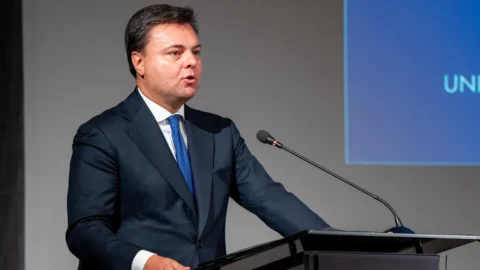
La economic growth it is not an individual fact, but "a collective exercise” which requires vision, collaboration and courageous choicesThis is the message at the heart of the speech by Marco Gay, president ofTurin Industrial Union, who at the association's annual meeting charted the course for the future of the production system: a long-term industrial policy, investments in innovation and training, defense of technological neutrality in the transition, and a Turin capable of leading the new mobility.
Before over 800 entrepreneurs and managers, Gay called on Turin and national industry to "work together" in a complex global context, where competitiveness depends on the ability to build alliances and generate shared value. "Our industrial footprint is solid. We continue to invest in tomorrow," he said from the stage of the Union's Congress Center.
The meeting was attended by the president of Confindustria Emanuele Orsini, the deputy prime minister Matteo Salvini, the Minister of Enterprise Adolfo Urso, the president of the Piedmont Region Alberto Cirio and the mayor of Turin Stephen Lo Russo.
Turin of the future: industrial intelligence as a driver of growth
The meeting opened with a video created thanks to theartificial intelligence, which imagined Turin in 2100. The film concluded with a pan of the audience, accompanied by the president's words: "This video starts here. It starts here because we have one certainty: our ambition and our commitment are the same as we left off a year ago." Gay spoke of "industrial intelligence," made up of creativity, technology, and passion, as the key to a region that wants to remain competitive: "Places where industrial intelligence can continue to grow and express its full potential."
A Europe to be reformed, not rewritten
In his analysis of the international context, Gay expressed concern about geopolitical instability and for his repercussions on the real economy"Across the Atlantic, a new diplomatic language is emerging. Alliances are being reconfigured and strengthened. Economic diplomacy is no longer the only tool for ensuring peace," he observed.
The President stressed the importance of national political stability and role of the European Union as a pillar of growth, but called for "policies to be reformed, not principles." According to Gay, it is necessary to reduce the EU's internal fragmentation—between tax regimes, regulations, and bureaucracies—which currently hinders industrial competitiveness: "We are standing still and watching what others are doing." He finally urged that the work and proposals initiated by the reports be transformed into concrete actions. Draghi e Read.
Budget, resources and industrial policy
Ample space has been dedicated to the Budget Law and public finance constraints. "We must be careful. Compliance with EU constraints must not become a reason for inaction. Because the '3%' target cannot be a justification for inaction," Gay declared. "Growth of 0,5% is not real growth."
He recalled that Italian industry is worth 510 billion euros, equal to 23,4% of the national GDP and 26% in Turin. "Do we want to be ambitious or continue to defend ourselves? We must decide how to answer this question," he said, calling for an "industrial policy with at least a three-year vision," as is done in businesses.
Regarding the super-amortization refinanced with Pnrr fundsGay called it "a clear, simple, accessible tool, well-known to businesses," but added: "It's unthinkable to achieve development and growth with these resources, especially if they're only used for material goods." The president finally emphasized the need for a sustainable and competitive energy mix, including nuclear power: "Public finances cannot be balanced without investment and growth. Making courageous choices serves to create value for all citizens, both today and tomorrow."
Turin, a laboratory for new mobility
On a local level, Gay claimed Turin's ability to to renew oneself"Turin has long been the time for courage," he said, addressing the automotive industry and industrial transition. He reiterated his defense of technological neutrality and the need to "create a new Turin mobility industry," including cars, microcars, drones, and soft mobility systems. Over the past ten years, Turin companies with a turnover above €5 million have grown by 37%, employment by 24%, and investments in plants and robots by 57%. "It's as if a new small industrial block were being created every year, with 62 more people joining the company," Gay emphasized.
Turin is today the third largest European city for investments in robotics and can aspire to lead strategic sectors such as aerospace, defense, semiconductors, energy, medicine, nanomaterials, and food. The Industrialists' Union has proposed the creation of a testing center for civil drone flights and a hub dedicated to future medicine linked to space research.
Training and skills: an alliance between schools and businesses
"The technological revolution involves a revolution that is also cultural," Gay said, emphasizing the need to bridge the mismatch between supply and demand for skills. "We must overcome all resistance to strengthen collaboration between the education system and the production system," he added, citing Its Academy, corporate academies, and supply chain training programs. He then emphasized the importance of active labor market policies for retraining staff and addressing the growth of layoffs: "Strengthening active labor market policies helps retrain staff for the most sought-after and hardest-to-find professions."
On young people: “Young people are our present and we owe them, first of all, the attention we pay to our choices. They will repay us with extraordinary enthusiasm.”
Infrastructure and alliances for growth
Looking to the business world, Gay announced the launch of the "Destination Growth" project, an initiative dedicated to businesses seeking to increase their size and competitiveness. "We expect the financial and banking sectors to join forces," he explained, noting that "growth will be a prerequisite for being a key player in the future." He reiterated the need to complete major strategic infrastructure projects, such as Turin-Lyon and the Third Pass, essential for connecting Piedmont to European markets. On Single national ZesGay commented: “Turin has always been an Extraordinary Economic Zone. I would enthusiastically welcome any extraordinary measures that can help us make it easier to do business.”
“Industrial optimism” as a vision of the future
In closing, the president of the Turin Industrial Union invited the production system to a new industrial optimism"We have a responsibility to propose, it's our job: but the decisions are up to politicians, local, regional, and national institutions," he said. And he concluded: "It's time to reclaim and nurture that industrial optimism that has always distinguished our city: the belief that the future can be born from doing, thinking, and planning together."