

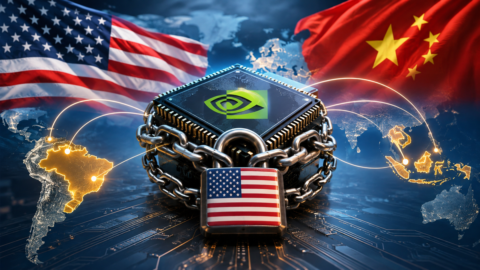
The technological war between the United States and China is entering a new phase, in which the battlefield is no longer just the direct trade in semiconductors. American control now extends to Countries that could become intermediate platforms to allow Chinese companies to remotely access the computing power of the most advanced chips. Brazil has joined this new map, along with Singapore, Malaysia, Thailand, and Indonesia.
Washington's decision comes in a particularly delicate moment for Nvidia, the company that dominates the market for processors used to train and run large artificial intelligence models. The crisis that hit the group, culminating in the resignation of co-founder and CEO Jensen Huang And with the investigation into the company's relations with China, it has reignited the debate over the United States' ability to prevent its most powerful chips from ending up, directly or indirectly, in Beijing's hands. However, the allegations of links to Chinese intelligence activities remain unproven and have been disputed by those involved.
China's race for Nvidia chips
For Chinese companies, the problem is real. For over a year, Washington limits exports of Nvidia's most advanced semiconductors to China, while Beijing has to deal with a national production capacity that, especially in the most sophisticated range, is not yet able to completely replace the American one.
The consequence is a increasingly intense search for alternatives and, above all, indirect routes to obtaining computing capacity. According to Reuters, Chinese artificial intelligence companies have begun seeking and reserving computing capacity equipped with Nvidia chips at data centers outside China, with a particular focus on Southeast Asia. Some operators have even considered pre-securing capacity abroad, fearing that this option, too, could soon be closed.
This dynamic reveals the limits of a sanctions system based solely on the chip's geography. If the processor isn't shipped to China but remains, for example, in a data center in Singapore or Brazil, a Chinese company can theoretically purchase computing capacity through the cloudFor Washington, however, the strategic outcome may be essentially the same: Beijing gains access to the power needed to train advanced AI models.
Washington closes the side door
It is precisely this "side door" that the new American legislation aims to close. The Bureau of Industry and Security of the Department of Commerce has introduced specific rules on remote access to advanced semiconductors and the servers that use them. The stated aim is to prevent existing restrictions from being circumvented through data centers located in third countries. From November 19, for certain categories of advanced chips intended for Brazil, Singapore, Malaysia, Thailand and Indonesia an American license is required.
Requests will be evaluated on a case-by-case basis. The same regulation also imposes auditing obligations on data centers that provide significant amounts of computing capacity, directly or indirectly, to companies based in China or other countries subject to U.S. oversight. The qualitative leap is evidentThe United States no longer seeks to control only the sale of semiconductors, but also access to the computing power that those semiconductors enable.
Brazil becomes part of the game
For Brazil, the news is especially relevant because the country is trying to attract investments in data centers and artificial intelligence infrastructure. The new rule is not equivalent to an embargo: a Brazilian company can continue to import the affected chips, but the supplier will need to obtain US authorization. The risk is therefore primarily operational. Longer lead times, greater uncertainty and possible cost increases may impact projects that depend on more advanced processors.
In 2026, Brazil imported $6,8 billion in semiconductors, memories, and graphics processors for data centers in the first nine months of the year, a 51% increase compared to the same period in 2025. The American decision, however, does not mean that Washington treats Brazil in the same way as China. The regulation identifies the five countries as destinations that present a higher-than-average risk of semiconductor diversion. Therefore, they are: considered possible crossing points, not the ultimate target of American politics.
A technological war that changes geography
The Nvidia case thus demonstrates a deeper transformation. The competition between Washington and Beijing for control of artificial intelligence is no longer just about factories, patents, and shipments. It's about the geography of data processingChina, largely excluded from direct access to Nvidia's most advanced chips, is seeking capacity abroad. The United States responds by extending its controls to the places where that capacity could be installed and used. And the countries building data centers are becoming, almost unwillingly, part of America's industrial policy and national security strategy.
The paradox is that the measure may simultaneously strengthen demand for alternatives. It's getting harder for Chinese companies to access American chips, the greater the incentive to develop domestic processors, turn to different suppliers, or acquire computing power through new intermediaries. The game, therefore, is no longer simply Nvidia versus Chinese manufacturers. It's a competition for control of the entire AI supply chain: from chip design to manufacturing, from the data center to the cloud, all the way to where the computing power is actually used. And Brazil, along with a growing portion of Asia, is now in this game.