The aim of this analysis is to interpret the main trends that will characterize the art market in 2026, with particular attention to exchange models, collecting practices, the role of technology, and the geographical redefinition of centers of cultural power.
More stable, less expansive and selective market
In 2026, the art market is expected to be more stable but less expansive than in previous periods of rapid growth. Reduced global liquidity and increased investor caution have led to a gradual abandonment of short-term speculative dynamics. In this context, a marked selectivity of demand emerges., This trend favors works characterized by high formal quality, solid provenance, and institutional recognition. The lower-middle end of the market is more vulnerable to economic fluctuations, while the "blue chip" segment—artists with established histories or already fully recognized by the museum system—continues to show relative resilience. The value of artworks is thus increasingly anchored to long-term criteria rather than temporary hype dynamics.
Centrality of the work
From a typological perspective, 2026 confirms the centrality of the physical work, particularly painting, sculpture, and ceramics, considered by collectors as durable and culturally stable goods. At the same time, interest in highly narrative and identity-based artistic practices, often linked to social, political, or environmental issues, is growing. New generations of collectors, particularly Millennials and Gen Z, are exhibiting a less canonical orientation, favoring emerging artists, hybrid languages, and works that combine aesthetic value and symbolic experience. This transformation is helping to redefine the criteria for artistic legitimacy, expanding the field beyond traditional disciplinary boundaries.
Art and Technology towards a new era
After the speculative phase associated with NFTs, the relationship between art and technology will take on a more mature and functional dimension in 2026. Digital technology is no longer conceived as an autonomous end, but rather as an infrastructure supporting the market, especially in terms of traceability, authentication, and provenance management. The use of blockchain as a certification tool, the integration of digital archives, and the adoption of advanced verification systems contribute to strengthening operator trust and reducing information asymmetry, historically one of the critical issues in the art market.
A new role for intermediaries is needed
In 2026, auction houses, galleries, and online platforms will be called upon to redefine their roles. From simple commercial intermediaries, they are transforming into knowledge producers., Offering market analysis, curatorial consultancy, and increasingly sophisticated valuation tools. At the same time, we are witnessing a growing financialization of art, with the spread of investment funds, fractional ownership, and structured products. This evolution raises significant questions about the balance between the cultural and financial value of artworks, as well as the risk of a progressive commodification of artistic heritage.
La geographical decentralization of the art market
Alongside the traditional Western hubs (New York, London, Paris), new areas of strategic importance are emerging, particularly in the Middle East and the Asia-Pacific region. These new centers do not simply replicate existing models, but propose alternative cultural narratives and soft power strategies through art. Competition between cultural systems contributes to the pluralization of global artistic discourse, but also introduces new tensions between market, politics, and cultural identity.
The new scenario
The art market in 2026 presents itself as a system in the process of rNationalization and maturation, characterized by greater selectivity, technological integration, and geopolitical complexity. Far from the speculative euphoria of the recent past, it tends to valorize the quality, institutional legitimacy, and cultural and economic sustainability of artistic practices. In this scenario, art continues to play an ambivalent role: on the one hand, a symbolic and cultural asset, on the other, an economic asset embedded in the logic of global capitalism. Understanding this tension represents one of the main analytical challenges for art market studies in the near future.
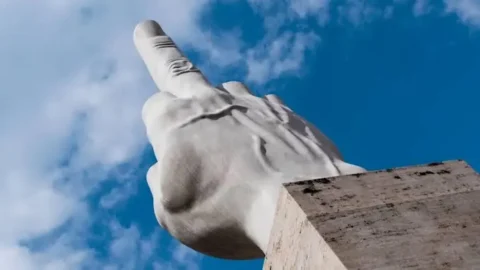
Cover image: LOVE (an acronym for Freedom, Hate, Revenge, Eternity), commonly known as The Finger, is a sculpture by Italian artist Maurizio Cattelan. The work is located in the center of Milan's Piazza degli Affari, in front of Palazzo Mezzanotte, home of the Milan Stock Exchange. The sculpture, 4.6 meters tall (11 meters total including the base on which it stands), is made of Carrara marble.