The Strait Bridge to bridge the North-South gap: it is one of the most used slogans to endorse the construction of the very expensive infrastructure (14,6 billion) by the same political representatives who in the meantime approved the differentiated autonomy.
The Bridge is considered a strategic work to boost Sicily. “For the development of an area, also the local transport network but it is important, elThe state of the local railway network in Sicily is very weak”, underlines theCPI Observatory in an article written by Carlo Cottarelli and Leoluca Virgadamo who also cite two examples: on the one hand the doubling works on the Palermo-Messina section have been going on for some time; on the other hand, the maintenance of the Palermo-Trapani route, passing through Milo, interrupted since 2013 due to a landslide, forces any connection with Trapani to proceed via Castelvetrano, more than doubling the distances to travel.
Within the article, the authors analyze the weakness of Sicilian local transport, comparing them to those of the other regions of Italy, calculating what they define as "effective travel speed” (VPE), obtained as the ratio between the time needed to reach the destination and the spatial distance between the provincial capitals of Sicily, Tuscany and Piedmont. “The VPE depends on three factors: (i) the service speed of the trains on the route; (ii) waiting times in the event of a change between one train and another; (iii) the distance to travel compared to the distance as the crow flies (which reflects how “complicated” it is to connect the starting point and the arrival point compared to a linear route). The low VPE in Sicily compared to the other regions considered reflects a worse situation with respect to all these factors", we read in the text.
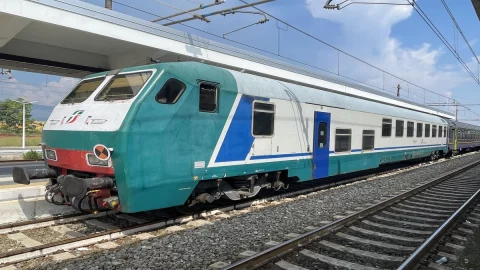
The Sicilian railway network
1.370 km of railway, 8% of the national network. Of these 1.370 km, only 223 (16%) are double-trackor, against 46% of the national network. Regarding the type of fuel, 42 percent of regional routes are powered by diesel, compared to 28 percent of national routes", underlines the Observatory.
Sicilian trains seem to be in line with national ones in terms of punctuality: on the national average, regional trains with a delay of less than five minutes were, in 2022, 94,4 percent in Sicily, as reported on the region's website, in 2023 95,5 percent of trains were on time. A note of color in a gloomy panorama which however fades considering two factors: the first is that the region does not report the reference threshold for calculating punctuality. The second are i travel times, much higher than those of other regions.
The CPI Observatory underlines first of all, how after 18pm in Sicily traveling is almost impossible, a factor indicative of the weakness of the Sicilian network. It then shows the "effective travel speed" (VPE) on the routes between the provincial capitals, comparing them with those of Tuscany and Piedmont in two reference time slots (8-9, 14-15). Well “the difference in speed in travel is evident: going from one city to another in Sicily involves moving, on average, at 26 km/h – 28 km/h. Compared to other regions, the speed is almost 40 percent slower (the VPE is in fact similar in Piedmont and Tuscany)”.
Among the routes with the slowest speeds, and therefore the highest travel times, are: connections to and from Trapani, which require a travel time of a minimum of four hours and connections with Ragusa which require a minimum travel time of five hours, with the exception of the Ragusa-Syracuse route, where the journey lasts two hours but covers a distance of only 52 km.
“It is true that trains in Sicily connect cities further away from each other, and this in some cases makes the itinerary that must be followed more complex, but if the railway network were adequately designed and served the problem of distance between cities would not affect the VPE”, the authors highlight.
The causes of the Sicilian low speed
“Route complexity is not the only cause of low VPE. The causes are in fact to be found in worse performance for all three determinants of VPE", observe the experts. What are these determinants? The speed on train tracks, 10 km/h less than those of Piedmont and 7 km/h less than those of Tuscany; The low development of the railway network Sicilian which forces us to take longer itineraries (53 meters of railway per square kilometer of territory, against 64 and 75 meters per square kilometer of territory for Tuscany and Piedmont respectively, and it is even worse on double track); the lower frequency of trains: “the average number of trains to travel to the capitals of interest in the time slot from 8:00 to 9:00 is less than 1 for Sicily, compared to values of 1,3 in Piedmont and 2,7 in Tuscany. Similar differences exist for the time slot from 14pm to 00pm,” explains the CPI Observatory.
The prospects of the Sicilian railways
In addition to building the bridge over the Strait, these are investments to strengthen the local public transport network, also with funding from the PNRR, reassures the Government.
“There are fourteen ongoing projects, which should be completed by 2027,” the article underlines. “As reported by RFI, the planned works seem to have modest objectives, in some cases aimed at the restoration and normal service of lines that have been interrupted for years. The picture seems far from the prospects of an adequate speed line extended to the region. Among other things, no high-speed connections are planned for any route”, states the CPI Observatory.
“The purpose that in Ferrovie dello Stato's commercial plan comes closest to a quick route, to be implemented on a date to be determined and in any case not before 2027, is a 60 minute reduction in travel times between Palermo and Catania. Therefore an increase in the average speed on the route to around 100 km/h, with speed peaks along the route of 200 km/h or (according to the web page) 250 km/h, and in any case only in the few sections doubled”, Concludes the article.