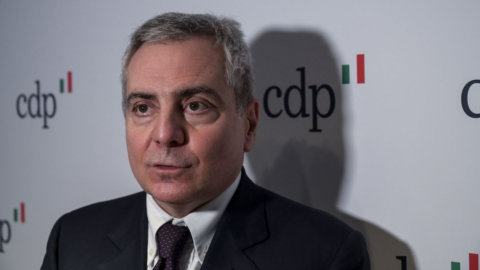
Initiatives capable of transforming environmental and social challenges into opportunities for the country, generating tangible impacts for people, communities and territories: these are the rewarded on the occasion of the second edition ofImpact Awards, promoted by Polimi Graduate School of Management in collaboration with the Tiresia Research Center and with the support of Cassa Depositi e Prestiti (CDP)The award was given to the representatives of the seven winning projects during the event held at the National Museum of Science and Technology "Leonardo da Vinci" in Milan and which saw the participation of the president of Cdp, Giovanni Gorno Tempini, of the CEO of CDP, Dario Scannapieco, and the Rector of the Polytechnic University of Milan, Donatella Sciuto.
Impact Award: What Gorno Tempini Said
Gorno Tempini stated: "The greatest challenge for companies and institutions is to combine competitiveness and sustainability, while ensuring a transition that leaves no one behind. CDP has a balanced and pragmatic approach: we support the country's development. facilitating access to credit and directing funding towards projects capable of producing positive impactsFurthermore, we are focusing on innovation, which today more than ever requires a systemic commitment. The experiences we are recognizing with the Impact Award, together with the Politecnico di Milano, are a clear example of the connection between sustainability and digital transformation.
Impact Award, what Scannapieco said
Scannapieco then underlined: "The winners and finalists of the second edition of the Impact Award tell concrete cases of companies that plan the future from a social and green perspective, generating real and measured impacts thanks also to our evaluation methodologies and the work with the Polytechnic University of Milan. As emerged from the Doxa research, Companies and organizations continue to see investments in sustainability as an opportunity for growth in the medium to long termCDP's task is to provide resources and expertise to promote a virtuous circle towards a just transition."
Impact Award, what Sciuto said
Sciuto then stated: “As a technological university committed to the common good, we believe that impact goes beyond the results achieved; the ability to generate new knowledge and opportunities for the local communities is also important. The Impact Award recognizes not only what has been done, but also the growth potential of the people and initiatives awarded. to make its effects even more solid, transforming experience and knowledge into shared value".
Impact Award, what is it?
Now in its second edition, the Impact Award is divided into several categories: SMEs, Businesses, Infrastructure, Public Administration – with distinct recognitions for environmental and social impact – and International cooperationThe seven winning projects stand out for their ability to produce measurable benefits for the environment and people, thanks to innovative solutions that address concrete needs with positive and lasting effects. The initiative is aimed at those active in these fields who have signed a financing agreement with CDP.
The jury, composed of sustainability and innovation experts from business, the public sector, as well as academia and the third sector, selected the winners from a shortlist of 20 finalists.
Here are the winning projects
SME Category
Simpro Spa (Piedmont): has built an industrial building to eliminate almost all energy consumption, thanks to a photovoltaic system, a geothermal system, and electric mobility facilities.
Environmental Business Category
Damiano Spa (Sicily): developed water efficiency improvements in the production process along the dried fruit supply chain, digitalized the warehouse, and created a dedicated allergen department.
Social Enterprise Category
Esaote Spa (Liguria): created and marketed a magnetic resonance imaging device for brain glioma surgery, collaborating with neurosurgeons and using innovative technologies.
Infrastructure Category
E-Distribuzione Spa (Lazio): has invested in strengthening the national electricity distribution network, improving the quality and efficiency of the service and strengthening its climate resilience.
Environmental PA Category
Abc Napoli (Campania): has created a next-generation platform to reduce water network losses, improving service efficiency and sustainable water resource management.
Social PA Category
Arca Puglia Centrale (Puglia): has begun the redevelopment of public housing, prioritizing the elimination of architectural barriers and accessibility of housing.
International Cooperation Category
XacBank (Mongolia): has expanded its loan portfolio to support Mongolian micro, small, and medium-sized enterprises, particularly those led by women and youth and in rural areas, as well as green projects and the sustainable cashmere supply chain.
The investigation into sustainability and competitiveness
During the award ceremony, the survey “Sustainability, competitiveness and impact” conducted by Doxa, part of the Ipsos group, was also presented, from which it emerges that, in a global scenario characterized by uncertainty, companies oriented towards investing in sustainability and local authorities should pay greater attention to the social and governance dimension, without neglecting the environmental component. In short, a progressive shift from the E component towards the S and G components of sustainability is emerging.
In detail, the share of businesses, including SMEs, which declares it wants – in the next three years – increase investments in worker well-being and protection (offering smart working, flexible working hours, corporate welfare and training), reaches the 66%, up from 44% in the last three years. The number of businesses aiming to increase their commitment to employee health and safety, including safety, is growing: 53% from 44% in the previous three years. Finally, the percentages relating to investments in improving governance are rising (39% from 33%). However, the recommendation to reduce environmental impact is decreasing, although it remains a priority, falling to 69% from 89%.
Greater attention to the social component it is also found for the local authoritiesi: 35% of the Municipalities that invest in sustainability intend to make their territories more attractive in terms of infrastructure and services (it was 26% in the past three years) while the commitment to reducing environmental impact remains constant (69%).
The research also highlights how for the entire sample of interviewees Sustainability no longer represents just a reputational factor but is increasingly perceived as an economic-financial lever in the medium-long termIn particular, for 30% of companies, it improves financial performance, and for 26%, it facilitates access to public and European funds. Finally, to accelerate investments, 81% of companies and 93% of municipalities believe support, with resources and expertise, is necessary, especially during the technical and financial planning phase.