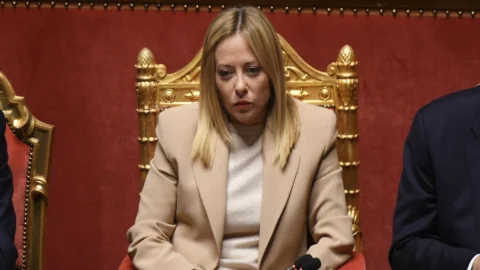
The information of Giorgia Meloni in the Chamber, which lasted about an hour, had a simple objective, that of nip in the bud any crisis reading after the referendum defeat on justice and regain control of the political landscape. The Prime Minister did so with a speech built on three axes: the government's holding, the international projection of Italy At the height of the Iranian crisis, the parliamentary vote attempted to relaunch several domestic issues, from the housing plan to security. Beneath the surface of firmness, however, the parliamentary vote revealed something else. A government feeling the need to reaffirm its stability, a majority forced to defend itself on political grounds, and a prime minister who, while raising her voice, attempts to transform the difficulties into a new narrative offensive.
Meloni, the lost referendum and the need to relaunch
Meloni has chosen to starting from the freshest political wound, that of the referendum on justice. He acknowledged the verdict of the polls, but without any substantial self-criticism. "We we always respect the opinion of Italians, whatever it is, even when it does not coincide with our opinions and expectations", he said, defining however the outcome also as the fruit of "a close comparison, alas, not always on merit." Immediately afterwards he spoke of "regret" for having missed, in his opinion, "a historic opportunity."
The political point is all here. The Prime Minister has having taken note of the defeat, but he tried to empty it of its weight, transforming it into a parenthesis and not a setback. Indeed, he relaunched. "The hope I express is that the the construction site of this reform should not be abandoned“, insisting on the need to find “concrete, courageous, effective solutions”, “certainly not against the judiciary but in favor of a judiciary free from political and ideological conditioning”.
It's a line consistent with Meloni's approach: never retreat on symbolic ground, not even after a missed pass. But it's also the sign of political difficultyWhy did the prime minister feel the need to so emphatically defend the justice system at the very moment when that project was rejected by the voters?
Meloni, no cabinet reshuffle or resignation: the prime minister closes ranks.
The most anticipated passage, however, was the one on fate of the governmentAnd it is here that Meloni chose the clearest, almost definitive tone.No resignations, no reshuffle" closing the door to any idea of a reorganization. He spoke of "palace alchemy" as a world "light years away" from his idea of government and reiterated that "there is no restart to be made, given that the government has never stopped."
“We will not run away, we will not retreat, we will not take cover by making citizens pay the price of the usual palace games,” he said, adding that the executive will govern "until the last day of its mandateMeloni then claimed to have asked some members of the government to "step back," explaining that these were neither "simple nor painless" decisions.
Meloni: "Subservient to Trump? We've been for 80 years."
The most intense part of the speech was dedicated to the international crisis. Meloni described the temporary ceasefire between Iran, the United States and their respective allies as a fragile window, recalling that we had reached "one step away from the point of no return." From there, he expressed the hope that the peace talks in Islamabad could strengthen the agreement and consolidate a lasting truce.
But the real political issue was another: explain where Italy is located, and above all how independent it is from Washington. The Prime Minister anticipated the criticism and openly rejected it. "Italy's international positioning was not invented by this government, but It's been the same for about 80 years now“, he said, in response to the “refrain about subordination” to Trump. Then he added a formula that is destined to last: “We are 'stubbornly Western'".
This is where Meloni tested her most difficult balancing act. On the one hand, the reaffirmation of the Euro-Atlantic axis; on the other, the attempt to assert autonomy. "You tell your allies clearly when you disagree. As in the war in Iran, an operation Italy didn't support and in which it didn't participate."
Meloni: "No tolls in Hormuz, stop the Stability Pact if the crisis continues."
Then the chapter on the Strait of HormuzThe Prime Minister indicated the "full restoration of freedom of movement" as a priority but maintained that this step “should not be subject to any form of restriction“. The reference is to the fear that Iran might obtain the possibility of applying extra duties to transit, including payments in bitcoin. A scenario defined as potentially harbinger of "unpredictable economic consequences."
And then it arrived the most demanding request addressed to Brussels. “It should not be a taboo to think about the possible temporary suspension of the Stability and Growth Pact" in the event of a new outbreak of conflict, calling for "generalized" intervention, not limited to individual states. The Prime Minister also reiterated the need to suspend the ETS mechanism.
The controversy with the opposition and the counterattack on the anti-mafia
Anti-mafia chapter. Meloni accused the opposition of taking refuge in propaganda and wanting to explain every problem as "all Meloni's fault"His tone became even harsher when he addressed the issue of criminal infiltration of political parties and the controversy surrounding the Brothers of Italy party. "The parliamentary anti-mafia commission should address organized crime's attempts to infiltrate political parties, including the Brothers of Italy party." Then came the more personal attack. "I won't accept lectures on this issue," he declared, denouncing "surreal theories" about his alleged closeness to organized crime and criticizing the fact that "a father, who died of other causes, whom I haven't seen since I was 11 years old, was brought up in the same light."
Housing and Security Plan: An Attempt to Return to Concrete Issues
At the end of the briefing, the Prime Minister tried to bring the discussion back to more immediately understandable measures outside the Palace. The most relevant is the House plan, announced in view of May 1st. “A robust, structural plan” with the aim of to make available "over 100 homes in the next ten years" between social housing and affordable housing. However, for now, it remains a stated commitment, not yet measurable in the operational details that will determine its credibility.
The same goes for security.. Meloni admitted to not being “satisfied with the results” and indicated as a priority a greater control of the territory, including through the reorganization of administrative activity and the introduction of 10 volunteer assistants for the Carabinieri and police. Here too, rather than assessing the current situation, the discussion had the flavor of a relaunch.