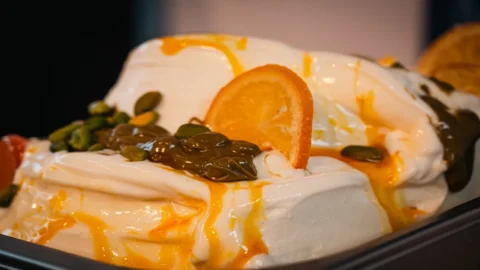
"Melody," a truly harmonious composition with a creamy and enveloping base, complemented by a pistachio swirl, chopped pistachios, and a delicate orange sauce, will represent the Flavor of the Year 2026 for Gelato Day, the European Artisanal Gelato Day. This is the only day the European Parliament has so far dedicated to a food celebrated across Europe with events, meetings, and initiatives aimed at spreading the culture of artisanal gelato. On March 24, 2026, Melody will take center stage, offered both in the "original" version according to the official recipe and revisited by master gelato makers from across Europe using ingredients and inspiration from their local area. But it's not just cones and cups: March 24 will feature numerous initiatives throughout Italy and Europe to promote and showcase the quality of artisanal gelato, gastronomic culture, artisanal creativity, and the European spirit. And the events will continue in Vienna in May thanks to the collaboration with Eurovision, which will reinforce the message of a united Europe through the art of taste and music, celebrating professionalism, talent, and sharing. This year's Gelato Day celebrates two great symbols of European culture: the art of artisanal gelato and the expressive power of the international music of the Eurovision Song Contest, taking place in Vienna from May 12th to 16th. Therefore, the theme for this year's Gelato Day is: "The Gelato That Makes Europe Sing." For 12 years, a different European country has chosen the Flavor of the Year each year, drawing inspiration from its traditional desserts and the most iconic ingredients of its homeland. The official recipe for "Melody" was chosen during the competition organized by Artglace at SIGEP WORLD – The World Expo for Foodservice Excellence, which saw master gelato makers from all over Europe compete. Among the innovative proposals, the official recipe for the Flavor of the Year was created by Juanma Guerrero of the Sicilia Gelati ice cream shop in Torre del Mar (Malaga, Spain). The recipe is a harmonious composition of flavors reminiscent of a musical score: a creamy and enveloping base, complemented by a pistachio swirl, chopped pistachios, and a delicate orange sauce, which adds a bright, citrusy note to the flavor.
The artisanal ice cream market in Europe
Artisanal gelato can count on a very broad geographical reach, with Europe playing a leading role. Gelato parlors are present in 76 countries across all continents, and the Old Continent represents the heart of this tradition: over 66.000 outlets and approximately 300.000 employees. Among the main European markets in terms of number of gelato parlors are Germany (with 9.000 outlets, including 3.300 specialized gelato parlors), Spain (2.400), Poland (2.000), the United Kingdom (1.300), Belgium (1.200), and Austria (900), followed by Greece (700) and France (600). In 2025, sales of traditional Italian artisanal gelato will reach a value of 11,7 billion euros, recording a 7% growth compared to 2024 (11 billion). The United Kingdom and Spain stand out as the most dynamic countries, Germany shows a slight decline, while Italy consolidates its leadership, confirming itself as the world's leading market and a successful supply chain model for the artisanal ice cream sector.
The history of artisanal ice cream
Legend has it that drinks with ice or snow were consumed as early as ancient Egypt, as early as 2.700 BC. However, some argue that artisanal ice cream originated with the ancient Romans, who distinguished themselves with their "nivatae potiones," a kind of cold dessert. On the other side of the world, in China, during the Tang Dynasty, people drank a milk beverage (goat, cow, or buffalo) cooked with flour and camphor and placed in iron containers under snow or ice. Similarly, the Arabs prepared "shrb," from the Turkish "sherbet" (cold drink) and the Arabic "sharab" (to sip, to drink), the ancestor of sorbet: a sugar syrup, the basis for making sorbets made with fruit, medicinal herbs, spices, and flowers. In the Americas, however, the first ice cream is believed to have originated in Ecuador, where it was created by mixing ice, snow, fruit juices, and milk in a large pot called a "paila." In reality, however, we had to wait until the 16th century and return to Italy to witness the true triumph of this food. It was Florence, in fact, that claimed the invention of modern gelato, the first to use milk, cream, and eggs. The credit goes to an architect: Bernardo Buontalenti. He is credited with the "candiero," offered by Cosimo I de' Medici in 1559 to Charles V, King of Spain, for a celebration celebrating the inauguration of Forte Belvedere. The dessert was a cold cream made from sugar, milk, cream, eggs, and a touch of wine, flavored with bergamot, lemon, and orange: the basis of the more famous "crema Fiorentina" or "gelato Buontalenti," which can still be enjoyed today in all the finest gelaterias in Florence. But the modern history of this delicious treat officially begins when the Italian Filippo Lenzi, at the end of the 18th century, opened his first gelateria in America. In a very short time, ice cream became a veritable craze, so much so that George Washington himself is said to have enjoyed it at many parties and gatherings. And it was also in America, at the hands of an Italian, that the first ice cream cone was patented in 1903 by Italo Marchioni, who, having emigrated to New York, began selling the first ice cream cones. The rest is history.