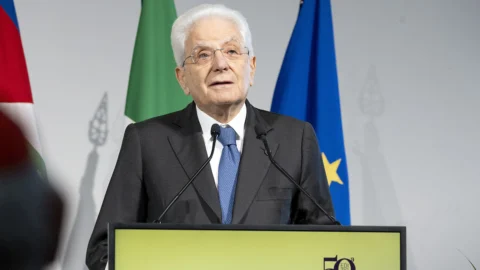
The president of the Republic Sergio Mattarella, who spoke at the opening ceremony of the Social Week of Catholics in Trieste, addressed a firm warning on 'absolutism of the majority. “There cannot be authority without limits,” she declared, underlining the importance of a democracy that respects the rights of minorities and maintains a balance between power and freedom.
Lectio magistralis on democracy
Mattarella began his speech by reflecting on the meaning of the word "democracy". “Word in common use, even in its declension as an adjective. It is widely spread. It suggests value,” he said. Then a memory of how the dictatorships of the twentieth century “identified it as an enemy to be defeated. Free men made it a flag. Together an achievement and a hope that, at times, we try, in an unscrupulous way, to mortify by placing the name in support of partisan theories".
The president highlighted that democracy is “a fabric that opponents would claim worn out“. He criticized instrumental interpretations of democracy that do not respect mutual respect and quoted Tocqueville: “A democracy without a soul is destined to implode.”
For Mattarella there is a need to fight "theilliteracy of democracy“, since democracy is a bottom-up exercise and walking together. He quoted Don Milani: "Give the floor because only the language equals."
The reminder of the limits of power
Mattarella then went to the heart of his speech, warning againstabsolutism of the majority, recalling that “the exercise of democracy presupposes the effort to elaborate a vision of the common good“. He underlined that “the exercise of democracy cannot be reduced to a simple procedural aspect and it is not even consummated only with the indispensable expression of one's suffrage at the ballot box on electoral occasions". Mattarella highlighted that "it presupposes the effort to develop a vision of the common good in which individual freedoms and social openings, the good of freedom and the good of shared humanity, are wisely intertwined - because they are inseparable from each other".
Do not transform the right of the majority to govern into absolutism of the majority; we must remain aware of our limits in the exercise of power: the "duty to govern" can never mean a restriction of rights by the majority towards the minority.
Democratic participation, the heart of the Constitution
Mattarella reiterated that “at the heart of democracy there are people, the relationships and communities to which they give life, the civil, social, economic expressions that are the fruit of their freedom, their aspirations, their humanity: this is the cornerstone of our Constitution“. He underlined that democracy operates and supports the growth of a country only if there is a perception of a way of being together and of a common good: "if we do not give in to the obsessive proclamation of what is in opposition, of revenge, of delegitimization . If the universality of rights is not impaired by conditions of social imbalance, if solidarity remains the connective tissue of a sustainable economy, if participation is alive, widespread, aware of its own value and essentiality".
In another reminder, the president then highlighted that rights come true through democratic exercise. “If this weakens, the guarantee of their effective validity is reduced.” He warned against "democracies weakened by illiberal traits and devices that alter the representativeness and will of the voters". “It is necessary”, explains Mattarella, “to make concrete efforts to ensure that every citizen is in a position to be able to fully take part in the life of the Republic”.
An criticizes also towards Rousseau's idea that the general will should have no limits. And he quotes Sheared: “We all know by now that the presumed general will is in reality only the will of a majority and that the will of a majority, which is considered to represent the will of the whole people, can be, as has often been demonstrated, more unjust and more oppressive than the will of a prince."
Mattarella then asked a series of rhetorical questions about quality of modern democracy: “Can we think of being content with a low-intensity democracy? Can we think of giving in to the growing absenteeism of citizens from issues of public affairs?”. He then reiterated his concern about disaffection with voting and modest electoral participation.
Building solid European sovereignty
Mattarella underlined the need to build one solid European sovereignty that strengthens that of the member states and the European people: "if in the past democracy took place in the states - often opposed and in any case with rigid, insurmountable borders - today, precisely on the continent which was its cradle, there is a need to build a solid European sovereignty that integrate and give substance concrete and not illusory to that of the Member States. Which allows and strengthens the sovereignty of the people designed by our Constitutions and expressed, at the level of the community institutions, in the European Parliament". European sovereignty, explains the president, is fundamental for the continent's democracy.